
All On One Wall
Part 1 of 2

This two-part essay grew out of two things. The first was 60,000 people walking through Toronto on June 7 at UJA’s Walk With Israel. The second was a piece by the CJN’s opinion editor the next day, taking on the Walk from a cultural angle. She wished that the big Jewish gatherings were broader celebrations of Jewish life rather than Israel events. Respectfully, I think she is, on that wish, mostly wrong.
My original essay that I, admittedly, started writing several weeks ago, was too long, so I’ve split it into two.
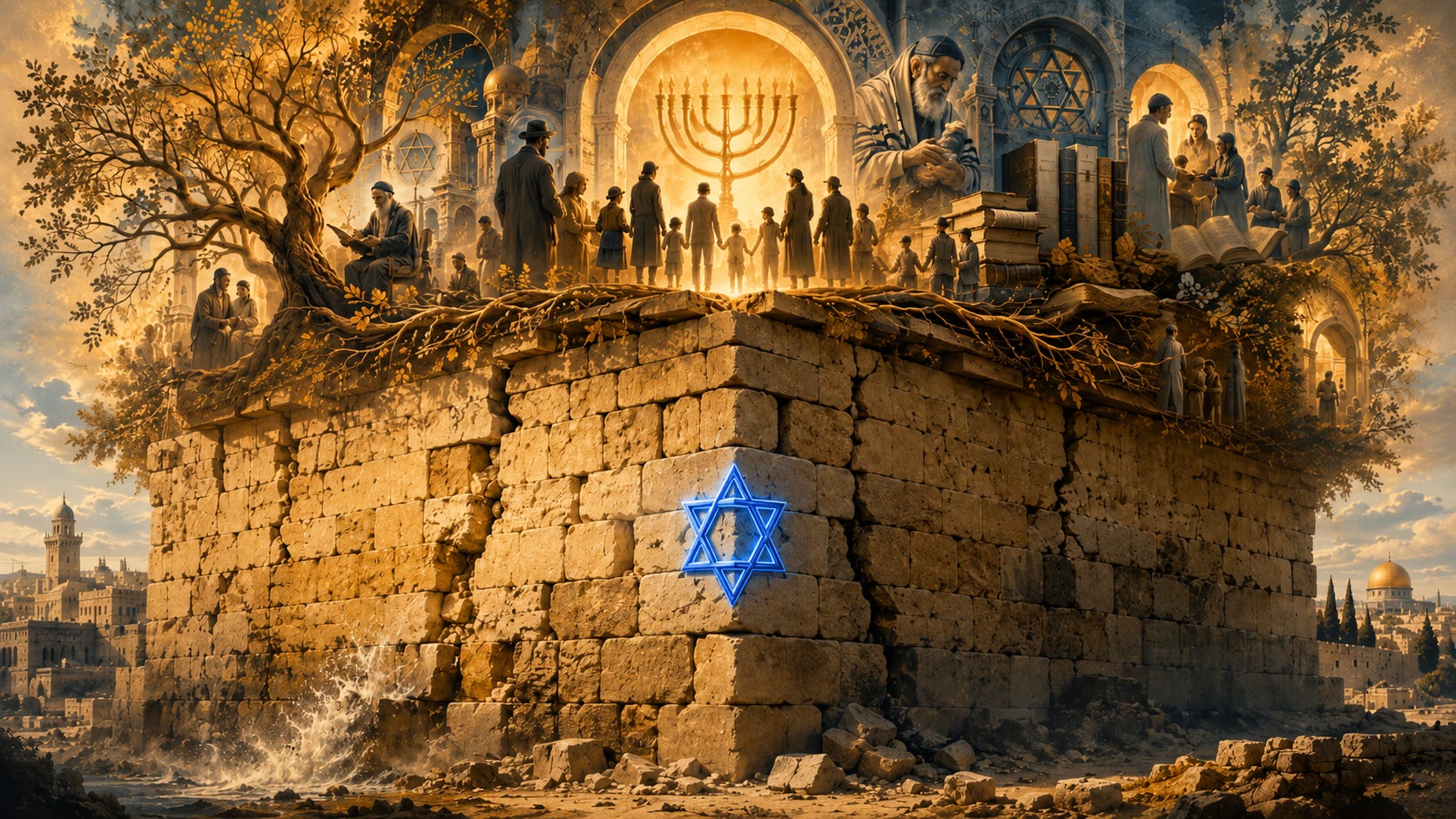
To be honest, I do more Israel than I do Judaism (if one can even distinguish Israel/Zionism as being separable from “Judaism” but I’ll get to that later). Israel is on my mind every single day. I read about it, argue about it, write about it, think about it, pick fights about it, doomscroll about it. It forms more a part of my Jewish identity than religious observance, though I do admittedly keep mostly kosher, mark Shabbat in some way (though don’t strictly observe it), and go to synagogue now and then.
This weekend, for example, I didn’t wake up early on Saturday for shul, but woke up early on Sunday for the Walk With Israel. Israel or Zionism is just how I primarily express my Judaism these days, and I am completely fine with that.
I’m not unusual in this.
In fact, I think I’m completely typical.
But it is worth thinking about.
Numbers
The data on this is not subtle. In its 2020 study of Jewish Americans, Pew Research asked what was essential to being Jewish. 45% said caring about Israel. 33% said being part of a Jewish community. 15% said observing Jewish law. Caring about Israel outscored observing Jewish law by three to one. When you broaden the question to include those who said Israel was at least important, even if not essential, the figure reaches 82% of all American Jews. 82%.
The Canadian numbers, where I live and write, are not gentler. In 2018, the Environics Institute conducted the first national survey of Canadian Jews. 79% of us were emotionally attached to Israel. By 2024 it had climbed to 84%. 94% affirmed Israel’s right to exist as a Jewish state. Just 3% did not.
Whatever else is on our list, Israel is the plurality answer.
Cause and effect
I am not the only one noticing this. The day after 60,000 people walked through Toronto in the country’s largest annual Jewish gathering ever, the CJN’s opinion editor Phoebe Maltz Bovy published “Walk This Way? The big North American Jewish festivals are ‘Israel’ events. Not everyone loves this” making the same observation in cultural terms. The biggest Jewish community events in North America, she writes, Toronto’s Walk With Israel and the Israel Day Parade in New York, are not really ‘Jewish’ events that happen to include Israel. They are Israel events that happen to be the Jewish events. She does not love this for some reason. She writes that, “the case on its merits favours doing a Jewish Cultural Parade,” and concludes that this is what she wishes these gatherings were.
I respectfully, and wholeheartedly, disagree.
I read the piece three times. The diagnosis is right. The framing, I think, gets the question backward. The Walk With Israel in Canada and the Israel Day Parade in NYC are not the biggest Jewish events of the year because some cabal of organizers chose Israel as a theme. They’re the biggest because, for most of the 60,000 people walking, Israel is the most important part of being Jewish! The thing that will actually get them out of the houses and onto the streets! The Walk With Israel hasn’t displaced a Jewish festival. The Israel festival is the Jewish festival because Israel is what most of us who are not Orthodox are doing when we are doing Jewish. Asking for a Jewish festival instead of an Israel festival assumes there is a Jewish identity, large enough to fill a parade, to get some of those 60,000 out on the streets again, that exists apart from Israel. I may be wrong, but I just don’t think there is. Not because no one wants one. Because we have not been building one the other fifty-one Sundays of the year.
This isn’t how Judaism was structured for two thousand years. But it is how it’s structured now.
Modern Judaism
For most of our history, Judaism was a set of practices. It was what you did. You prayed three times a day or you didn’t. You kept kosher or you didn’t. You sent your children to get a Jewish education or you didn’t. You married inside the community or you didn’t. The practices didn’t require a state. They didn’t require a homeland. They didn’t require political solidarity with any government anywhere. They were portable because we were displaced. Because we figured out a way to exist as Jews outside of a homeland from which the majority had been evicted. Whatever else was lost in exile, the practices remained.
In the 20th century, in the Diaspora, the practices started going.
Some of this was assimilation. Some was the ordinary pressure of modern life on any traditional community. Some was the deliberate choice of Jews who wanted to be modern more than they wanted to be Jewish in the old way. Whatever the cause, the effect is visible. Each generation, on average, knows less, practises less, reads less, prays less, and marries more often outside the community than the generation before.
It can be argued that Canada has thinned more slowly than the United States. Our intermarriage rate is roughly half the American one, and our community remains more denominationally traditional, with larger Orthodox and Conservative shares than south of the border. But the trend line is the same. There are exceptions, and the Orthodox world is a real and growing one. For most of the non-Orthodox majority however, which is to say most of the Jews I know, the practices thinned.
And as they thinned, something had to remain, because identity can’t survive on nothing. A person who calls themselves Jewish needs somewhere for the word to land. For the post-war generation, Israel became that place. The Holocaust, to them, had made the stakes unmistakable. Israel’s founding and survival gave the word Jewish a public, visible, dramatic reference point. You didn’t have to keep kosher to feel Jewish when Israel won the Six-Day War. You didn’t have to know Hebrew to cry at a Yom Ha’atzmaut ceremony. You didn’t have to read Talmud to send a cheque to JNF. Israel did the work of meaning for a generation that had less and less of the other sources of meaning.
The generation that came after inherited an arrangement in which this was already settled. The generation after that inherited it more deeply. By the time you get to me, sitting on the couch checking the news from Israel before bed, the load-bearing wall of Jewish identity, at least for me, and I’d argue for most of us in the Diaspora, is Israel. Not halakha. Not text. Not ritual.
Israel.
Anti-Israel
Now consider what anti-Israel activism does in a Jewish world built this way.
Its practitioners frame it as a political position. A disagreement about a state’s policies. A critique of a government, of a military campaign, of an ideology. Its defenders argue it is no different from being anti-Saudi or anti-Russian or anti-American. It’s a view on a country, nothing more. Except its not. They know it, and we know it.
This framing is false in the only way that matters. It’s false not because the critics intend it to be false, but because of where the critique lands. When you attack the legitimacy of Israel, in a Jewish world where Israel is the load-bearing wall of identity, you aren’t attacking a policy. You’re attacking the thing most of us have, at this point, instead of ‘Judaism.’ You are telling us that the primary form in which we know ourselves as Jewish is illegitimate, colonial, criminal, or obscene. You are not debating a government.
You’re telling a person that the content of their Jewishness is a crime.
This is why the reaction inside our community is not proportional to the framing outside it. This is why we respond to encampments and boycotts and chants with something closer to grief than to political disagreement. This is why the reaction is the same among Jews who disagree violently about Israeli policy, who have voted for different parties, who hold different views about settlements and two-state solutions and Netanyahu and the war. Whatever the internal disagreements, the attack from outside lands on the same wall. And that wall, for most of us, is holding up the whole house.
This is what it looks like on the ground. Ordinary Jewish life has felt strange lately. The conversations at dinner are different. The hesitation before saying you are Jewish in a new room is different. The calculation about which colleague to tell, which group chat to leave, is different. None of these are about Israel directly. They are downstream of the structure I’ve tried to describe. When the central form of being Jewish is under attack, the rest of being Jewish gets pulled into the same defensive posture. The shul becomes a security question. The Hebrew day school becomes a security question. Friday night dinner, for some of us, becomes a security question. We are working harder than we have ever worked at Jewish life, in a sense. But the energy is going almost entirely into defence. There is very little left for the patient work of building. And the longer the siege continues, the thinner the rest of the house gets.
Here’s the Catch
Support for Israel has quietly become the primary way most Diaspora Jews express our Judaism. Not because of ideology, but because the older practices that used to carry Jewish identity have thinned out over the generations. That is why anti-Israel activism in our community cuts so much deeper than its practitioners can see. It is not landing on a policy disagreement. It is landing on the load-bearing wall of a structure that has had almost everything else removed. That is one worry, and it is the easier one to name.
Tune in for essay #2.
Yes, Adam.