
Bangaranga
Eurovision 2026

We only turned the TV on for Israel.
Eurovision is kitsch. It is sequins and fog machines and a Bulgarian woman singing a word that doesn’t mean anything, and it is entirely irrelevant to my life. I know this. But, on Saturday afternoon, I watched with my kids, because Israel was competing, and I wanted to see how we did. For the last few weeks, we have started every drive to school listening to Michelle. My three-year-old now somehow knows the French lyrics. And for a few hours every May this silly contest turns itself into a referendum because Israel is on the ballot.
Bulgaria won. Dara, with a track called “Bangaranga,” a song built out of what I think is a made-up word and a fun chorus. It was a great song and fantastic performance! While they were going through the results, she was interviewed and said that “Bangaranga” is the feeling you get when you choose to lead through love instead of fear. It is the kind of thing you can say when your song is about nothing. What a luxury! To sing about nothing.
Israel came second. Noam Bettan, a fantastically catchy “Michelle.” And in the final minutes the public vote came in and Israel surged, and for a moment the hall did two things at once. It booed - loudly - and it called out Am Yisrael Chai! The same room. The same second. I had told my kids, and myself, that none of this mattered, that it was kitsch, that it was irrelevant. And then I sat in my living room exchanging glances with my wife and felt both of those sounds land somewhere in my chest. I quickly tweeted:

That evening, the internet, of course, already had its theories. People pulled up the jury results, noticed which countries had given Israel points, and decided that these were the righteous ones. The countries that had been good to the Jews when it counted, in the 1940s. The scoreboard, they decided, was a kind of moral X-ray.
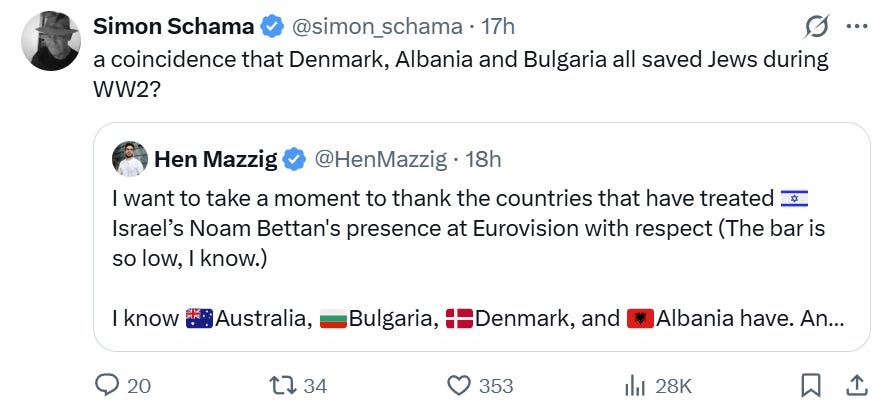
It is a tempting idea. But it’s wrong, and wrong in an important way.
Let’s start with the obvious.
The warmth for Israel this year was not in the juries. It was in the public vote, the ordinary people at home with their phones, and it was enormous. The juries are small panels of music professionals, and music professionals are exactly the people most exposed to the cultural weather, the open letters, the boycotts. If you wanted to read the scoreboard as a verdict on a nation’s feeling about Jews, you would have to read the televote, and the televote actually adored Israel.
There’s also the winner. Bulgaria. Bulgaria is actually one of the great rescue stories of the Holocaust. In 1943 its Jews, some forty-eight thousand of them, weren’t deported, because clergy and politicians and ordinary citizens stood in the way. It is also worth saying that Dara was one of the few Eurovision participants who actually publicly supported Noam and the Israeli delegation.

So, that bad internet theory was reaching for something real. It was reaching, clumsily, for a different idea that’s out there in the antisemitism literature.
Inherited hate
There’s an interesting study I read about in Dave Rich’s book Everyday Hate. Two German economists went looking for anti-Jewish violence in German towns during the Black Death, in 1349, when Jews were accused of poisoning wells and were burned for it. Then they looked at the same towns six hundred years later, in the 1920s and 1930s. And the towns lined up. The places that had murdered Jews during the plague were more likely, six centuries later, to vote for the Nazi Party, to attack synagogues, to write letters to the most antisemitic newspaper in the country, to organize the deportations. Six hundred years. Same soil.
Rich draws the obvious conclusion: if you live somewhere that persecuted Jews once, the capacity for it is still there, dormant, beneath the ground. “Do not let it wake.”
I believe him. But I noticed, reading it, that the study measures only one thing: the persistence of hatred. So I found myself wanting, badly, to believe in the other study. The one nobody has run: Maybe it goes both ways? Surely if contempt can be inherited like a dialect, so can affection? In Poland, in towns scoured nearly empty of Jews, there are Jewish culture festivals now, klezmer bands, young Poles learning the Yiddish songs of a people no longer there to sing them. The scholar Ruth Ellen Gruber wrote a whole book about it and called it Virtually Jewish. Love, apparently, can also outlive the absence of its object.
I wanted that to be the answer. I wanted to write the hopeful version, the one where the soil holds good things too.
But obviously the evidence is not symmetrical. There’s a six-hundred-year dataset for the hatred. There is no dataset for the love. Nobody has shown the towns that sheltered Jews in 1349 and were therefore kinder in 1933. The hate has been measured across the centuries. The love has festivals and some good intentions. And maybe that asymmetry is itself trying to say something.
Allosemitism
The sociologist Zygmunt Bauman had a word for this, borrowed from a Polish critic before him. The word is allosemitism. It does not mean loving Jews and it does not mean hating Jews (it also shouldn't be confused with Alosemitism, the recent trend by Canadian Jews abandoning Lululemon in favour of new yoga brand Alo).
It means setting Jews apart. Treating the Jew as a category that needs its own separate set of concepts, its own special handling, a thing that can never just be ordinary. And allosemitism, Bauman said, is unstable. It is the trunk. Philosemitism (the love of Jews) and antisemitism (the hatred of Jews) are two branches off the same trunk. The lover and the hater aren’t opposites. They agree completely on the premise - that Jews are different. They have only shaded in a different answer.
Which means I had Rich’s image slightly wrong. Or rather, I think there is one more layer beneath it. It’s not the hatred that lies dormant in the ground, but the attention. The conviction that the Jew means something, that the Jew is a sign and not a neighbour. That’s what gets passed down, town to town, century to century. And it doesn’t much care what it grows. The same soil that produced a pogrom in 1349 can produce a klezmer festival in 2026. They’re the same plant. One of them is just easier to love.
Round and round, under your spell
So I sat in my living room with my kids and watched Israel be, at least to us, the most interesting thing in a song contest, and I understood, finally, why I hadn’t been able to look away.
Bulgaria got to sing a nonsense word. Bulgaria got to be weightless, three minutes of pure pop and wild dancing with nothing riding on it. Israel doesn’t get that. Israel walks out under a dome of meaning, and every televote and every jury point and every boo and every Am Yisrael Chai is people deciding, in real time, what we signify. The applause isn’t the opposite of the booing. They’re the same act, but in the room refusing to let the song just be a song about a seemingly toxic relationship.
And I was doing it too. I was sitting there reading Jewish survival into a three-minute song called “Michelle.” I turned a stupid pop contest into an oracle. I had the same condition as everyone else in that hall.
What I actually want, I realized later, is not to win - though that would have been nice simply to shove it in the face of the haters. It is not even, really, to be loved by the juries or the crowd. What I want is the thing Bulgaria had and maybe didn’t notice. I want the song to be ordinary. I want a field that lies fallow. I want, for my kids, ground that grows nothing at all when you say the word Jew. Not a festival and not a fire. Not a hurricane and not a promise that a new day will rise. Just an ordinary patch of earth, an ordinary evening, and a catchy song.
I won’t get it. The soil is the soil. But I think it is worth knowing what we’re praying for. I’m not praying for a kinder crop, but in some sense, fallow ground.
Here’s the Catch
The Eurovision scoreboard isn’t a moral X-ray, and the countries that gave Israel points are not, therefore, the righteous. The truth, the one two economists measured across six centuries and Dave Rich rightly warns us about, is that disposition toward Jews really is inherited, soil to soil, generation to generation. But what is inherited is not the love and it’s not the hate. It is the attention itself, the certainty that the Jew is a sign and never just the neighbour. Bauman called it allosemitism, and the lover and the hater are two branches off its single trunk. Which is why the kindest crowd in Vienna and the cruelest were, last night, doing one thing together. They were refusing to let an ordinary song be ordinary. And the quiet, probably unanswerable thing a Diaspora Jew is left wishing for is not a warmer verdict. It’s fallow ground: a field where the song is just a song.
Interesting piece and food for thought. If I understood correctly, you are longing for an environment where we are not who we have always been? Or, is it that the onus should be on the those who’ve indulged their propensity to hate us by framing us (and watching in wait) within their imposed dichotomy of who is good and who is evil (gleefully and consistently placing us, on the evil side of the Venn) and would they kindly just stop and leave us be and see as just regular … like them? Nothing really stops us from singing about nothing. I read/invested a lot into this kitschy business the past few years and I’m ok with standing our in the crowd and revelling in such an accomplishment (it is one that has happened numerous times too, I learned. Not bad for a tiny country and a while lot of trauma and resilience and a fight for light and joy. I’m happy for Bulgaria - most of all for being kind to Noam/us. If that - and Noam graciousness are what it is or what it should be about then, I will wiggle my his and harms in kitsch euphoria and embrace the breakaway. Have you read Hen’s piece. It was brilliant and I think adds a number of layers that needs to be considered. For now, I will enjoy a little bit nya-nya-nya-nya-nya at the expense of the haters and a giant feeling of love and warmth from the lovers. I don’t know all their reasons for it, but I do know they didn’t have to. And, frankly, after finalizing the dissolution of yet another friendship a few hours ago with a non-Jew who has been dead silent since October 7th except to post a meme that said “Ceasefire now” a few weeks later and who works at McGill and saw, up close, , the unbridled Jew-hatred, had the nerve to text me this response to the recent Bill Maher video I shared with him: “I will not engage on matters about Israel. The situation drove me to seek mental health support and medication in 2022. I need to maintain that boundary for my health and sanity.” He never explained the year 2022, but I let him know it was some next level chutzpah to appropriate our trauma and that I should somehow set mine aside as he works through whatever tf he was working through and that I should therefore, deny my identity in his presence. This … from a gay man, no less🤦🏻♀️. It must be so hard to live on the sidelines silently rooting for the ones who pretend they are on the side of social justice and have your JEwish friends call that out. Sorry … not about your article. But maybe why I feel a little extra pep in the ay-yi-yi-yi of my steps when Noam Bettan sings that silly love song. Everything and everyone who is Jewish and alive today is here and becasue of all that we have survived. We may as well embrace that and sustain the outcome.
Fun read, and a lot of the sub‑topics really resonated. I’m not sure I share the wish for “fallow ground” where "Jew" carries no inherited meaning. It’s the double standards and the negative projections that are repugnant — but I do value our distinctiveness and the contributions that make us who we are. Still, as you note, maybe the uniqueness and the burdens come from the same trunk, and you can’t fully separate one from the other.