
Documenting Our Catastrophe
What Jewish catastrophe loses on its way to a wide audience

In the lengthy piece below, I argue that the public memory of October 7 is already being narrowed in much the same way Elie Wiesel’s original Yiddish testimony was transformed into Night: not necessarily by removing the facts, but by framing suffering as a story of resilience, redemption, and the ‘human spirit.’ I argue for preserving a fuller record, one that keeps grief, anger, responsibility, survival, and the ordinary lives of the victims together, without forcing the catastrophe into a neat lesson before its meaning has settled.
Click here to listen on Spotify
Elie Wiesel published two endings to the story that became Night.
In the one most people have read, a boy whose just been liberated from Buchenwald drags himself to a mirror. He hasn’t seen his own face since the ghetto, and a corpse looks back at him. The look in its eyes has never left him. That’s the last line.
In the other, the boy looks into the same mirror and sees the same corpse. Then he raises his fist and puts it through the glass. He faints. He wakes up, and from that moment his health begins to improve. He starts writing immediately. And then the book keeps going, out of the camp and into the world, where he reports that, ten years on, Germany is sovereign and has an army again, the sadist of Buchenwald – Ilsa Koch - is raising her children in peace, war criminals stroll through Hamburg and Munich unbothered, and the world is already forgetting. He doesn’t believe his book will change any of this. He ends by asking whether breaking the mirror was worth it at all.
Told about these two versions, most readers assume the second is the later one: the angry one, the bitter one, written by an older man who had watched the decades go by and lost patience.
But it’s not.
It came first.
I.
The angry version is Un di velt hot geshvign - And the World Remained Silent - published in Yiddish in Buenos Aires in 1956, in a series of memoirs of Polish Jewry. The first, famous, version is La Nuit – Night - published in French in 1958.
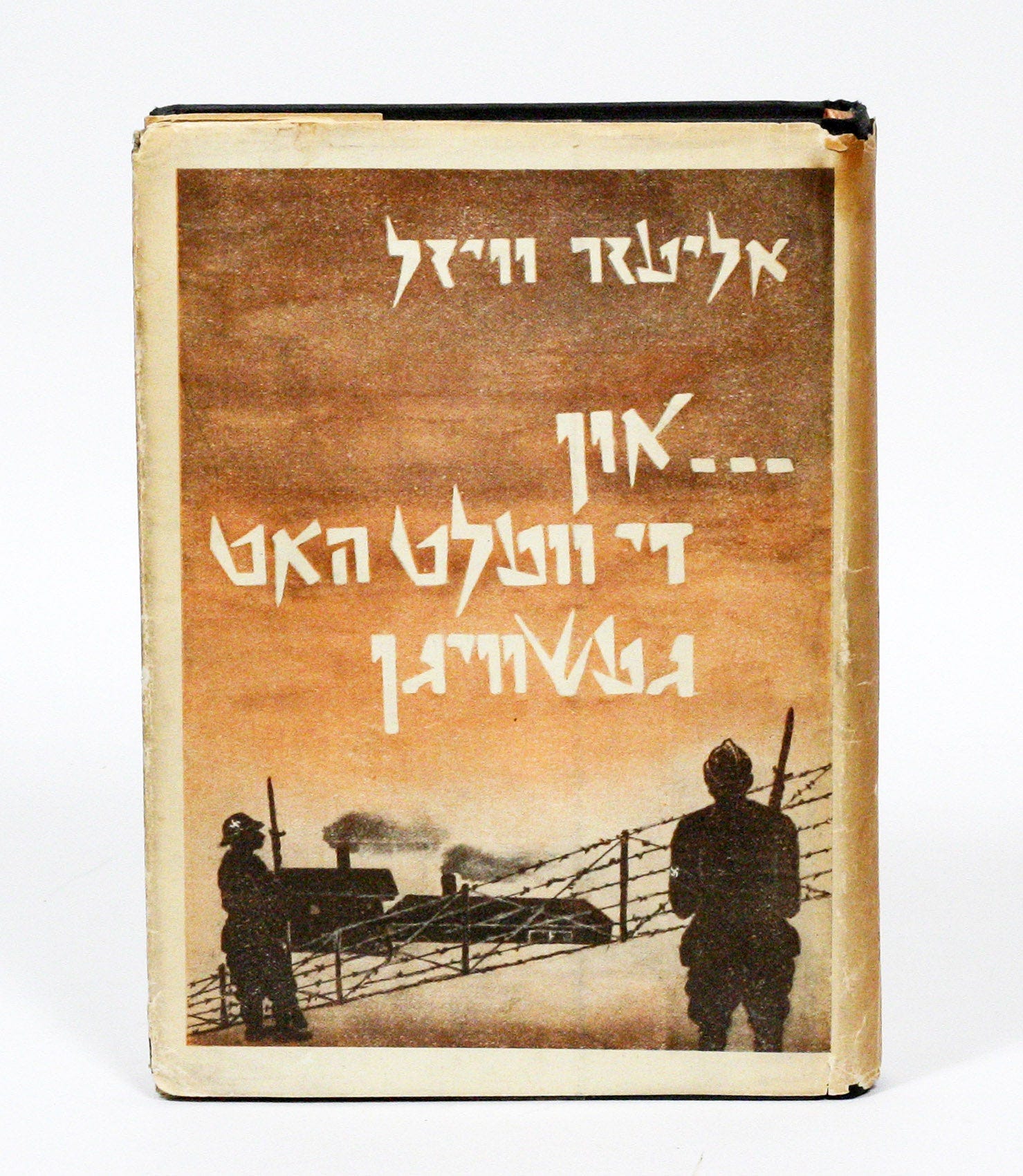
Two years apart. The same author. The same events. A totally different moral grammar.
Wiesel recast the book in French with the encouragement of François Mauriac, the Catholic Nobel laureate who read the manuscript and helped him find a publisher. Jérôme Lindon, the publisher who finally accepted it, made further cuts. Wiesel accepted those cuts because he understood that the fuller book would not otherwise be published.
We tend to imagine that Holocaust memory softened as it grew more distant: that the first generation told the truth and the third generation turned it into a lesson plan to be used in a curriculum. That’s not exactly what happened, or at least not what happened here. This softening took just two years. It happened at the point of first contact with a general readership, and it happened with the survivor’s participation.
Naomi Seidman laid out the particulars in an essay first published in 1996 and reprinted in Tablet in 2023. She notes that Wiesel’s Yiddish version dedicates the book to his mother, father, and little sister, adding that they were killed by German murderers. The latter French version dedicates it to his parents and little sister. Period.
In Yiddish, Sighet - Wiesel’s hometown – is given as a real place with borders and history: the largest Jewish population in Marmarosh, Austro-Hungarian and then Romanian and then Hungarian again. In French, it’s described as a little town in Transylvania where Wiesel spent his childhood.
Then there’s a passage around which Seidman built much of her argument. In both versions, the narrator is disgusted that the newly liberated Jewish prisoners think only about bread and not about revenge. In the Yiddish, he says that Jewish boys went to Weimar to steal potatoes and clothes and to rape German girls, and laments that the “historical commandment of revenge went unfulfilled.” In the French, some young men go to Weimar for potatoes, clothes and girls, and “of revenge there is no sign.”
Jews and Germans in the first. Young men and girls in the second.
The nouns that carry responsibility disappear.
Even the titles do heavy lifting. And the World Remained Silent accuses somebody. Night names no one, human or divine. Night is an inevitable part of the daily cycle. It comes and goes no matter what.
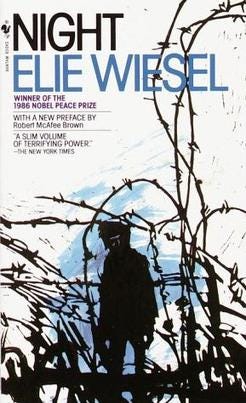
Seidman’s conclusion was that there were two survivors in Wiesel: a Yiddish one and a French one. The difference between them was not how much they suffered. It was whether they were permitted to be angry, and at whom.
This wasn’t censorship imposed on Wiesel against his will. He participated in the transformation and accepted the cuts that were made. He approved the editions that followed, including the English translation his wife published in 2006. In his preface to that edition, he finally acknowledged the Yiddish book and explained that some of what he had omitted was simply too private to publish.
That’s not a scandal as writers always edit. Publishers make demands. Authors decide what they wish to disclose and what their readers can be persuaded to receive. Anyone who wants to be widely read makes accommodations.
The question however is not whether Wiesel edited his book.
The question is what kind of truth became unpublishable.
II.
The horror of the Holocaust survived. The accusation did not.
Mauriac’s foreword, which has been printed in nearly every edition of Night since, is entirely at ease with horror. It arranges the murder of six million people into a hierarchy and places at the top the death of God in the soul of a child. That’s horror rendered into something of a theology, and theology was something the European reader of 1958 understood.
Rage is far more difficult because rage has an address – it must be directed at someone. The moment you write down who you’re angry at, you make a claim on your reader. You suggest that his society failed, that his neighbours watched, that his government is letting the guilty walk around Munich. Grief can flatter a reader by inviting his sympathy. Fury risks implicating him.
The inimitable Dara Horn puts it more bluntly. Writing about this episode in People Love Dead Jews, she says the French version “repositioned the young survivor’s rage into theological angst,” and asks: what reader wants to hear about how his own society had failed? Better to blame God!
Her account explains much of what changed between the two books. But Horn’s larger case is that this just wasn’t an unfortunate exception. It became a standard operating procedure of later Holocaust literature.
She points to The Tattooist of Auschwitz, Sarah’s Key, The Book Thief and The Boy in the Striped Pajamas. The latter three place non-Jewish rescuers near the moral centre: people who risk or sacrifice themselves to save Jews and thereby give the reader something redemptive to carry away. Such people existed, and yes, their actions matter enormously. They were also extraordinarily rare. The question is why this exceptional experience has become one of the Holocaust stories most likely to travel.
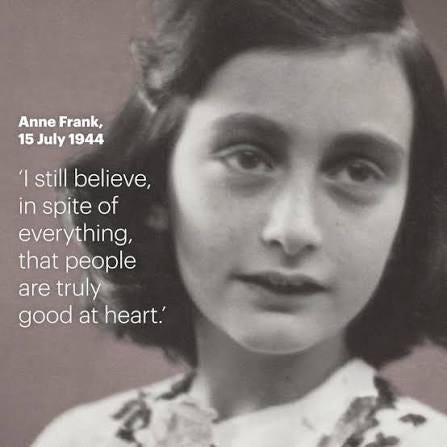
The most quoted sentence in the literature is a fifteen-year-old Anne Frank’s declaration, “I still believe, in spite of everything, that people are truly good at heart.” It was written, as Horn points out, three weeks before she encountered people who were not at all good at heart. We love the sentence because it flatters us, and because it came from a murdered girl, we can treat the pardon as though it were issued with authority.
But Horn also offers a counterexample: Chava Rosenfarb’s The Tree of Life, a Yiddish trilogy published in 1971 about the Łódź Ghetto. Rosenfarb introduces a large cast of characters before the war closes around them and allows them to remain real people rather than symbols of victimhood or instruments of somebody else’s redemption. The book’s honesty doesn’t consist in being gorier. It consists in refusing to make catastrophe useful, to turn it into something uplifting, a reassuring judgment about humanity. It doesn’t ask Jewish deaths to prove that people are good. It asks the reader to know that real Jews lived and died.
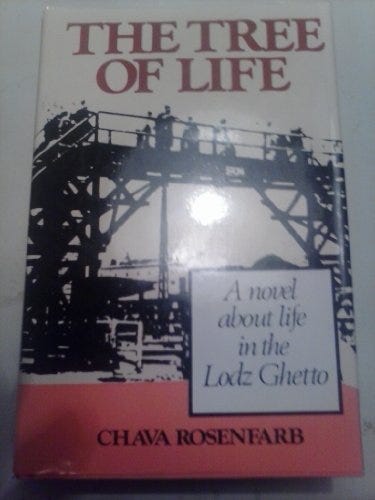
That distinction is important. The alternative to an uplifting account of catastrophe isn’t necessarily a more graphic one. It’s an account that refuses to reduce the people inside it to the lesson an outside reader wants to receive.
None of these stories is necessarily false, but it’s the selection that’s the issue. One true part of a catastrophe is elevated until it supplies the meaning of the whole.
Accounts of Jewish catastrophe tend to travel furthest once accusation has been made safe. Sometimes the accusation is cut. Sometimes it is turned into theology. Sometimes the story is made to end in an uplifting way. The reader is allowed to mourn without feeling addressed or shamed or guilty.
It was the price of the ticket: how the words got printed, and how they became available to everyone beyond the Yiddish world.
III.
It wasn’t reading Elie Wiesel that first made me think about this. It was something I recently experienced over two days in Israel.
The first day was Yad Vashem.
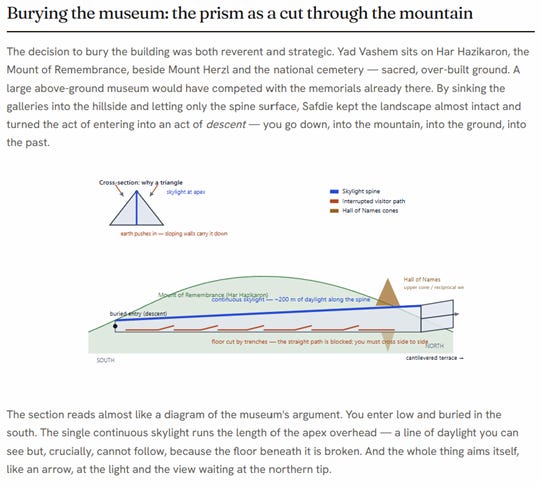
The museum ends as Israel’s Holocaust Museum was designed to end. You emerge onto a bright balcony with the Jerusalem Forest in front and below you. The architecture makes an argument which is: you’ve just descended into the catastrophe of European Jewry and as the war and Holocaust play out and eventually end, you emerge into the middle of our eternal capital. Israel, the Jewish state, was established three years after the Holocaust ended, and the shape of the museum is survival.
The second day was Kibbutz Kfar Azza.
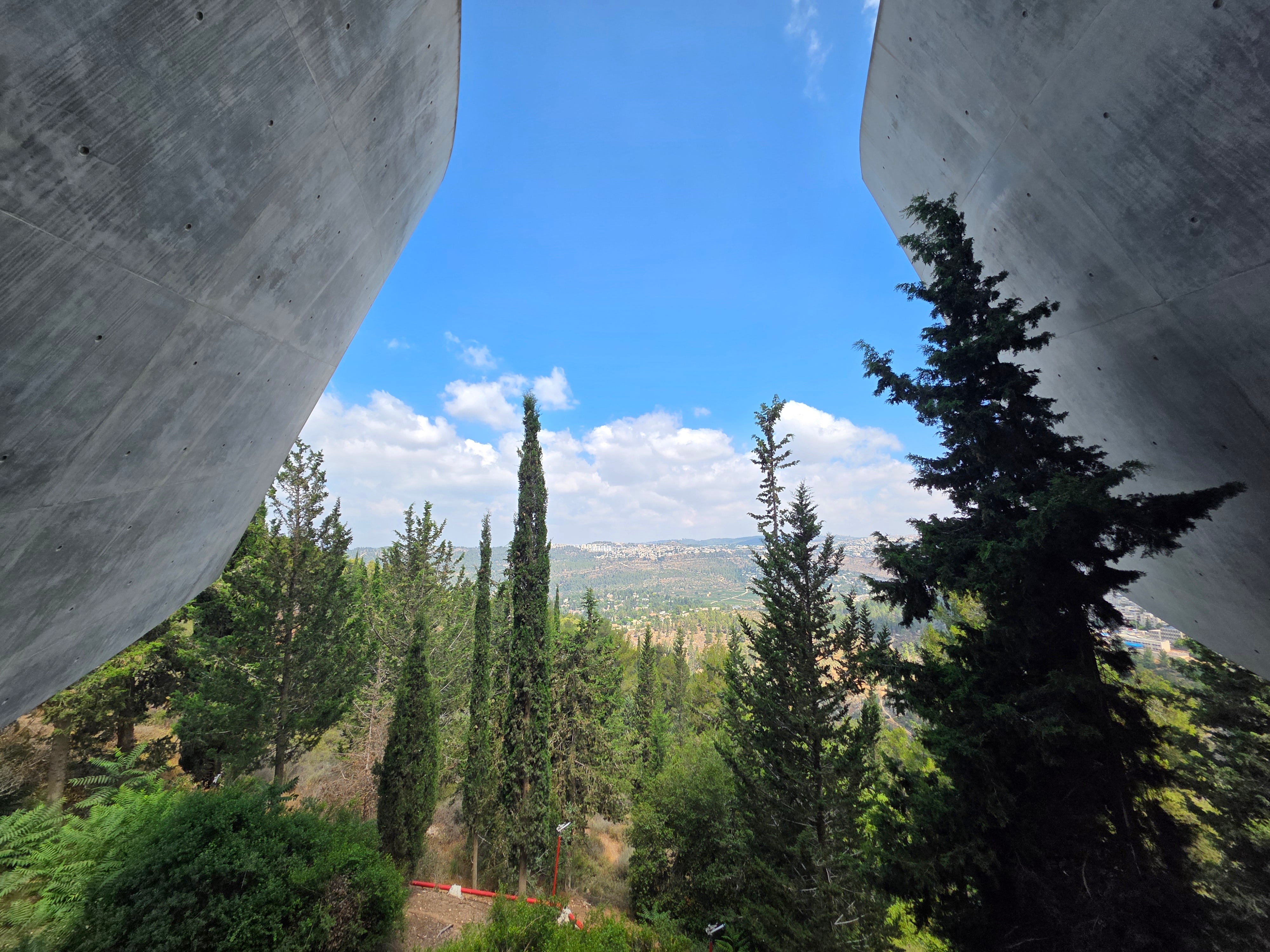
The kibbutz is rebuilding and wants its families back home. New construction is going up beside buildings deliberately left as they were after October 7, 2023. The neighbourhood where young couples lived is still standing and still shot through, its walls carrying the record – bullet by bullet - of what came through them.
One of those houses belonged to Sivan Elkabetz. She and her boyfriend, Naor Hasidim, were killed there. Her parents have preserved the house and opened it so that people can walk through its rooms and see what happened inside. The bullet holes remain in the walls and ceiling. Their CD player sits destroyed. Their shoes and clothing are in disarray on the ground, and their mattress is shoved into a corner of their room, a failed shield from that fateful day. Their WhatsApp messages from the day have been printed off and stuck to the wall. We get a minute-by-minute understanding of how a beautiful couple was murdered.
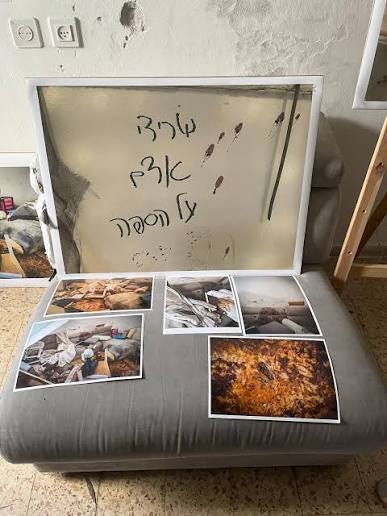
In Kfar Azza, there’s no balcony emerging onto a serene forest. Nothing at the end resolves what happened. You literally leave the destroyed neighbourhood and get back onto the bus waiting for you on a dusty road. Look past the bus, there’s a field. Look past the field, there’s Gaza. The kibbutz is rebuilding, which is itself a form of return and survival, but the ruins haven’t yet been made to deliver any sort of coherent lesson.
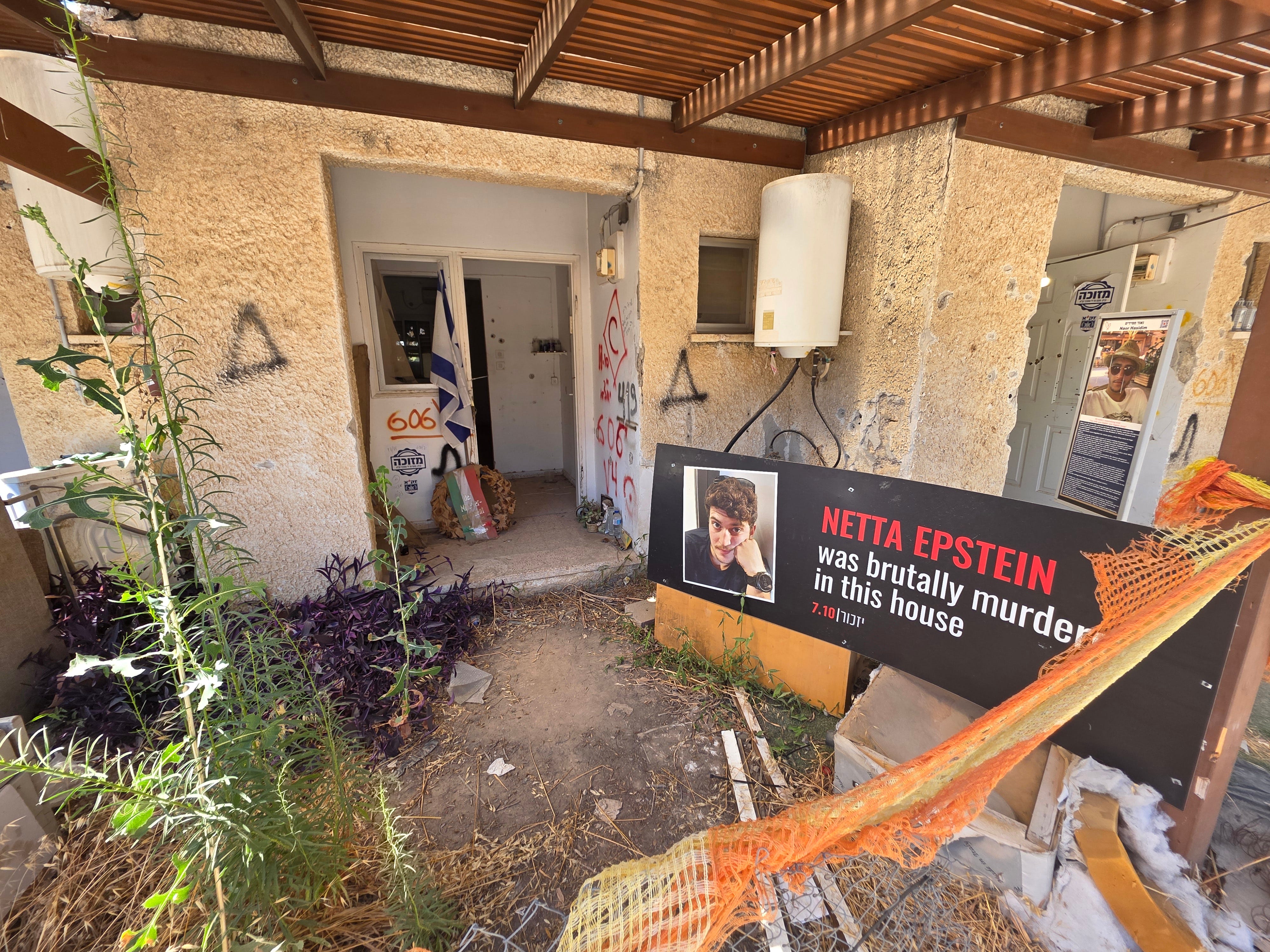
I certainly don’t mean that Yad Vashem does any disservice to the Holocaust. The balcony and what’s below isn’t a consolation prize. It’s a thesis from those who built it: destruction, then sovereignty. But every thesis selects. It gives the catastrophe a destination and makes everything before it lean towards that destination. Once survival becomes the ending, anger, failure, contingency, and unresolved loss can begin to look like things the visitor must pass through on the way there. The danger isn’t that the meaning is false. It’s that one meaning becomes the whole meaning.
Every museum makes an argument. But every argument has a shape, and a shape is a decision about where to stop. Walking out of Kfar Azza, where the event has not yet acquired a settled ending, I understood what a memorial necessarily costs: the unresolvedness of the catastrophe, and the possibility that it might still mean several things at once.
A people must rebuild. Survivors don’t owe anyone permanent brokenness, and Kfar Azza is one of the only kibbutzim left that hasn’t removed their October 7 destruction, yet. The danger isn’t the balcony itself. The danger is the speed with which every ruin is required to lead there.
I found myself wondering how long Kfar Azza had before somebody built it a balcony.
That question sent me back to the books.
IV.
I don’t believe that the October 7 books themselves are being cleaned up. Maybe it’s still OK to be raw, and maybe that’s because of the availability of self-publishing. But it appears the softening often happens around them: in subtitles, jacket copy, reviews, and screen adaptations that tell the public, before it has read a word, what the suffering is supposed to mean.
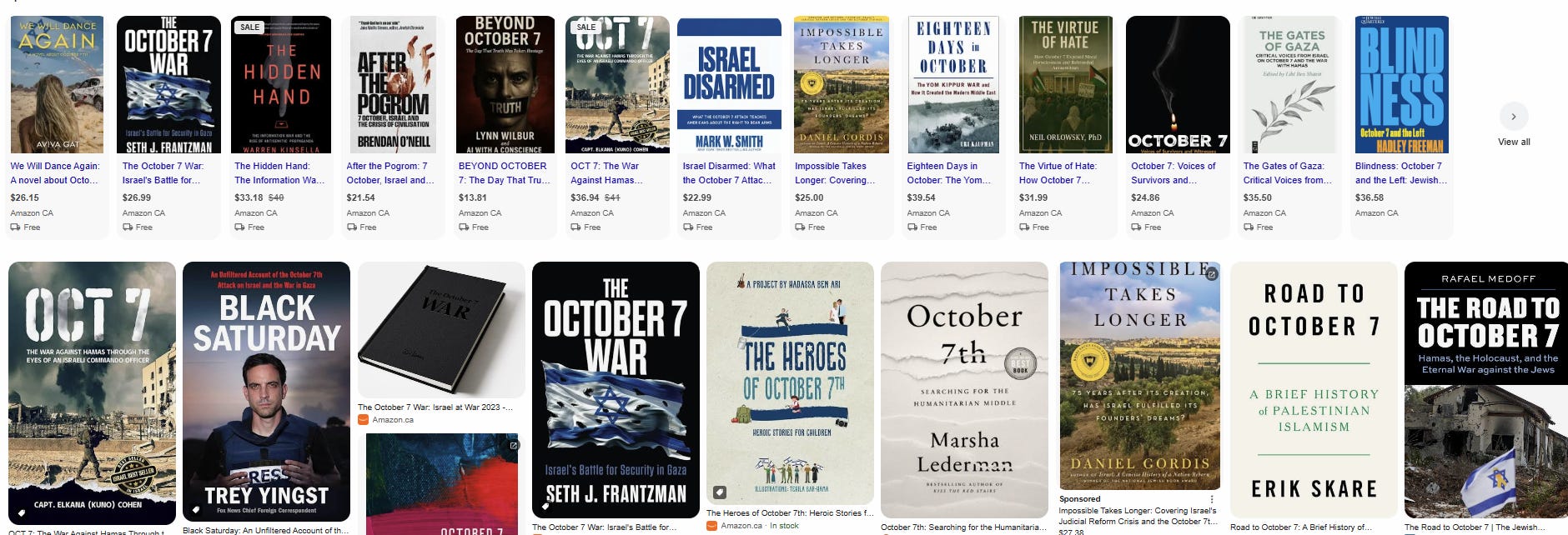
Since the first books began appearing, I’ve read as much as I could. I just felt compelled, as a Jew in the Diaspora, to know as much as possible about what happened that day: who was killed, who acted courageously, how the state failed, and what’s followed.
Many of the books are remarkably direct. Rachel Goldberg-Polin’s When We See You Again holds loss without turning it into a lesson. Lee Yaron’s 10/7: 100 Human Stories refuses to reduce the attack to a handful of representative stories; it records many lives at once. In Surviving October 7, Shahar Horovitz writes about what the Nova massacre did to the innocence of the young.
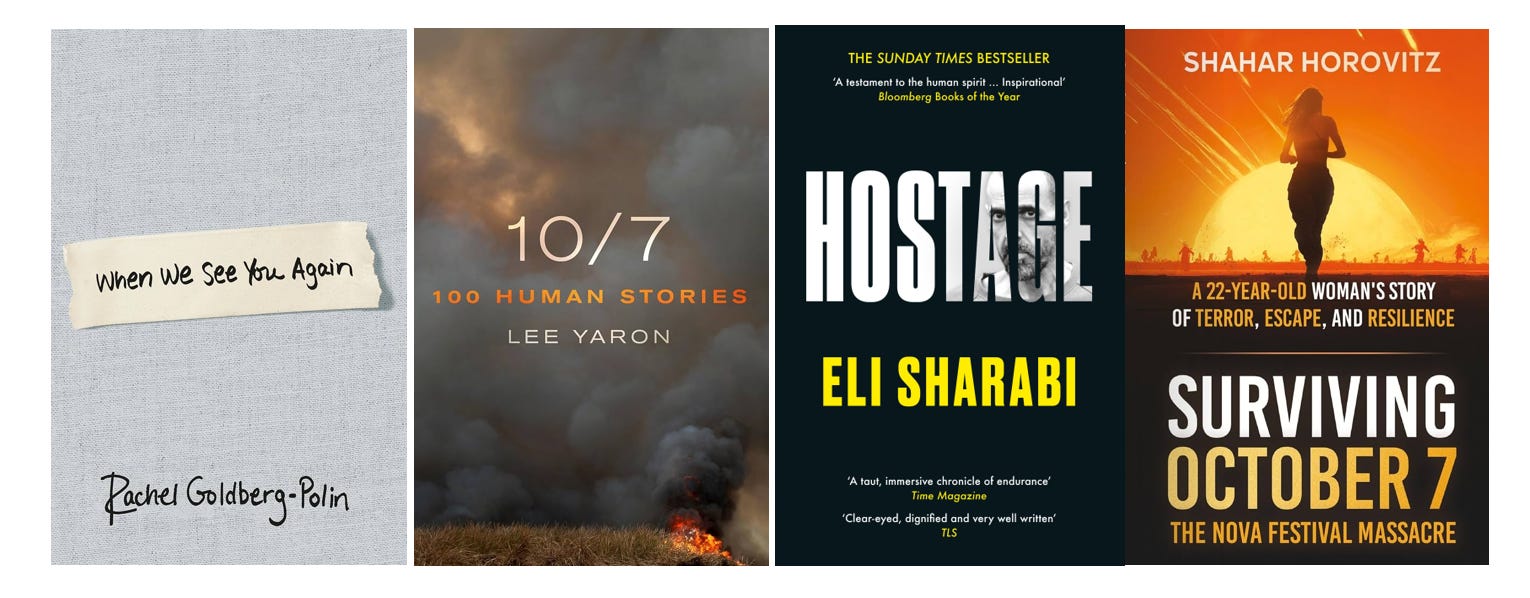
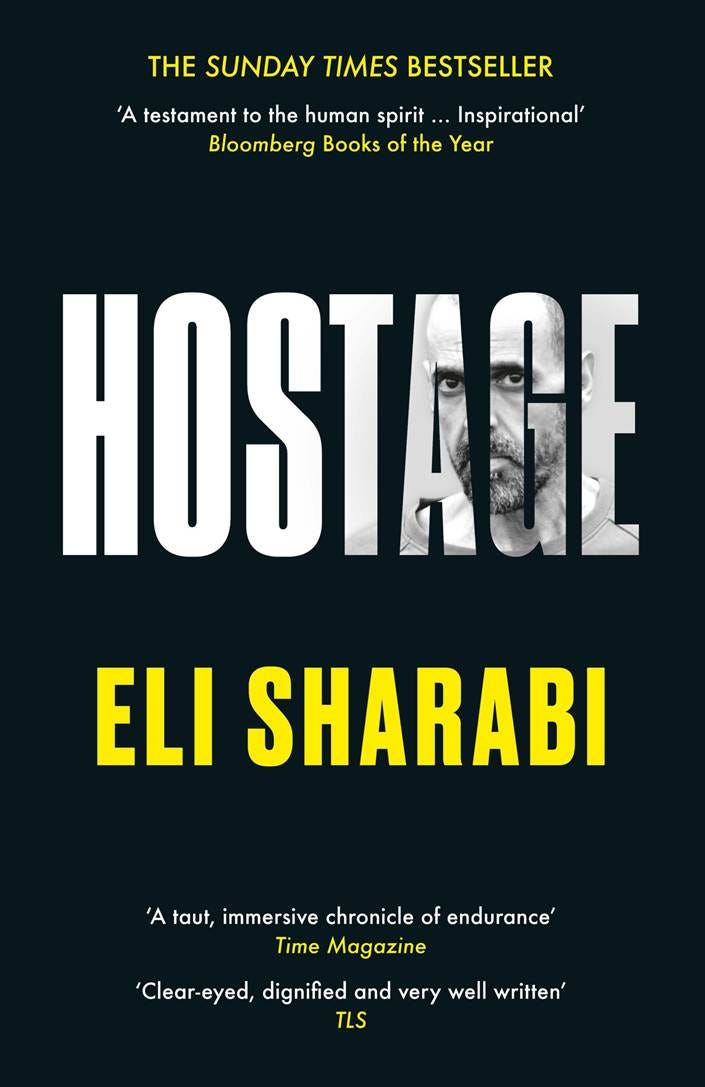
Then there is Eli Sharabi’s Hostage, which recounts his 491 days in Hamas captivity. The book’s final devastation lies outside the tunnel. When Sharabi emerged, he learned that his wife and both of his daughters had been murdered on October 7.
Now look at how the book is presented to English readers.
The Jewish Chronicle says it is ultimately about “finding the light in the darkest of circumstances.” Commentary calls Sharabi “unbroken and unbowed” and presents him as an example of resilience. The Washington Free Beacon calls the book “captivating and inspiring.” Its American subtitle promises a memoir of survival and the human spirit.
Presumably, little has been removed from Sharabi’s testimony. But one part of it – resilience - has been chosen to explain everything else.
This isn’t an isolated example. HBO presented One Day in October through the language of love, courage, sacrifice, hope, and resilience. A Nova survivor’s memoir carries the subtitle Terror, Escape, and Resilience. The wording tells the reader in advance where the story is meant to end. Terror and escape are what happened. Resilience is what they’re supposed to mean.
That doesn’t make the resilience false. Sharabi himself has said that he wants readers to understand what captivity was like while also choosing light and humanity. That intention must be taken seriously. He’s entitled to decide what his survival means to him.
But a survivor can mean several things at once. Sharabi’s story can be about courage and about cruelty, bereavement, abandonment, and irreparable loss. The problem begins when one true part of the story is promoted into its official conclusion.
Resilience is true, but it’s not the whole truth.
That’s why the cover and the publicity matter. Most people don’t encounter a book without preparation. Heck, most people don’t even read full books anymore. Before they read it - if they read it at all - they see the title, subtitle, jacket copy, advertisements, and reviews. Those things tell them what kind of story they are receiving and what they should carry away from it. Over time, the frame can become the public memory of the book.
Mauriac’s foreword did something similar for Night. It taught generations of readers to understand Wiesel’s suffering principally as a crisis of faith. The words of the book remained, but the interpretation waiting outside the book told readers which words mattered most.
There is, however, an important difference. Wiesel was entering a Christian European literary world that was more comfortable with Jewish suffering than with Jewish accusation. The framing of the October 7 books is often being done by Jewish and strongly pro-Israel institutions: Commentary, The Jewish Chronicle, the Washington Free Beacon, publishers bravely risking boycott to seek Jewish readership and organizations trying to defend Israel before a hostile public.
No outside editor is then forcing this meaning upon us.
But that does not mean the choice is inexplicable or contemptible. A wounded community needs stories of endurance. It needs to know that people resisted, rescued others, fought, survived, and returned. Resilience helps a society continue. It also gives Israel’s defenders something useful to say in a public argument: we were attacked, and we remain standing.
“Unbroken” is a powerful word in a fight, but it may also be a poor description of what survival costs.
A person can survive and still be permanently changed. A community can rebuild without turning its destruction into an inspiring story. To call someone resilient may honour his strength. To insist that he is unbroken can deny the reality of what was actually done to him.
So the parallel with Wiesel isn’t exact. His text was altered as it crossed into a wider language and readership. The October 7 texts may remain intact while the material around them supplies a safer conclusion.
But the result can be similar. A wide audience receives the grief, the courage and the survival more easily than it receives the anger, the blame and the demand for judgment. The accusation hasn’t vanished from the book, but in some ways it’s been pushed away from the centre of what the book is said to mean.
That’s what I mean when I say that October 7 is being translated on Wiesel’s schedule. The language isn’t literally being changed. The meaning is being narrowed before it enters public memory.
We don’t have to wait forty years and learn another language to notice. The translation is already there, printed on the back cover in yellow letters.
V.
There’s an obvious objection to what I’m writing.
The rawest document of October 7 is a 47-minute compilation assembled by the IDF Spokesperson’s Unit from Hamas body-camera footage, dash cameras, security cameras, and the phones of people who were being murdered. It hasn’t been publicly released. Instead, it’s shown at invitation-only screenings to legislators, diplomats, journalists, and community leaders.
The editors, Yuval Horowitz and Matan Harel-Fisch, have explained their reasons. One is the dignity of the dead and their families. Another is strategic: publicly releasing the film might attract intense attention for a day or two and then become just another piece of material circulating online. Its restricted existence may preserve more of its force.
They may be right, and they’ve of course thought about the question harder than I have.
The choice before us is therefore not courage against cowardice, or unfiltered truth against squeamish concealment. The rawest artifact we possess is already being curated, deliberately and for serious reasons.
That objection clarifies what I am asking for.
I’m not asking for footage, nor am I asking for maximum horror.
Go back to what was removed from Wiesel’s Yiddish book. It wasn’t gore.
What disappeared was the dedication naming German murderers; the identification of Jews as Jews and Germans as Germans; Ilse Koch named as walking around freely; the accusation that an obligation to respond had gone unmet; and Sighet presented as a real place with a real history rather than a picturesque little town somewhere east.
Names. Attribution. Anger. Specificity.
That’s the list.
Anger is the emotional register. Attribution is the historical claim. Anger may cool with time. Attribution must remain. We can lose the heat without losing who did what to whom, who watched, who failed to arrive and who was left exposed.
The lesson is not to preserve the worst detail. It is to preserve the naming and the assignment of responsibility.
Keep the accusation pointed at people rather than dissolving it into metaphysics, “cycles of violence,” the tragedy of the region, or the human spirit. Night is inevitable. Murder just isn’t.
This is also the form of memory most likely to survive hostile scrutiny. Specific claims involving named actors, places, and events can be tested and defended. They’re evidence. Atrocity detail on its own can’t bear the same weight. Where sensational claims have run ahead of verification, they have handed deniers exactly the lever they wanted.
The answer to abstraction is precision.
VI.
But naming the dead is not enough.
Horn’s central complaint in her recent writing is that the world knows Jews as a people who were murdered in Europe between 1933 and 1945, and that this is dehumanizing even when every fact is true. She doesn’t ask for a more graphic Holocaust curriculum. She asks why people care so much about how Jews died and so little about how Jews lived.
By her own logic, an essay demanding that October 7 remain raw forever risks doing to Israelis exactly what has so often been done to Jews: fixing an entire people at the moment of their deaths and calling it remembrance.
That objection is persuasive. Horn’s admiration for Rosenfarb points to one answer: don’t make one person or one lesson stand for everyone. Show many lives, with their names, flaws, habits, and ordinary details. The more particular the people remain, the harder it is to turn their suffering into a tidy story of redemption.
The beginning of an answer to this can also be found in Seidman’s essay.
The Yiddish Holocaust memoirs of the 1950s modelled themselves on the pinkes, the communal register where community events are recorded, and the yizker-bukh, the memorial book. Their governing instinct was to catalogue. Seidman notes a reviewer in Wiesel’s own series praising one memoir for its index of eight hundred actors, writers and poets, not all of them famous. (There’s an interesting new book about this, Once There Was a Town: The Memory Books of a Lost Jewish World, by Jane Ziegelman)
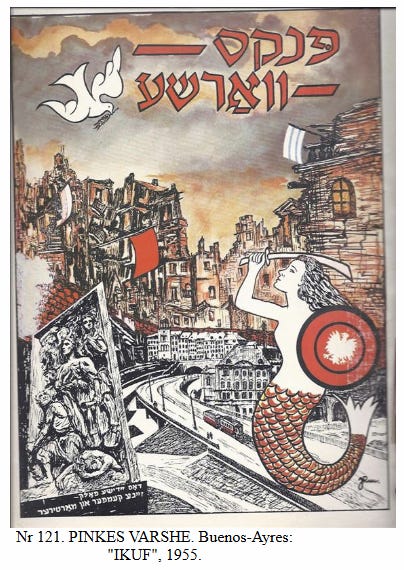
Narrative elegance was not the only standard. Comprehensiveness mattered.
Get everybody down.
That’s what the French edition traded away, and I think it’s what must be defended now.
Not the footage, but the register.
The names. The kibbutz. The moshav. The dog. The ordinary Saturday morning. The woman who ran the dining hall. The family argument. The music somebody listened to. Who these people were before any of us had a reason to know their names.
Specificity is what resists being turned into a metaphor.
You can’t make a bumper sticker out of a list.
Lee Yaron understood this, which is why 10/7 is, in my opinion, one of the most important book on my shelf. It’s in many respects a yizker-bukh. It’s doing in English what Yiddish writers were doing immediately after the war. It catalogues rather than distils. It does not ask one life to stand in for everybody else.
So, for that matter, does the Elkabetz house. Nobody appointed Sivan’s parents. No ministry commissioned the project. No committee approved the wording, and no architect calculated where the visitor should be standing to maximize the impact of the place. They preserved one house and allowed people to enter.
That is the pinkes instinct in its purest available form, practiced by a family on a kibbutz otherwise busy rebuilding.
But this is still only half an answer.
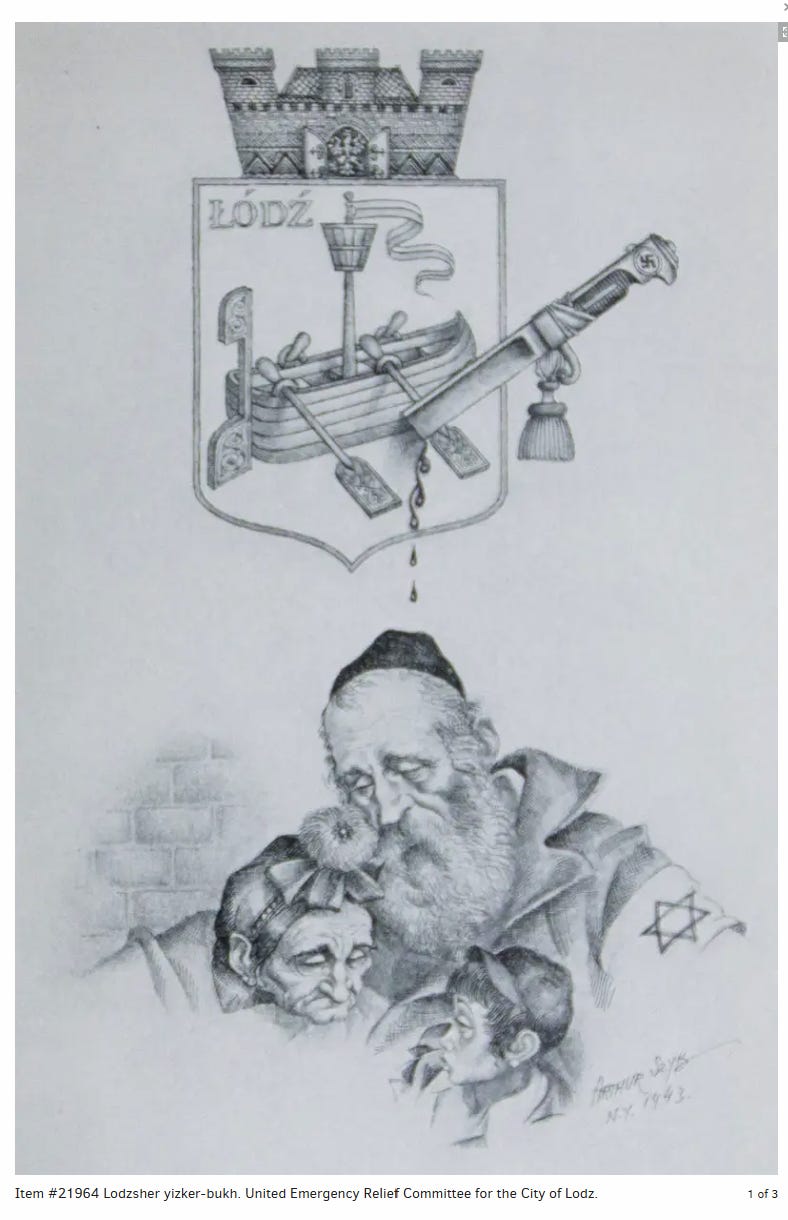
A memorial book is, after all, a book about the dead. Cataloguing our murders more carefully, however well we do it, may still leave us known principally for having been murdered. That is the condition Horn objects to.
The register must therefore record not merely how people died, but the worlds in which they lived. A book can begin that work; it can’t complete it. The rest happens in classrooms and around tables, in the stories we tell our children and in the continued life of the places that were attacked.
Get the record right and nothing else, and all we will have built is a very good index of our own dead.
VII.
There is one final pattern.
By my count, I have read about fifteen books about October 7, and they divide, more or less, into two groups. The testimony carries the suffering. The commentary carries the anger. Few carry both.
Rachel Goldberg-Polin, Lee Yaron, Eli Sharabi and Shahar Horowitz hold grief with enormous dignity. Howard Jacobson, Dave Rich, Brendan O’Neill, Bernard-Henri Lévy, and Adam Kirsch hold the fury. But those books are likely to be read mostly by people who already share the anger.

The anger didn’t disappear from October 7 writing.
It was relocated.
With Wiesel, accusation was cut from the book. With October 7, it is often distributed across separate forms: grief in testimony, fury in commentary, resilience on the cover. Each element remains somewhere. What disappears is their coexistence.
The suffering reaches one audience. The anger reaches another. The frame that travels furthest – the blurb or the cover - tells us that endurance is the final meaning of both.
This is the same operation performed by different means. Wiesel had nowhere acceptable to put his rage, so it remained in Yiddish and disappeared from general view for decades. We have somewhere to put ours: a separate shelf, in a separate genre, for a separate audience.
Maybe that’s not an improvement. Maybe it’s only a more sophisticated way of achieving the same result.
What I am advocating for, however, is simple. As the public memory of October 7 is built, grief, anger, responsibility, and survival should be kept in the same account. The record should name the people who were murdered and abducted, the communities that were attacked, Hamas and the other perpetrators (including their gleeful allies abroad) who carried it out and excused their actions, the warnings that were ignored, and the Israeli failures that left people exposed. It should also record who those people were before the attack - their work, their families, their jokes, their habits, their disputes, their ambitions, and their ordinary days. It should leave room for the survivor who feels resilient and the survivor who doesn’t; for courage without pretending that courage cancels devastation; for rebuilding without making rebuilding the answer to every question. The goal isn’t to keep October 7 forever raw or to preserve the maximum amount of horror. It’s to preserve a complete, specific, and morally legible account of what happened, to whom, by whom, what failed, and what was lost.
This can be done through ordinary publishing decisions being made now. A memoir like Sharabi’s need not be sold as a universal parable. Its subtitle could simply describe the record: Hostage: 491 Days in Hamas Captivity. The jacket copy could name Hamas, Kibbutz Be’eri, the murder of his wife and daughters, and his own stated commitment to humanity, without turning the last of those into the meaning of all the others.
A multi-voice book could place each testimony beside a verified timeline, a map, a short biography and, where relevant, an account of the documented military and political failures that shaped the day. An editor could allow anger and judgment to remain inside a survivor’s account rather than moving them to an outside essay, and could commission an afterword on responsibility rather than a foreword that universalizes the event. A book about a kibbutz could include the dead and the abducted, but also the work roster, the children’s drawings, the music, the dogs, the recipes, the private jokes and the arguments. Detail the fact that before October 7, many Gazans worked on those kibbutzim. Some of them passed on intelligence to Hamas, of where the schools were located, how many family members lived in each building, where the ammunition was kept, and turned on their employers on that dark day. Among other reasons, that’s why there are no longer Gazans working in Israel. Publishers can still speak of courage and endurance. They should stop promising redemption though before the reader has opened the book. None of this requires propaganda or a single approved interpretation. It requires refusing to make the record neat before it’s complete.
Wiesel’s Yiddish book ends by asking whether breaking the mirror was worth it. He doesn’t answer. He asked the question in a language almost nobody outside the Yiddish world was going to read, which is - I think - the only reason the accusation survived to be asked at all.
We don’t have that excuse. We’re still close enough to decide what enters the common record and what is sent to a separate shelf. Whatever we permit to be edited out, universalized or separated from the testimony, we’re letting go with our eyes open.
The mirror may break.
The register must remain.
Bibliography
Testimony: Rachel Goldberg-Polin, When We See You Again, on true and irreducible loss. Lee Yaron, 10/7, in my view the most important of these books: raw, blunt and extensive, cataloguing rather than distilling. Eli Sharabi, Hostage, devastating in a particular way because the reader knows what news is waiting for him after his captivity. Shahar Horowitz, Surviving October 7, on what the attack at the Nova festival did to the innocence of the young. October 7: Voices of Survivors and Witnesses, compiled testimony presented with relatively little shaping. Liz Naftali, Saving Abigail, on the extraordinary effort required to bring one child home. Amir Tibon, The Gates of Gaza, an account of Israel’s failures told from inside a safe room.
Failure and war: Yaakov Katz, While Israel Slept, on the disappointment of a country that allowed the attack to happen. Seth Frantzman, The October 7 War, an early account of the attack and the war that followed.
Reception and argument: Howard Jacobson, Howl, satirical and furious about the response to Jewish suffering. Dave Rich, Everyday Hate: How Antisemitism Is Built Into Our World And How You Can Change It, on the reach and adaptability of antisemitism. Brendan O’Neill, After the Pogrom, on the hypocrisies exposed after October 7. Bernard-Henri Lévy, Israel Alone, on Israel’s isolation and the Jewish future. Adam Kirsch, On Settler Colonialism, and Gil Troy, To Resist the Academic Intifada, on the ideas and institutions through which the attack and its aftermath have been interpreted.
On Wiesel, I used Naomi Seidman, “Elie Wiesel and the Scandal of Jewish Rage,” Jewish Social Studies 3, no. 1, Autumn 1996, reprinted as “Jews of Rage” in Tablet on January 10, 2023. Also essential are Dara Horn’s People Love Dead Jews, her essay “Is Holocaust Education Making Antisemitism Worse?” in the May 2023 issue of The Atlantic, and Wiesel’s preface to the 2006 English translation of Night.
Wow. Lots to say here.
I appreciate your final recommendations re: not dumbing down these accounts--both Holocaust and 10.7, and allowing for as much complexity and irresolution as possible. Of course, such pancakes are harder to sell, as you note and we know.
Serious work on Holocaust lit. (beyond Pajamas, etc. ) is already far more complex. For example, there is no shortage of rage in Elie after Night 2.0. See his One Generation After and later essays like "A Play for Survivors" and "A Plea for the Dead." He did not stop accusing. He did not can his rage. (As you probably know, there are still other versions of the text).
Meanwhile, the most obvious core of redemptive rhetoric was Israel itself--the "New Jew," etc. Which is partly why some survivors welcomed the transformation and some, Aharon Appelfeld, for example, felt as lonely as before.
As you suggest, none of this is simple.