
How Did We Get Here?
Part 2 of The Architecture of Exclusion

This is Part 2 of a five-part series about APR called The Architecture of Exclusion. Part 1, “The Training They Don’t Want You to See,“ examined the HWDSB’s refusal to disclose its mandatory APR training. Part 3 will examine how the TDSB adopted APR and what it reveals about institutional accountability.
In April 2022, the Arab Canadian Lawyers Association published a report called “Anti-Palestinian Racism: Naming, Framing and Manifestations.“ It was the first formal attempt to define so-called APR as a distinct category of discrimination. The report was allegedly produced in consultation with Palestinian community organizations, so-called anti-racism academics, and activists across Canada.
Within two years, the concept had been adopted by the Toronto District School Board (TDSB), mandated in training for over 8,000 teachers in Hamilton, and embedded in equity frameworks across Ontario. That is a remarkable institutional velocity for a concept that didn’t really exist before 2022. It is worth understanding how that happened, because the speed of adoption tells you something important about the machinery that was already in place.
But first, let’s read it.
What the Definition Actually Says
The ACLA’s description of anti-Palestinian racism goes like this: it is “a form of anti-Arab racism that silences, excludes, erases, stereotypes, defames or dehumanizes Palestinians or their narratives.”
OK, on its face, that sounds like something most decent people could get behind. Nobody should be silenced for who they are. Nobody should be dehumanized. If you stopped reading there, you might wonder what the fuss is about.
You should not stop reading there.
The ACLA report lists specific forms that APR apparently takes. These are the categories that matter, because these are the categories that get operationalized in school board policies, equity training, and complaint mechanisms. These are the categories that determine what a teacher in Hamilton or Toronto can and cannot say in a classroom. So let’s walk through them carefully.
Nakba denial. This includes “claims that there are no such people called Palestinians,” “denial of the ethnic cleansing of Palestinians to establish the state of Israel,” and “rejecting the inalienable rights of Palestinian refugees including the Palestinian right of return.”
Notice what’s packed into that last reference. The Palestinian “right of return” is one of the most contested political demands in the history of the Israeli-Palestinian conflict. It refers to the claim that descendants of Palestinians who left or were expelled in 1948 have the right to return to their ancestors’ homes inside what is now Israel. If implemented, it would fundamentally alter the demographic composition of the Jewish state. This is obviously a non-starter for Israelis. Entire peace processes have collapsed over it. But under this framework, if you even question the right of return as a practical policy matter (which it is very much not), you are apparently engaging in “Nakba denial.” You are an anti-Palestinian racist.
Failing to acknowledge Palestinians as an Indigenous people. This includes “denying the settler-colonization of Palestine” and “erasing Palestinian ancestral and present-day ties to their land.”
Here the framework does something clever. It adopts the settler-colonial analytical lens not as one way of understanding the conflict but as the correct or only way. If you believe the conflict is better understood as a clash between two peoples with legitimate historical claims to the same land, you are wrong, and you can just stand there in your wrongness and be racist. If you believe that Jews are indigenous to Israel, which is the mainstream position of Jewish theology, history, archaeology, identity, and reality, and you believe this complicates the claim that Israel is a “settler-colonial” project, you are “failing to acknowledge Palestinians as an Indigenous people.” You are an anti-Palestinian racist.
Erasing human dignity of Palestinians. This includes “excluding or smearing those who support or participate in Palestinian movements” including “boycott movements.” If you oppose BDS on principled grounds, believing it to be a movement aimed at delegitimizing Israel rather than achieving Palestinian rights, or as a movement with antisemitic roots, you are potentially erasing Palestinian human dignity. You are an anti-Palestinian racist.
Defaming Palestinians and their allies. This includes “claiming Palestinian movements are motivated by hate or antisemitism.” In other words, if you look at a chant, a rally, a political movement, and you conclude in good faith that it has crossed the line from legitimate advocacy into antisemitism, saying so is itself a form of anti-Palestinian racism. The framework preemptively delegitimizes the very accusation it is most likely to provoke. “From the River to the Sea”? It is racist to suggest that this actually means pushing the Jews out of the entire land between the Jordan River and the Mediterranean Sea. “Globalize the Intifada”? Not the blow-up-buses-and-nightclubs Intifada of course! The more peaceful, civic, let’s-sit-around-and-debate-the-ideas Intifada.
Read those categories again.
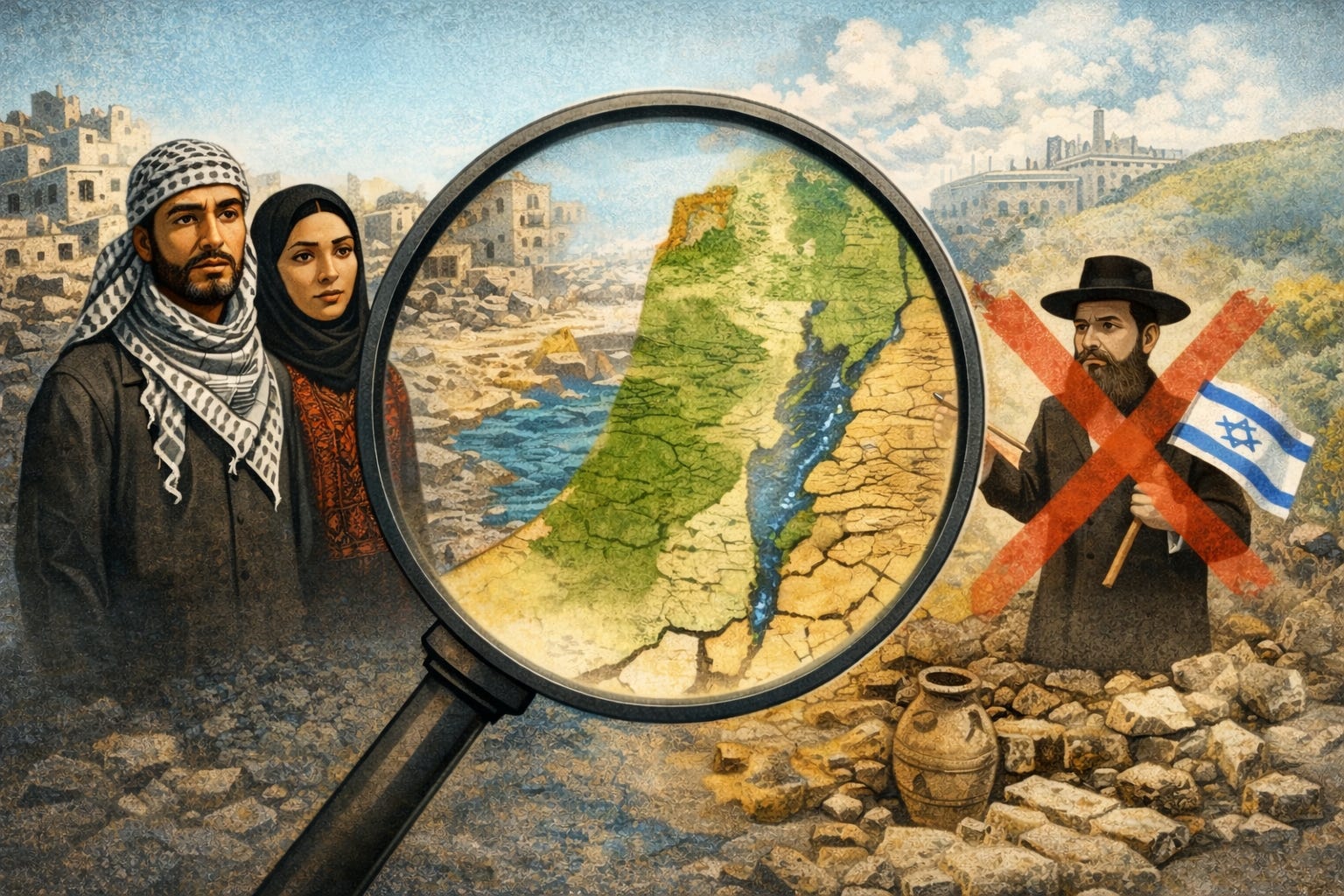
What you are looking at is not an anti-racism framework. It is a political platform dressed in the language of anti-racism. And the dressing is the point, because it’s hard to argue against something that calls itself anti-racism without looking like you are arguing for racism. Otherwise, you’re a racist. See?
The Counter-Framework
The APR framework wasn’t developed in a vacuum. It was developed as a direct response to the International Holocaust Remembrance Alliance’s (IHRA) working definition of antisemitism, which Canada adopted in 2019. The ACLA report discusses IHRA explicitly and argues that it is being used to suppress Palestinian voices. The entire architecture of APR is designed to be effectively deployed against the IHRA definition in institutional settings.
The two frameworks do not coexist; they cancel each other out. Where IHRA says that denying Jewish self-determination can be antisemitic, APR says that affirming Israeli sovereignty while questioning Palestinian claims is anti-Palestinian racism. Where IHRA tries to draw a line between criticism and bigotry, APR erases that line by classifying the very accusation of antisemitism as itself a form of racism.
That isn’t an accident, but the design.
The Racialization Problem
There is an even more fundamental issue with the APR framework that gets remarkably little attention: it treats “Palestinian” as a racial category.
Palestinians are a national group. They now have a cultural identity, a historical narrative, political aspirations, and a diaspora. But a national group is not a race. Canadians are not a race. Ukrainians are not a race. Israelis are not a race. When we say “anti-Black racism” or “anti-Indigenous racism,” we are talking about discrimination rooted in perceived racial characteristics and centuries of racialized oppression. We are talking about something that can’t be separated from the person who experiences it.
Palestinian identity, however, is inseparable from a political context. To be Palestinian like the Lebanese-born founder of Palestinian nationalism, Ahmad Shukeiri, or the Egyptian-born Yasser Arafat, is, among other things, to hold a set of claims about land, sovereignty, displacement, and justice. Those claims can be heard and debated. But when you racialize a political identity, you do something specific: you make it impossible to disagree with the political claims without being accused of racism against the people who hold them.
This isn’t a small thing, but the whole ballgame.
If “Palestinian” is a racial category, then disagreeing with the complicated Palestinian narrative of 1948 is not a historical argument. It is racism. Supporting Israel’s right to exist as a democratic Jewish state is not a political position. It is racism. Questioning the characterization of Israel as a “settler-colonial” project isn’t an intellectual disagreement. It is racism. A teacher who mentions that Israel has Arab members of parliament isn’t providing context, but giving cover for apartheid. A student who writes a book report on Exodus isn’t completing an English assignment. He is platforming a colonial narrative. A principal who schedules a Holocaust remembrance assembly without equal time for a Nakba commemoration is not exercising academic judgment, but perpetuating erasure. At a certain point you have to ask whether a framework that turns every expression of Jewish life into an act of racial aggression is really about protecting Palestinians or about something else entirely.
The racialization of Palestinian identity is what allows a political framework to now be laundered through equity offices, human rights commissions, and school board training modules. Because once something is racism in 2026, it’s no longer up for debate. It is something to be trained out of people (unless it’s antisemitism, but I digress…).
The Canadian Conveyor Belt

The ACLA published its report in April 2022. By June 2024, TDSB had voted 15 to 7 to include APR in its Combating Hate and Racism strategy. By November 2024, the Hamilton-Wentworth District School Board had delivered mandatory APR training to over 8,000 teachers that they refuse to now talk about. Other boards across Ontario were in various stages of consideration.
How did a concept go from a single advocacy report to mandatory teacher training in two and a half years?
It is worth noting what did not happen during that period. The Ontario Human Rights Commission, the body that would ordinarily validate a new category of discrimination in the province, declined to recognize APR. A federal parliamentary study on the concept produced what was described as “heavily divided” opinions. The definition itself remains contested at every level of government that has examined it seriously. Jewish organizations like the Centre for Israel and Jewish Affairs (CIJA) argue that the framework describes Israel as a racist endeavour and effectively classifies mainstream Jewish identity as bigotry.
In other words, the concept was adopted by school boards faster than it could be validated by the institutions responsible for defining discrimination in Ontario. The school boards leapfrogged the province’s own human rights apparatus. How?
Infrastructure. Canadian public institutions, particularly school boards, had already built the machinery for this kind of adoption. They had equity offices. They had anti-racism frameworks. They had mandatory training pipelines. They had complaint mechanisms. They have teachers who are required to attend professional development meetings. They had the bureaucratic architecture to receive a new category of discrimination and plug it directly into existing systems. The ACLA didn’t need to build anything, it just needed to provide a concept. The conveyor belt was already running.
This is important as it means the fight over APR isn’t really a fight about one definition or report. It’s a fight about the institutional infrastructure that allows any sufficiently well-packaged concept to become mandatory ideology for public employees. Today it’s APR. Tomorrow it could be something else entirely. The machine doesn’t care about the content, just the format. And APR arrived in exactly the right format.
What This Means
I have tried to read the ACLA report charitably, looking for the version of it that is simply about protecting Palestinian students from bullying and discrimination in schools. Giving the benefit of the doubt, maybe some part of that version exists, in fragments, buried under layers of obscene political assertion presented as factual description.
But the dominant thrust of the document is unmistakable. It defines mainstream Zionist positions as racist. It treats the existence of Israel as a Jewish state as an ongoing act of “colonial” violence. It pre-emptively classifies any accusation of antisemitism directed at Palestinian advocacy as itself a form of APR. And it presents all of this not as a political argument to be debated in the public square, but as an anti-racism framework to be implemented by institutions and enforced through training, policy, and complaint mechanisms.
With respect, when a school board adopts this framework, it isn’t “adding anti-Palestinian racism to its anti-racism strategy.” It is adopting a political position on one of the most contested conflicts in the world and encoding it as institutional orthodoxy. It’s also telling every Jewish teacher, every Jewish student, every Jewish parent who holds mainstream Zionist views that because of their identity, they’re racist.
In Part 3, we’ll look at how this actually played out at the TDSB: how the vote happened, who got to speak, who didn’t, and what it tells us about the death of democratic process in Canadian public institutions.
Here’s the Catch
The concept of anti-Palestinian racism did not exist as a formal framework before April 2022. By late 2024, it was embedded in mandatory teacher training across Ontario school boards. The speed of adoption tells you everything about the institutional machinery that was already in place. The ACLA’s definition does something specific: it classifies mainstream Zionist positions as racism. It treats Palestinian identity as a racial category, making political disagreement indistinguishable from bigotry. This didn’t happen by accident. The equity infrastructure in Canadian public institutions was a conveyor belt waiting for new content. APR was the content. And the result is that Jewish identity in Canadian schools is now apparently a form of racism.
This is Part 2 of a five-part series about APR called The Architecture of Exclusion. Part 3 will examine how the TDSB adopted APR and what it reveals about institutional accountability.
This is all literal projection - the DARVOing mutation of Jew hatred into the 21st century version.
Vasily Grossman, Life and Fate:
“Antisemitism is always a means rather than an end. It is a measure of the contradictions yet to be resolved. It is a mirror for the failings of individuals, social structures and state systems. Tell me what you accuse the Jews of, I’ll tell you what you’re guilty of.”
The form changes, the essential nature never does.
Thank you Adam for this vital research and information.
Also, re, the Arab Canadian Lawyers Association, one of the chief lawyers, Yafa Jarrar, is the daughter of Khalida Jarrar, who is considered the head of the PFLP (and till recently was in Israeli jail for planning and funding terror attacks). Until at least sometime in 2025, the website listed the lawyers involved. They have since remastered the website to only include propaganda and events.