
Stop Speaking for Iranians
A Message to Western Voices Lecturing Us About Our Own Freedom

This is a guest piece by Golrokh Alvandi, an Iranian-Canadian elementary teacher and Zionist based in Toronto. Passionate about Judaism, and Middle East geopolitics. She writes about culture, identity and current events from a personal, passionate, and informed perspective.
Over the past week I have experienced something both infuriating and surreal.
Iranians around the world are witnessing what may be the first real crack in the Islamic Republic in nearly half a century. For many of us, this moment carries emotions that are difficult to describe. It is a mixture of relief, disbelief, hope, and fear all at once. But instead of listening to Iranians, something strange has happened.
People who openly admit they know almost nothing about Iran have suddenly become experts on what should happen to our country. The conversation almost always begins the same way: “I’m anti-war… and I don’t really know much about Iran.” If you don’t know much about Iran, perhaps the appropriate response is not a lecture. Perhaps the appropriate response is to listen, ask questions, and educate yourself.
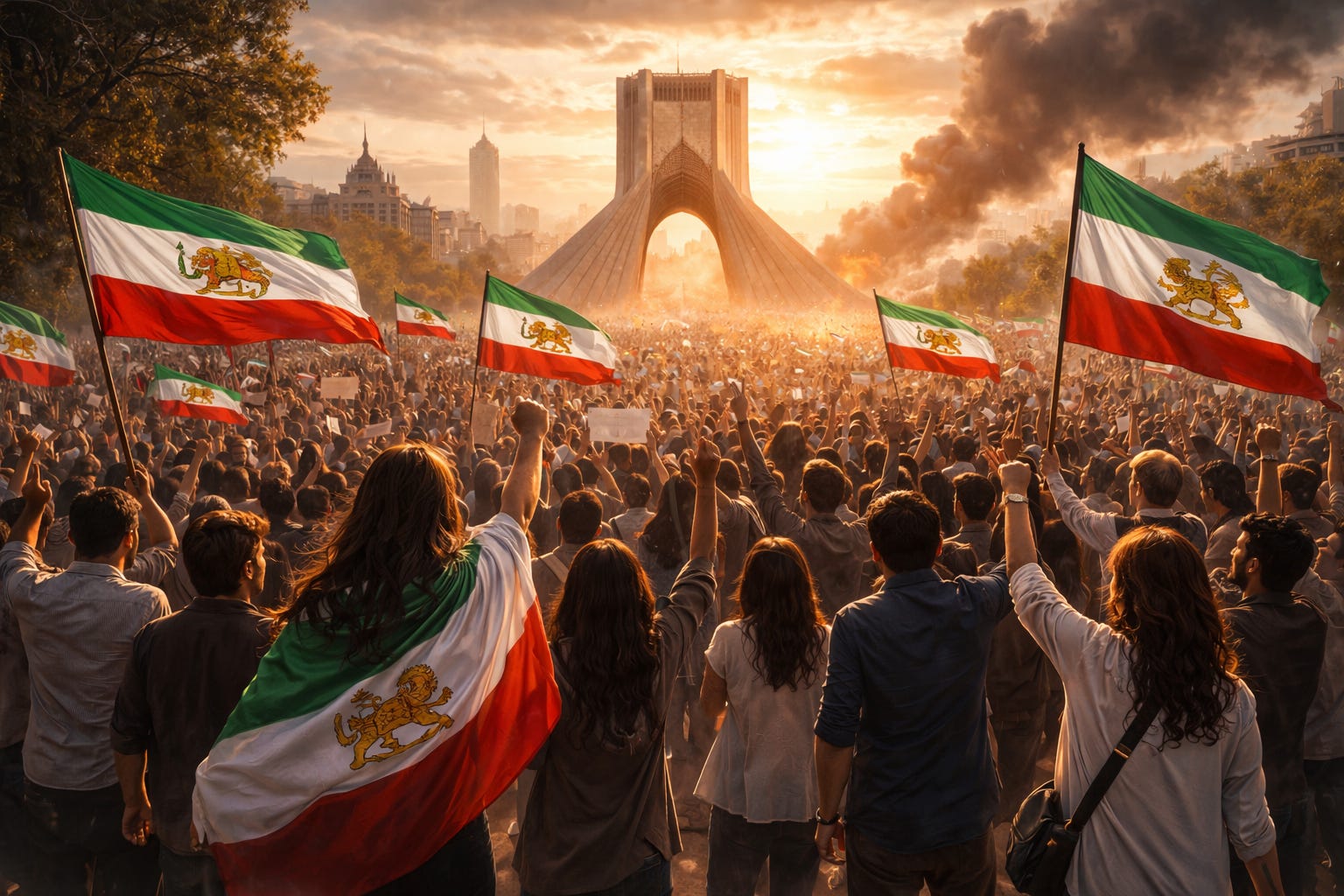
What you do not get to do is speak over the people who have actually lived under this regime. And yet suddenly everyone is a self-appointed Middle East expert. Social media is now full of confident geopolitical analysis from people who would not last a single day living under the conditions they so casually analyze. People who have never experienced authoritarian rule, religious policing, or the constant fear that a careless word could cost them their freedom or worse.
Critics from abroad
It is easy to preach from a distance. It is easy to demand “peace” when you are not the one living under tyranny. For decades many of these same voices were silent. Silent while the regime crushed dissent. Silent while protesters were executed. Silent while women were beaten in the streets for refusing to wear the compulsory hijab. Silent while prisoners were tortured in places like Evin Prison. Silent while tens of thousands were slaughtered in a matter of days. Silent while families buried sons and daughters whose only crime was demanding freedom. The silence was deafening.
But now suddenly those same voices have discovered their outrage. Not about the regime that inflicted this brutality, but about the possibility that it might finally fall. From the comfort of stable democracies they chant slogans about “peace” and “no war,” as if diplomacy has not been tried for forty-seven years. Diplomacy failed while protesters were imprisoned. Diplomacy failed while the regime funded militias across the Middle East. Diplomacy failed while its leaders stood on podiums chanting “Death to America” and “Death to Israel.” Nearly half a century of diplomacy has done very little for the Iranian people.
Yet when Iranians dare to say openly that the Islamic Republic must end, we are told our views are extreme. We are told we are emotional. We are told we are being manipulated. Some even suggest we are happy that our country, our homes, and our families are being bombed. Let me make one thing clear: we are not happy about bombs or destruction. This is not a war on Iran. This is a rescue operation. We know exactly what is at stake. But we also understand the alternatives far better than those lecturing us.
Misguided concern
Many of the loudest voices in this conversation are not actually motivated by concern for Iranians. Their thinking is clouded by something else entirely: their hatred of Israel, their hatred of Trump, or their broader political obsessions. Iran has simply become another stage for those arguments. But Iran is not a political talking point. It is our country. And the lives being discussed so casually are not abstract concepts. They are our families, our memories, and our future.
What almost no one says is the simplest thing. “Congratulations, an evil monster is gone.” “I’m happy for you.” Instead, when many of us expressed relief at the death of the Ayatollah, the man responsible for decades of repression, we were immediately confronted with lectures. “I don’t trust Trump.” “Netanyahu is dangerous.” “Iran will become the next Afghanistan.” “There will be civil war.”
All of this was delivered with remarkable confidence by people who, moments earlier, admitted they knew nothing about Iran.
We do not need geopolitical predictions about our country from people who have never lived there and barely understand its society. If you want to say, “I don’t know enough about this. Educate me,” then we can have a conversation.
But if you begin with ignorance, offer no reasonable alternative to military intervention, and end with a lecture, perhaps you need to sit this one out.
We know war
Another common lecture is about the horrors of war. Iranians do not need lessons about war. We know war. We lived through eight years of it with Iraq. We stood in ration lines for food and fuel. We woke up to air-raid sirens in the middle of the night. We taped our windows so they would not shatter when bombs fell. We watched neighborhoods turn into rubble. We watched young men disappear into a senseless conflict. So when someone who has never experienced any of this tells us “war is bad,” forgive us if the statement feels hollow. We know war. But we also know tyranny. Sometimes history presents a moment when the possibility of change appears. Many Iranians believe this may be one of those moments.
Some people insist on framing what is happening as simply another war. Many Iranians see it differently. For them, this is a rescue operation. Because the alternative, the “peace” people advocate, means returning to the reality we have known for decades. It means going back to watching Iranian women sprayed with gunfire in the streets, abducted, tortured, raped. It means returning to a world where the United Nations embraces their abusers, congratulates them, and offers them a respected seat at the table of global diplomacy.
We know bombs are terrible. Missiles are terrible. The fear for loved ones is terrible. The mourning of the innocent is terrible. But history is rarely clean. The Nazis did not surrender after a strong word of condemnation from the Allies. Innocent people in Germany died while the Allied forces dismantled the regime that had weaponized an entire nation. Would Germans today bring back the Nazi regime if it meant avoiding those wartime casualties? Would they undo the defeat of Nazism? History is painful. Sometimes the fall of tyranny comes with terrible costs.
Another uncomfortable truth is that Western governments helped keep this regime alive for decades. Administration after administration chose engagement with the Islamic Republic rather than standing firmly with the Iranian people. During the 2009 Green Movement, when millions of Iranians flooded the streets demanding democracy, the world hesitated while the regime crushed the uprising. Later, negotiations and sanctions relief poured billions of dollars into the regime’s hands—money that strengthened repression at home and funded militant proxies abroad.
Time and again, the Iranian people were abandoned. So when outsiders now tell us to trust diplomacy again, forgive us if we are skeptical. What makes this moment different is that many Iranians are no longer asking for reform. They are asking for the end of the Islamic Republic entirely.
Inside Iran and across the diaspora, large numbers of Iranians openly support a democratic transition led by Crown Prince Reza Pahlavi, who has spent years advocating for a secular and democratic future for Iran. Whether one supports him or not, one thing is clear: Iranians are increasingly united around the idea that the Ayatollahs’ rule must end. Yet many Western commentators who claim to support democracy seem strangely uncomfortable when Iranians express exactly that desire.
Why do I care?
People often ask me something else. They ask why I care so much. I am fifty-two years old. I have lived longer in Canada than I ever lived in Iran. My husband is not Iranian. My children were born here. So why do I care? Because you can take an Iranian out of Iran, but you cannot take Iran out of an Iranian. Iran is where I learned to ride my bike. It is where I learned to stand firm with truth. It is where my parents taught me compassion and honesty while watching their homeland slowly being suffocated by authoritarian rule.
It is where I remember cherry trees in bloom and the smell of my mother’s garden. Fridays at my aunt’s house. Cousins laughing in crowded rooms. Nowruz holidays spent together. It is where my memories begin.
Since leaving, I have watched two worlds unfold. I watched my children grow up with freedoms Iranian youth can only dream about. I watched my teenage daughter experiment with makeup and self-expression while girls her age in Iran risk arrest and lashes for the same thing.
So yes, I care. Not because I plan to move back. But because I want Iranians to experience the same dignity and freedom my children take for granted. One day I hope to take my family to the country of my childhood and show them the streets I remember and the graves of their grandparents. If I stayed silent now, I would never forgive myself. As we say in Farsi, I would be bisharaf. Without honor.
For decades the Islamic Republic tried to silence us. We will not let outsiders do the same. If you do not know Iran, stop explaining Iran to Iranians. If you spent decades silent while the regime brutalized its people, do not suddenly discover your moral authority now. Listen. Learn. Stand with Iranians if you wish. But do not speak over us. For forty-seven years our voices were suppressed by a regime that ruled through fear. This time, we refuse to let anyone silence them again.
 | A guest post by
|
The most concise, heartfelt and knowledgeable expressions I have yet read. This should be seen in our main media. This should be read by our political leaders. This should be taught in the "woke" inspired universities....where "profs" and students have opinions but lack knowledge and caring and are inspired by hatred of Israel and Trump; and who's minds have already been infected by the Iranian Regimes outreach cells.
Absolutely beautiful. Curious how selective is the outrage of certain justice warriors.