
The Exhausted Watchman
On vigilance, its costs, and what Jewish tradition understood about the need to stop watching

Sometime in the last few years, I stopped trusting my inbox. Not because of any single dramatic incident. It happened gradually, the way most erosions do. A fake delivery notification here. A spoofed email there. A text from a number I almost recognized. I learned, through slow accumulation, that the digital world is a place where everyone is trying to take something from you.
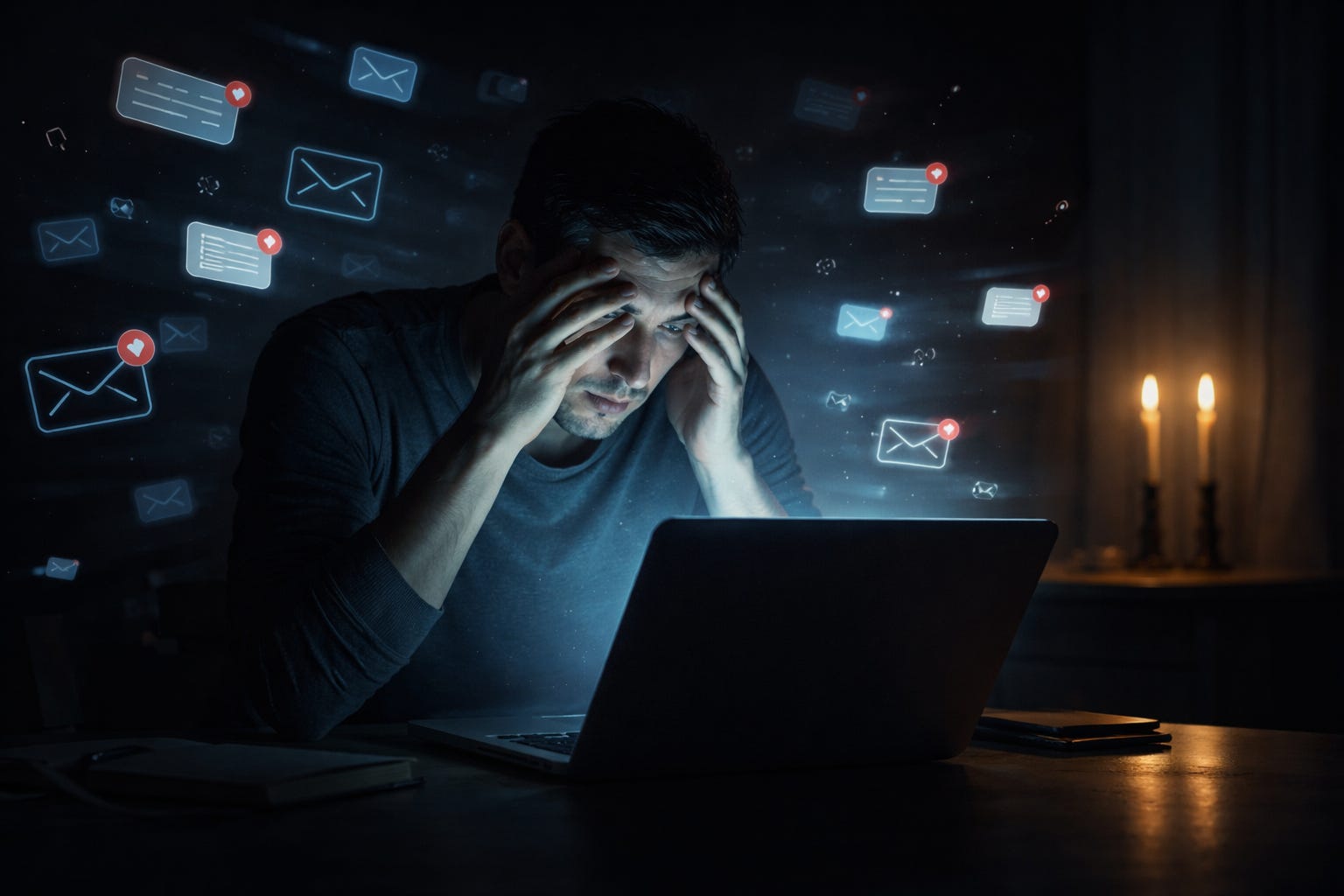
And so I became vigilant. I hover over links. I scrutinize sender addresses. I treat unexpected emails the way a medieval peasant treated a stranger at the gate after dark: with suspicion first, courtesy never.
This is, I am told, the correct response. Nobody talks much about what it costs.
The cost isn’t dramatic. That’s part of why it goes unacknowledged. You are not traumatized, just tired. There’s a particular exhaustion that comes from sustained low-level threat assessment - not the exhaustion of fear, but the exhaustion of readiness. The body and mind kept at permanent yellow alert, never green, never red, just perpetually braced. We have built an information environment that requires constant vigilance to navigate, and then we are surprised when people feel depleted, when they tune out, when something eventually slips through.
Vigilance isn’t a sustainable strategy. It is a drain.
Exhaustion
Here is where I want to say something about Jews. Not because we are the only ones navigating this, but because we have a long history with exactly this kind of exhaustion, and our tradition developed a serious response to it.
For most of Jewish history, vigilance wasn’t a metaphor. Jewish communities across Europe and the Middle East lived for centuries in permanent readiness for persecution. You watched the political climate the way a sailor watches the horizon. This was rational. The history justified it. But it was also, over centuries, grinding.
Post-October 7, I watch this happening again in real time. The headline monitoring. The antisemitism trackers. The group chats that never sleep. Many (most) Jews I know have not had a genuinely quiet week since October 2023. We are, once again, the exhausted watchmen.
The question is not whether the vigilance is warranted. It often is. The question is whether a life organized entirely around vigilance is, over time, a life at all.
Shabbat
The Zionist thinker Ahad Ha’am observed that “more than the Jews have kept the Sabbath, the Sabbath has kept the Jews.” He meant this historically. But I think the insight goes deeper.
Shabbat, in its traditional form, is not primarily about rest. It is about the prohibition on a specific posture. You are not permitted to create, to fix, to monitor, to strategize. The day is structured around a forced suspension of vigilance. The rabbis who developed this weren’t naive about danger. They required watchfulness six days a week. But they also understood that a people who are vigilant seven days a week will eventually break. The watchman who never sleeps is not more protected. He is less, because exhaustion weakens you when the real crisis arrives.

Shabbat was, among other things, a technology for managing vigilance fatigue. One day a week, you were commanded to stop scanning the horizon. Not because the world was safe. Because you were.
The digital world has abolished Shabbat for everyone. The scammers don’t observe a day of rest. The phishing attempts arrive Saturday morning the same as Tuesday afternoon. And so, increasingly, neither do we.
Jews are not uniquely positioned to solve this problem. But we may be uniquely positioned to name it, because we have the vocabulary, the history, and the tradition that identifies what is missing.
The lesson is not: stop being careful.
The lesson is: vigilance without rest is not more vigilance. It is less. It is the slow degradation of the very capacity you are trying to protect. The tradition knew this. It built a fence around it. One day a week, you put down the watch. Not because the world is safe. Because a watchman who never sleeps eventually stops seeing clearly - and that is when the real danger arrives.
Here’s the Catch
Vigilance is necessary. It is also a drug, and the dosage matters. The digital world has quietly removed all limits on that dose, demanding that we stay alert at all hours to scams, threats, and bad actors - and the result is a kind of chronic depletion that makes us worse at the very thing we are trying to do. Jewish tradition arrived at a hard-won insight that applies here with unexpected force: the people who most needed to stay alert built into their law a weekly, non-negotiable command to stop. Not as a reward. As a discipline. Shabbat is not the absence of vigilance. It is what makes sustained vigilance possible. The Jewish community, post-October 7, would do well to remember this. So would everyone else.
Great article. Makes me think of a question though: how did Jewish populations protect themselves on Shabbat? Were certain members allowed to violate Shabbat in thr name of Pikuach Nefesh?
Thoughtful and insightful. Thank you.