
The Exhausted Watchman
On vigilance, its costs, and what Rabbi Nachman understood about joy

Sometime in the last few years, I totally stopped trusting my inbox. Not because of any single dramatic incident. It happened gradually, the way most erosions do. A fake delivery notification here. A spoofed email there. A text from a number I almost recognized. I learned, through slow accumulation, that the digital world is a place where everyone is trying to take something from you.
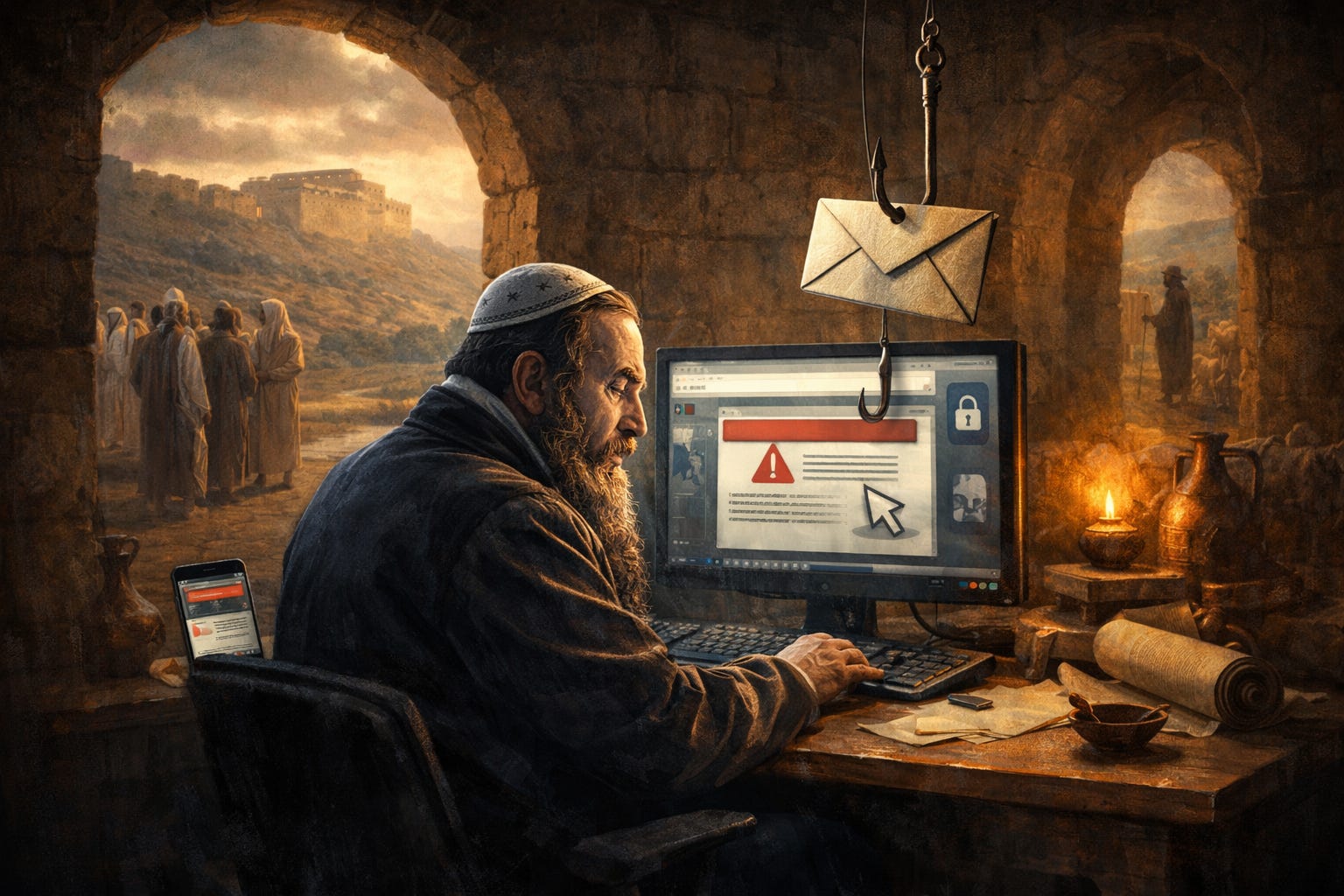
And so I became vigilant. I hover over links. I scrutinize sender addresses. I treat unexpected emails the way a medieval peasant treated a stranger at the gate after dark: with suspicion first, courtesy never.
This is, I am told, the correct response.
Nobody talks much about what it costs.
The cost isn’t dramatic. That is part of why it goes unacknowledged. You’re not traumatized, just tired. There’s a particular exhaustion that comes from sustained low-level threat assessment - not the exhaustion of fear, but the exhaustion of readiness. The body and mind kept at permanent yellow alert, never green, never red, just perpetually braced. We have built an information environment that requires constant vigilance to navigate, and then we are surprised when people feel depleted, when they tune out, when something eventually slips through.
Vigilance isn’t a sustainable strategy. It’s a total drain.
Our Experience
Here is where I want to say something about Jews. Not because we’re the only ones navigating this, but because we have a long history with exactly this kind of exhaustion, and our tradition developed a serious response to it.
For most of Jewish history, vigilance wasn’t a metaphor. Jewish communities across Europe and the Middle East lived for centuries in permanent readiness for persecution. You watched the political climate the way a sailor watches the horizon. This was rational and the history justified it. But it was also, over centuries, grinding.
Post-October 7, we watch this happening again in real time. The headline monitoring. The antisemitism trackers. The group chats that never sleep. Many (most) Jews I know have not had a genuinely quiet week since October 2023. We are, once again, the exhausted watchmen.
The question is not whether the vigilance is warranted; it is. The question is whether a life organized entirely around vigilance is, over time, a life at all.
Atzvut
Rabbi Nachman of Breslov (April 4, 1772 - October 16, 1810) lived among Jews who had every reason to be consumed by fear. Early nineteenth century Eastern Europe: poverty, pogroms, the pressures of a world that didn’t want Jews in it. He understood despair from the inside. And yet the teaching he returned to, over and over, was this: it’s a great mitzvah to always be in a state of joy.
Not happiness. Joy! The distinction matters. Happiness is what you feel when things go well. Joy, for Nachman, is a discipline you practice precisely when they do not. He called anxiety and depression atzvut - a Hebrew word that means something closer to paralysis than sadness. And he was fierce about it. Atzvut, he taught, is spiritually corrosive. Not because it feels bad, but because it closes you off. It narrows the aperture through which you engage with the world. A person sunk in anxiety cannot think clearly, act wisely, or connect meaningfully to anything beyond the threat they’re tracking.
This is not suggesting that one should be naive. Nachman was not telling his followers to stop taking threats seriously. He was saying something harder and more precise: that allowing vigilance to collapse into chronic anxiety isn’t a form of preparedness, but a type of defeat. The enemy doesn’t need to destroy you if your own fear does the job first.
The lesson he drew from this is one the digital age, and the post-October 7 era, desperately needs: Joy is not the reward you collect when the threats finally stop. The threats, for Jews, rarely stopped. Joy is the practice you maintain in spite of them - the deliberate refusal to let the scanning consume the life that the scanning is supposed to protect.
Post-October 7, many Jews are losing this. Understandably. But our own tradition is unambiguous about where that road leads. Nachman watched Jews succumb to atzvut in terrible condition. And yes, things are bad today: Jewish ambulances torched in London, buildings collapsing in Israel, synagogues shot at in Toronto. His response was not to minimize the danger. It was to insist, with something close to fury, that surrendering your capacity for joy is the one loss you cannot afford.
Here’s the Catch
Vigilance without joy isn’t safety - it is slow surrender. The digital world has made us all into permanent sentinels, scanning for the next threat, and the cost is a kind of atzvut, a paralysis of spirit, that Rabbi Nachman of Breslov spent his life fighting against. He understood, in conditions far grimmer than ours, that anxiety is not a sign of seriousness. It is a sign that the threat has already won. Joy, in his teaching, is not what you earn when the danger passes. It is what you practice so that the danger does not hollow you out while you wait. The Jewish community knows this teaching. Right now, especially as the holiday of Passover approaches, we need to actually live it.