
The Long Way Home
July 10: White

The last colour is white.
ANU Museum
We spent the morning at ANU, the Museum of the Jewish People, and there is no room on this whole journey that lands closer to the centre of so much that I have focused on the last few years. I’ve spent the last few years writing about the Diaspora, about whether we’re the rough draft and Israel the fair copy, or whether it’s always been one long argument carried on across an ocean. ANU doesn’t settle the argument, but honours it.
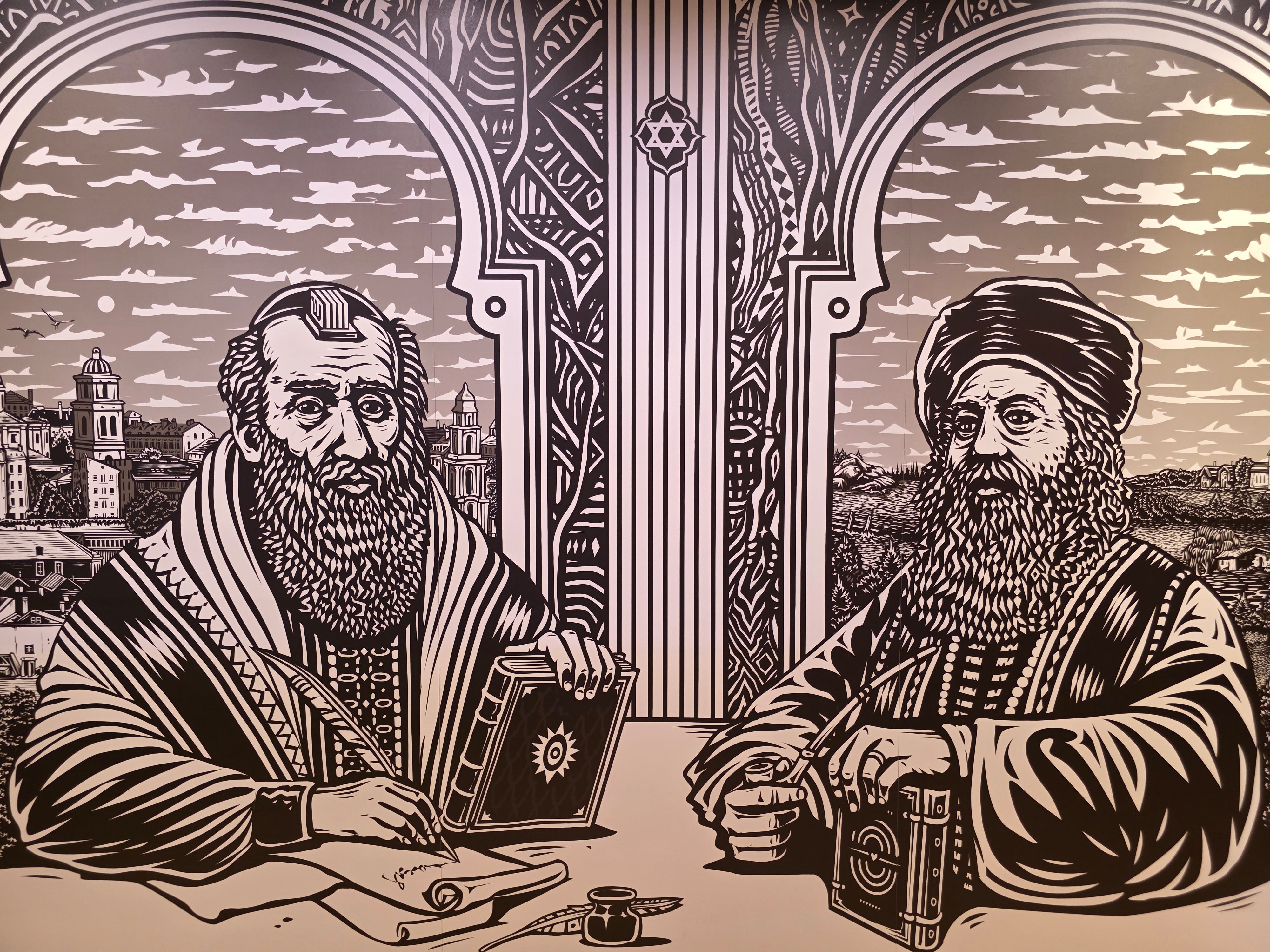
The tour was beautiful, the history laid out clean and whole, three thousand years of it told not as a list of disasters survived but as a civilization: its books, its arguments, its music, its endless wandering, its stubborn genius for staying itself in a hundred different costumes. It puts the shtetl and the Lower East Side and the Cape Town shul in the same building as the kibbutz, and doesn’t rank them.
Our guide told us something I’ve been thinking over the last few hours. This place used to be called Beit Hatfutsot, the Museum of the Diaspora, and at its heart, hanging down through the middle of the building, was a Holocaust memorial. The whole museum, he told me, effectively revolved around it. That was the Diaspora as Israel once understood it: the place Jews went to die, the long dark waiting room before the state, a story whose real subject was catastrophe. Then they rebuilt it as ANU, the Museum of the Jewish People, and the Holocaust is now a single modest room among many. He clarified the shift thus: Israel no longer sees the Diaspora as a graveyard. Not a prologue to disaster, not a cautionary tale, but a living, creating, arguing branch of the same people, worthy of a museum that is mostly about how we have lived rather than how we died. For a Diaspora Jew who has spent a long time insisting that we aren’t merely the sad part of the story, standing in that reimagined building felt a great deal like being seen.
Michal Cotler-Wunsh
And then Michal Cotler-Wunsh, and of course I don’t have the words for how impressive she was. She had been appointed Israel’s special envoy for combating antisemitism three weeks before October 7, which is something like being named chief of the FDNY a week before 9/11. She spoke for an hour without notes and without a wasted sentence, the way people speak when they have thought about a thing so long that it’s become part of how they breathe, and I sat there taking notes like a first-year student.
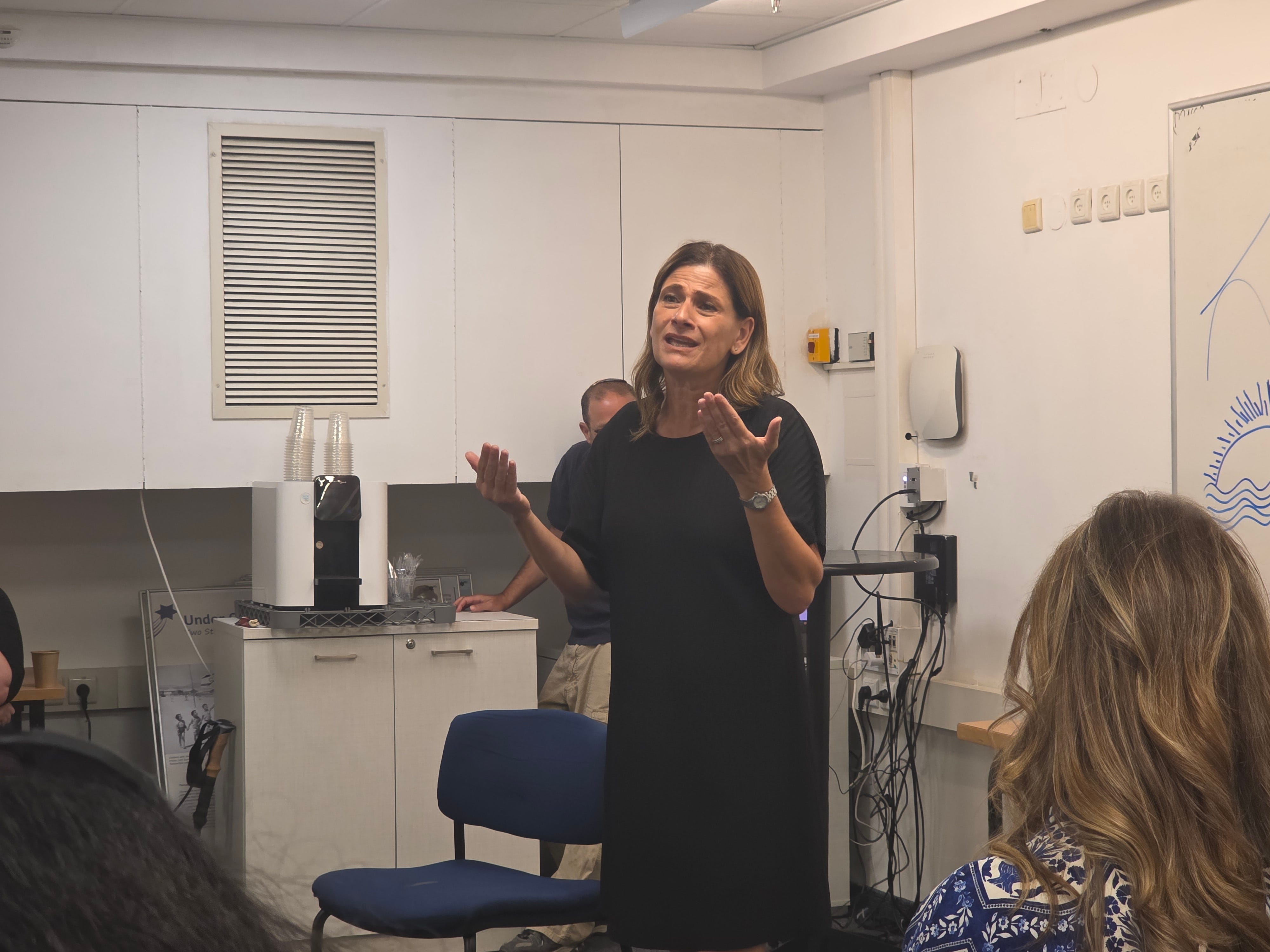
Her master frame is essentially this: antisemitism is a virus that survives by mutating, by latching onto whatever a society holds most sacred. When the sacred thing was religion, the Jew was the Christ-killer and the poisoner of wells. When it was race, the Jew was the contamination to be purified away. And the sacred thing of our own age is human rights and international law, so that is the costume the hatred now wears, fluent and credentialed, speaking the grammar of justice, which is exactly why antizionism has become the one respectable, even fashionable, strain of the oldest hatred alive. Once she said it, her most chilling line stopped sounding paranoid and started sounding obvious. She knew, she told us, on October 8, before Israel had fired a single shot, that a tsunami of antisemitism was coming in response to the worst slaughter of Jews since the Holocaust. We all knew it too. But that sentence shouldn’t make sense. A hatred that erupts in answer to the murder of Jews, before there is any war to protest, was never about anything Israel did. Their timing was their confession.
For the proof she reached back fifty years, to 1975, when the UN declared Zionism a form of racism and the American ambassador Daniel Patrick Moynihan rose to warn that a great evil had been loosed upon the world. That was the opening shot, she said: brand the Jewish national movement as racism inside the world’s highest chamber and you license the hatred everywhere, and the Jewish state stands convicted in advance of every conflict that follows. Thus, the collapse of morality is not October 7 itself; we know what genocidal terrorists are and do. The collapse is in the response to it, which is something that we all know, but that bears repeating nonetheless. The silence, a #MeToo that went mute the instant the raped women were Jewish. The denial, which began while the killers were still livestreaming their own pride at killing Jews. The justification, tenured professors calling the mass rape a form of resistance. And at the end, the open season on any Jew, or anyone who won’t disavow the Jewish state. She wasn’t describing a problem for Jews but rather a civilization whose moral language failed at the precise point where the victims were us, and in failing there, showed the exception it had been carrying the whole time.
And then she reached into the walls around us. The Holocaust itself, she argued, has been hijacked, conscripted as a weapon against the Jewish state, so that a child can tour a Holocaust museum and walk out having somehow concluded that a people who survived that must be uniquely monstrous to, in the slander she was naming, be perpetrating it now. A museum that shows only what happened, and never teaches how it happens, the machinery of demonization that makes any of it possible, doesn’t protect against the next catastrophe, but can rather feed it. And then I thought of our guide a few hours earlier, and the Holocaust memorial that once hung down through the centre of this building, and the decision to take the Jewish story back from catastrophe and tell it whole. She and the museum were making the same argument: that remembering how we died is not enough, that a people has the right to be about how it lives.
There was also a circle in her lecture that she couldn’t have planned. The definitive book on that Moynihan speech is Moynihan’s Moment, written by none other than Gil Troy, the historian who set our table on the very first morning of this trip. The man who opened the week four days ago had, years ago, written the book on the warning that explained its end. And she closed, on purpose, on hope, which she was careful to separate from optimism the way Rabbi Sacks did: optimism is the belief that things will turn out fine, and asks nothing of you, while hope is the belief that together we can make them fine, and asks everything. She reminded us that the country we were sitting in had named its anthem Hatikvah, the hope.
Florentine
The heaviness of the morning wanted somewhere to go, and the afternoon obliged. We ate in Florentine, a scruffy, bohemian corner of the city where the walls are all graffiti and the food is far better than the walls let on, at a place called Florentina. Salad and pasta and fish and pastries and coffee. Each plate better than the last.
Then we walked to the foot of Rothschild Boulevard, where our guide told us how Tel Aviv began, a little over a century ago, on nothing, on bare dunes north of Jaffa, a city conjured out of empty sand by people who decided that a modern Hebrew city should simply exist, and then made it exist. 1909 Tel Aviv was founded, named after Herzl’s Altneuland (Old New Land). I finally saw where the day’s colour had been hiding: Tel Aviv is the White City. They call it that for the pale Bauhaus buildings that went up here in the thirties, thousands of them, clean white lines raised on the sand by architects fleeing a Europe that was turning on them, so that the one white thing the refugees still owned, a blank modern surface, became an entire metropolis. We finished the afternoon in the Carmel Market, loud and jammed with the pre-Shabbat rush, the whole city buying flowers and challah against the clock and leaning, all together, toward sundown.
Tel Aviv Port
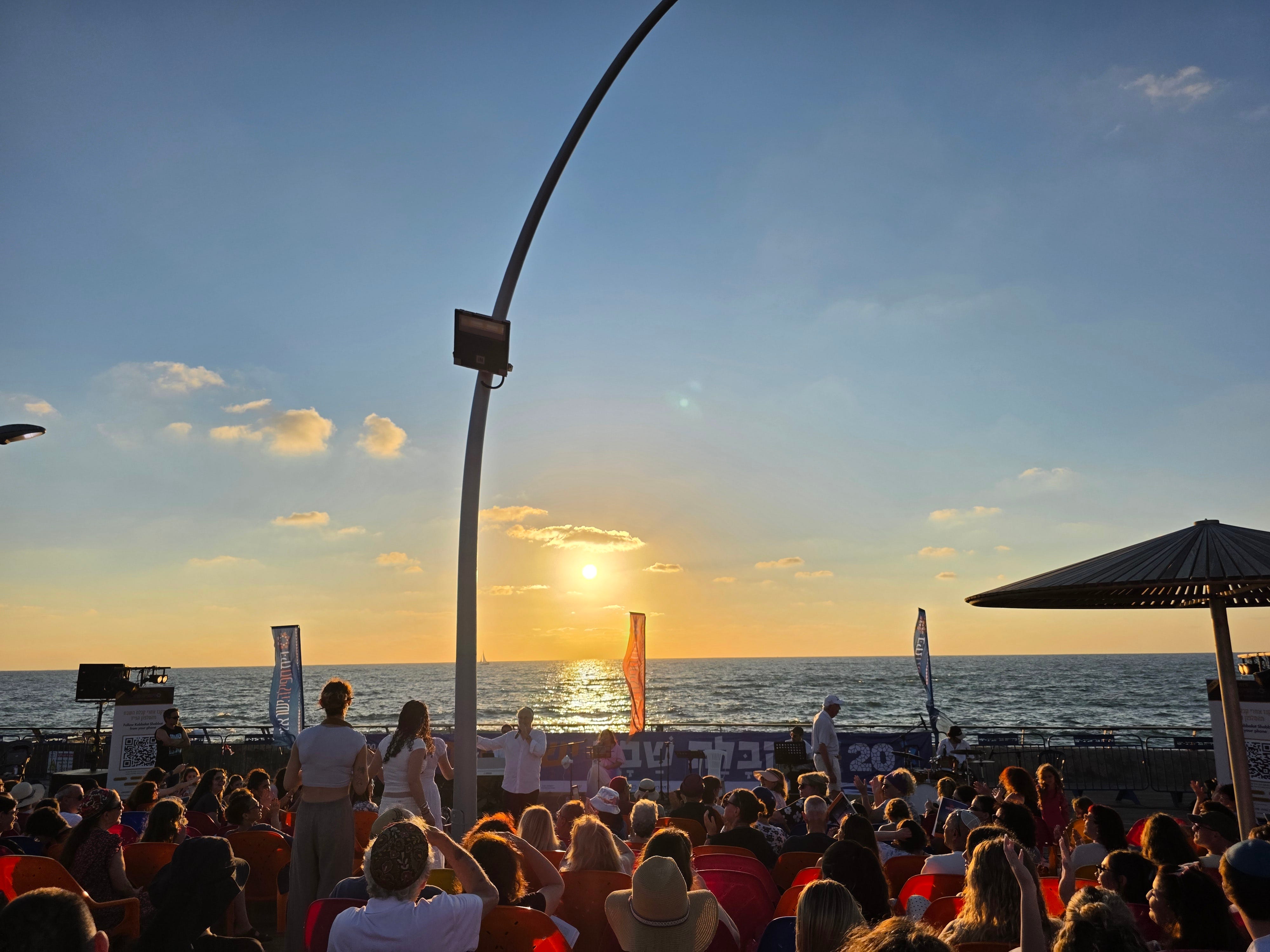
And then the hour I will remember longest. We walked to the old Tel Aviv port, where a Kabbalat Shabbat had gathered, a secular one, no synagogue and no rabbi, just a band and a crowd and the sea. They sang the Sabbath in, the old liturgical melodies threaded through Israeli folk songs, hundreds of people who may never set foot in a shul singing Lecha Dodi and meaning every word, welcoming Shabbat the way this city welcomes everything, in the open air, out loud, facing the Mediterranean Sea.
Kabbalat Shabbat is, underneath, a wedding: we rise and turn and sing to greet the Sabbath as a bride, and the tradition dresses her in white. I sat there with the Mediterranean going silver in front of me and a whole secular city singing a bride toward the shore, and I could not have told you where the religion ended and the Israeliness began, which I suspect, was the entire point. Israeli Judaism is a curious creature. It was, however, with no exaggeration, one of the most beautiful hours of my life.
Shabbat Dinner
We ended at the hotel, at Shabbat dinner with the group, around a single enormous table laid on purpose so that all of us could see one another and talk, a white cloth running the length of it. One of the non-Jewish educators spoke about how grateful she was that she finally got to “meet” Israel. Another spoke of how valuable the notion of allyship is, and why our community often craves it, because we can’t always do this alone, and we are grateful when someone says the courage to say something we’re always looking for others to say. Another reiterated a message we heard throughout the week, that history is someone else’s story, and that memory is your story, and how in Israel, culture is not about just observing, because the culture is alive and breathing everywhere around you, at all times. It was riveting and meaningful.
Some of the group spoke about the week, and sitting there I realized it had quietly closed a circle opened on Monday night. I began this trip at a table in Jerusalem, set in gold, where two grieving parents handed us their daughter’s story – that of Adi Kaploun Vital. I am ending it at a table in Tel Aviv, laid in white, where a room of near-strangers who have now seen the same unbearable and beautiful things try to say aloud what any of it meant. The whole week, it turns out, happened between two tables.
I gave a brief d’var Torah while we ate. It turned out that the week had actually written it for me. This Shabbat we read Matot-Masei, the double portion that closes the Book of Numbers, the one at whose end the whole congregation stands and says chazak, chazak, v’nitchazek, be strong, be strong, and let us strengthen
one another, the way we do at the finish of every book. Masei means journeys, and the portion does something tedious: it lists all forty-two places the Israelites camped in the desert, every stop between Egypt and the edge of the land, the good ones and the dull ones and the ones where everything went wrong. Rashi asks why bother, and answers that the stops are the story. You don’t reach the land in one leap. You get there in stages, and every stage counts, even the detours, even the hard ones. This past week, we made our own list of stops. Jerusalem. The Gaza Envelope. Caesarea. Haifa. Zichron Yaakov. Tel Aviv. Some of it beautiful, some of it almost unbearable. The Torah’s point is that all of it counts.
But it was the other half I thought was more important for a room of Diaspora educators. Before entering Canaan, two of the tribes, Reuven and Gad, come to Moshe and ask to settle on the near side of the Jordan, outside the land, where the grazing is good. Moshe is furious: your brothers will cross and fight while you sit here? And they answer with a promise: we’ll cross the river with everyone. We’ll fight at the front, beside our brothers. And only when it’s finished will we come back across to our homes. Moshe agrees, the deal holds, and here’s the key: the Torah never once condemns them for choosing to live on the far side of the river. It asks them for only one thing: that living far away never curdle into checking out, that when it matters, they show up and they cross over. That is us, I said. Most of Jewish history has happened across the river, and you are allowed to live there. But you must keep crossing back, again and again, and you have to bring your students with you. We need allies, we need those to fight with us, and then you can cross back and go your own way after the battle is over.
I said all that to the table, but I was also saying it to myself, because crossing back is the hard part. In a day I fly home to three children growing up Jewish in a city that has grown harder to be Jewish in, to a Diaspora that needs this place and is, in its quieter corners, a little tired of being told that it does. The job is to keep crossing the river, again and again, always fighting the necessary battles.
You can’t bring it back. Not the gold of the first evening, not the green hill, not the red the flowers should have been, not the blue that swallowed Herod’s harbour. None of it fits in a carry-on. The white you can bring, because white is the unwritten page, and that one is mine to fill when I land back home. That’s either faith or stubbornness. I’ll take either.
Here’s the Catch
Last year I gave this country the colours of grief. This week I came to win the spectrum back, and I did: gold, green, red, blue, and now white, which was hiding in plain sight the whole time. Tel Aviv is the White City, raised on bare dunes by refugees who had nothing white left but a clean modern surface and built a metropolis from it. At the port a secular crowd sang the Sabbath in as a bride in white, facing the sea. And the week that opened at a gold table in Jerusalem, where two grieving parents gave us their daughter, closed at a white table in Tel Aviv, where a room of us tried to say what it meant. ANU showed me a people deciding it is more than the sum of its catastrophes. Cotler-Wunsh named the collapse of morality, and ended, on purpose, on hope. This week’s Torah portion asked the two tribes who settled across the river to keep crossing back; the educator is not the destination, only the road. You can’t pack the gold or the green or the red or the blue. You can pack the white, the empty page, and on Sunday you’ll stand in front of people who weren’t there and begin to fill it. The week doesn’t end. It just gets handed to someone else.
Now, watch this video of the Kabbalat Shabbat service at the Tel Aviv Port:
Special article Adam. Beautifully written and incredibly meaningful. Travel safely.
Beautifully poetic journey and message. Nisiyah tova! Shabbat Shalom!