
The Millimeter
On Rachel Goldberg Polin's Book

I stayed up late last night reading Rachel Goldberg-Polin’s book, When We See You Again. Buy it, read it. Now. Then read it again.

It is the most tragically beautiful book I’ve ever read and so I wanted to get some of these thoughts out of my mind while they’re fresh.
Somewhere in the middle of the book, Rachel writes that she wants to parcel out the pain. To shove some of it under the bed in a pile. She describes how when she went to summer camp as a child, her mom and family members used to write her so many letters that she started to give them out to other kids who had less, so that they also had something to read from home. She talked about parceling out her pain the same way she distributed her her mother’s letters at camp, for others to help her carry.
That is what the book is. She wrote it because she couldn’t hold all of it inside one body. The book is the parcel. To pick it up is to accept what she could not carry alone.
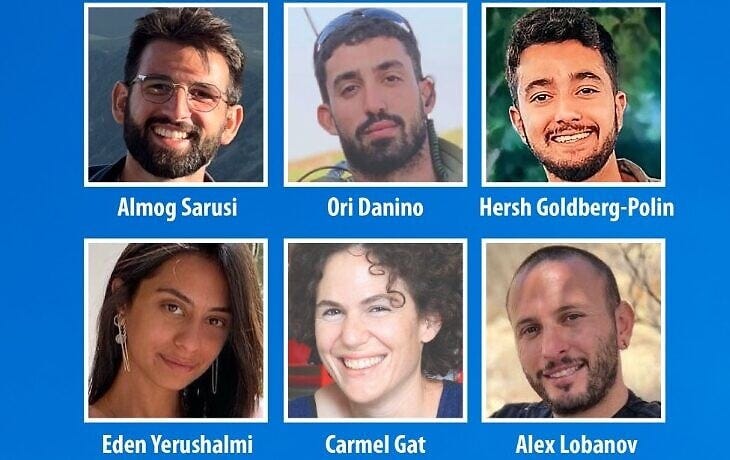
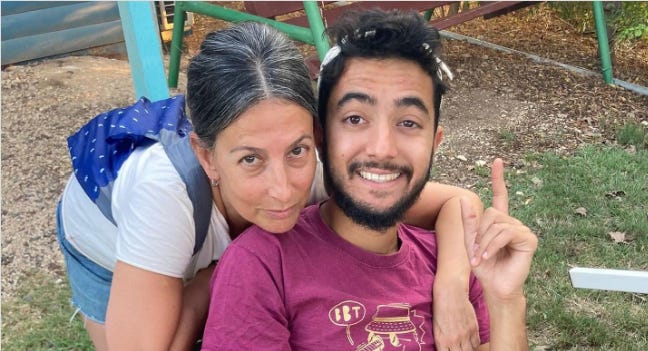
As we all now know, Rachel’s son Hersh was taken from the Nova festival on the morning of October 7, 2023. His left arm was blown off in the attack. He was murdered in Hamas captivity in late August 2024, in a tunnel beneath Rafah, alongside five other hostages. He was twenty-three. Part of the “Beautiful Six” - Hersh, Carmel Gat, Eden Yerushalmi, Ori Danino, Alexander Lobanov, Almog Sarusi. For all those days, Rachel wore a strip of masking tape across her chest with a number on it. Each day the number rose by one. Each day it was a count of how long her son had been gone. She started doing it so people would stop asking her how long it’s been.
The book moves between different times. Rachel calls the first The Before. Inside The Before, she could think about other things. She loved her children, she loved her husband Jon, but at work, at the gym, in line at the grocery store, there were stretches when she was simply doing the thing in front of her. After October 7 - The After - that ability was gone. After the cruel hours from August 31st to September 1st, when Hersh’s body was recovered, it wasn’t just gone but broken. There is not one second she and Jon are not thinking of him. She has a name for the condition: Hershsickness.
Near the middle of the book, she writes about how she gets through each day. I read the page perhaps ten times. I don’t understand it and don’t think I am meant to. She describes herself as a tightrope walker. Arms wide for balance. Eyes forward, neither down nor up. Blocking out the cars and the people and the static and the glare of the sun. She is trying, she says, to get through the day. The hour. The minute. The second.
And then this. “I want to believe that whatever I have to do, I will master the ability to figure it out. But I have to keep walking even if its just only millimeter by millimeter. I think just being stuck in the molasses and not moving will choke me.” (p. 122)
The first time I read that line, I took it as a line about endurance. The second time, I noticed what she doesn’t say. She doesn’t say she has hope. She doesn’t say she’ll get through it. She doesn’t say time heals, or that she'll be okay, or that any of it means anything. She says only that stillness will choke her. So she moves. Not toward anything. Just away from being choked.
This is not coping, per se. Coping assumes a future self who has integrated the loss and walked back into her life. Rachel does not write like someone reaching for that future. It’s too soon. She writes like someone who has discovered that motion itself, at any speed, even infinitesimal, is what the body has when nothing else is left.
Jewish mourning is built on a prescription of motion. Shiva for seven days, and then you get up; then shloshim; then the year, the yahrzeit. We sit, then we stand, then we walk back into the world. The structures assume a body that finishes grieving and walks into life with its grief tucked inside it. But what Rachel describes in her book is not in that structure. She’s in the one she is inventing, with no religious scaffold telling her how long. There is no end in sight. The loss doesn’t stop being a loss. Hersh does not slowly become someone she used to know. He is, every second, the boy she is missing. Her first of three children.
My grandmother Fay would have turned a hundred today - May 8. She died in 2019 at ninety-two, full of years. Children. Grandchildren. A great-granddaughter. A life that gathered into something a family could hold. Hersh got twenty-three. The two numbers don’t make a sentence together. They sit beside each other on the page and refuse to resolve. 92 vs. 23. A long life lets you mourn the way the tradition asks. A short one is what the tradition breaks against. I am thinking of both of them today. The thoughts are different weights.
I would also be remiss if I did not mention that one of my grandmother’s now nine great-grandchildren has a Hebrew name Hersh, named after this very one. Just one more way that a memory lives on.
Rachel quotes Rabbi Joseph Soloveitchik in the book. Writing a decade after the Holocaust, Soloveitchik asks what obligation suffering imposes on a person. His answer is severe. “The sufferer commits a grave sin if he allows his troubles to go to waste and remain without meaning or purpose…From out of its midst the sufferer must arise ennobled and refined.” (p. 265) She contrasts this with a similar sentiment from Rabbi Jonathan Sacks, who said that the real test of society is “whether we come out of "[suffering] cynical and disillusioned, or strengthened by our rededication to high ideals.”
This is heavier than the therapeutic frame, not lighter. Soloveitchik isn’t promising healing. He is saying you owe something to your suffering. You owe it the labour of not letting it be wasted.
At first, this seems to argue against the millimeter. The millimeter is not elevation. Moving that millimeter each day is simply about trying not to choke. But notice what Rachel has done: her book is the parcel. Her book is what has emerged from the midst. Whether or not she’d ever use Soloveitchik’s words about herself, she has done what he asked. She has refused to let the suffering go to waste. She has shaped it into something and handed it to us, to be read in an evening.
Perhaps the millimeter and the demand are the same thing seen from different angles. Soloveitchik names what suffering owes. The millimeter is what paying the debt looks like from inside the body. It doesn’t feel like elevation or ennoblement when you’re doing it. It just feels like walking.
Which brings us to the question of what we are doing when we read her.
There’s a default posture toward books like this, even sympathetic ones. We extract. We mine the grief for insight, take the lesson, set the book down, and feel that we have done something by reading. We cry afterwards. I certainly did. It was actually Jon Polin’s epilogue that pushed me over the edge, as he recalled now having to sit alone in shul, his son’s head no longer on his shoulder or under his tallit when they bless the Kohanim. That is consumption, not carrying. Rachel asked for carrying.

To carry is to let the reading change the day. To let the passage about the millimeter return on the subway, in line at the grocery store, the moment you are tempted to feel sorry for yourself about something small that doesn’t actually matter, the moment you’re tempted not to do the small disciplined thing in front of you. To carry is to take Hersh’s name with you. To say it.
Hersh Goldberg-Polin.
Carmel Gat.
Eden Yerushalmi.
Ori Danino.
Alexander Lobanov.
Almog Sarusi.
All the hostages who were murdered and did not come home.
All our soldiers lost in battle, fighting for our lives.
To remember that Hersh was twenty-three, and that his mother is walking the millimeter, the matriarch of a family of four no longer five, and that the book in your hands is a parcel she’s asked you to hold.
Here’s the Catch
The book doesn’t teach you how to grieve. It’s not about your grief. It teaches you what walking looks like when walking is the only thing left. Rachel parcelled out what she could not carry alone, and asked us to help.
Reading her is how the parcel arrives. It’s how her suffering doesn’t go to waste. It’s how Hersh, twenty-three years old, taken from Nova, killed in a tunnel beneath Gaza, becomes a name we will never let go.
Take the parcel. Walk the millimeter she handed you. That is what the book is for.
May Hersh’s memory be a revolution.
Shabbat shalom.
I’m buying her book today. What a remarkable woman! My guess is she was always remarkable. I am so impressed and grateful that she continues to share her words with us!
Thank you for putting into words my thoughts and feelings while reading Rachel's words...which feel as holy as a prayer book.