
The Sword and the Scroll
Our privilege as Jews

I recently finished reading Jews vs. Rome. The author, Barry Strauss, walks the reader through roughly two centuries of Jewish revolt against the Roman Empire, from the first uprising that erupted in 63BCE to Bar Kokhba’s last stand around 135. It is full of names most of us have only half heard: Simon son of Giora and John of Giscala, the rival rebel commanders who held Jerusalem against the legions, and Bar Kokhba himself, the messianic and barbaric warlord of the final revolt. Cities lost, walls breached, the Second Temple burned to ash in the year 70CE and its treasures hauled off to Rome as someone else’s trophy.
And then, in the epilogue, Strauss tells you what the whole bloody story was for.

Prevailing losers
The Jews of ancient Israel lost battle after battle, and yet Strauss calls them one of history’s great examples of a people who can lose on the field and still prevail. Lose and prevail. Not lose and endure, which would be sad, and not lose and recover, which would be lucky. Prevail. We were the people who learned how to be defeated and go on being ourselves anyway, and that, it turns out, is a rarer skill than winning.
A thing that has outlasted Rome isn’t necessarily fragile
The strategy behind it was almost reckless. Once the Temple was gone and the revolts crushed, the surviving rabbis made a bet that Strauss clearly admires: that a people could outlast its conquerors on spiritual armour rather than the metal kind. They traded the Temple for the study house or synagogue, the sword for the book. No army, no fortress, no king. Just text, memory, and the stubborn refusal to dissolve into whoever happened to be ruling. It was a wild thing to wager a nation and a future on, but it worked. Two thousand years later the culture is, in Strauss’s words, remarkably similar to what it was under Rome, which is to say we are still arguing about the same passages and lighting the same lights.
We aren’t fragile
I read this passage several times because so much of what I write circles that watchtower. The fatigue. The vigilance. The sense of standing guard over something fragile. But consider that a thing that has outlasted Rome isn’t necessarily fragile. We the Jewish people have buried more empires than most peoples have ever met. Rome is a ruin you pay to walk through, snapping pictures of Roman soldiers carrying the Menorah on the Arch of Titus on the way out of the Forum. But we are the ones still walking.
Strauss is too honest to leave it there, and I love him for it. Spiritual armour kept the soul intact, he says, but it left a great many bodies unprotected, and he doesn’t pretend otherwise: a straight line from antiquity to the Crusades to the pogroms to the Holocaust. The spirit is the most important thing, he writes, but it is not the only thing. A people needs a sword too. And a strategy for how to hold it.
Causeless hatred
Then there’s this: the Jewish rebels who fought Rome were a remarkable generation, capable of the best and the worst in the national character. Brave, swift, deadly. Also factionalized, also poisoned by what the Talmud calls sinat chinam, causeless hatred of one another. They had troops to train and walls to build and Romans to ambush, and instead they spent their last good years fighting each other inside a city that was about to fall. Strauss calls it military and political malpractice. The Jews of Jerusalem had everything they needed to make Rome bleed. The one thing they could not manage was each other.
I read that passage and winced, because it’s not only ancient history. Need proof? Just look around at our own community. But the uplifting reading is right there if you reach for it. The thing the ancients could not do is the thing now in front of us. They had the sword and lacked the unity. We have, mostly, the unity that survival forces on a people, and now, for the first time in two thousand years, we have the sword back too.
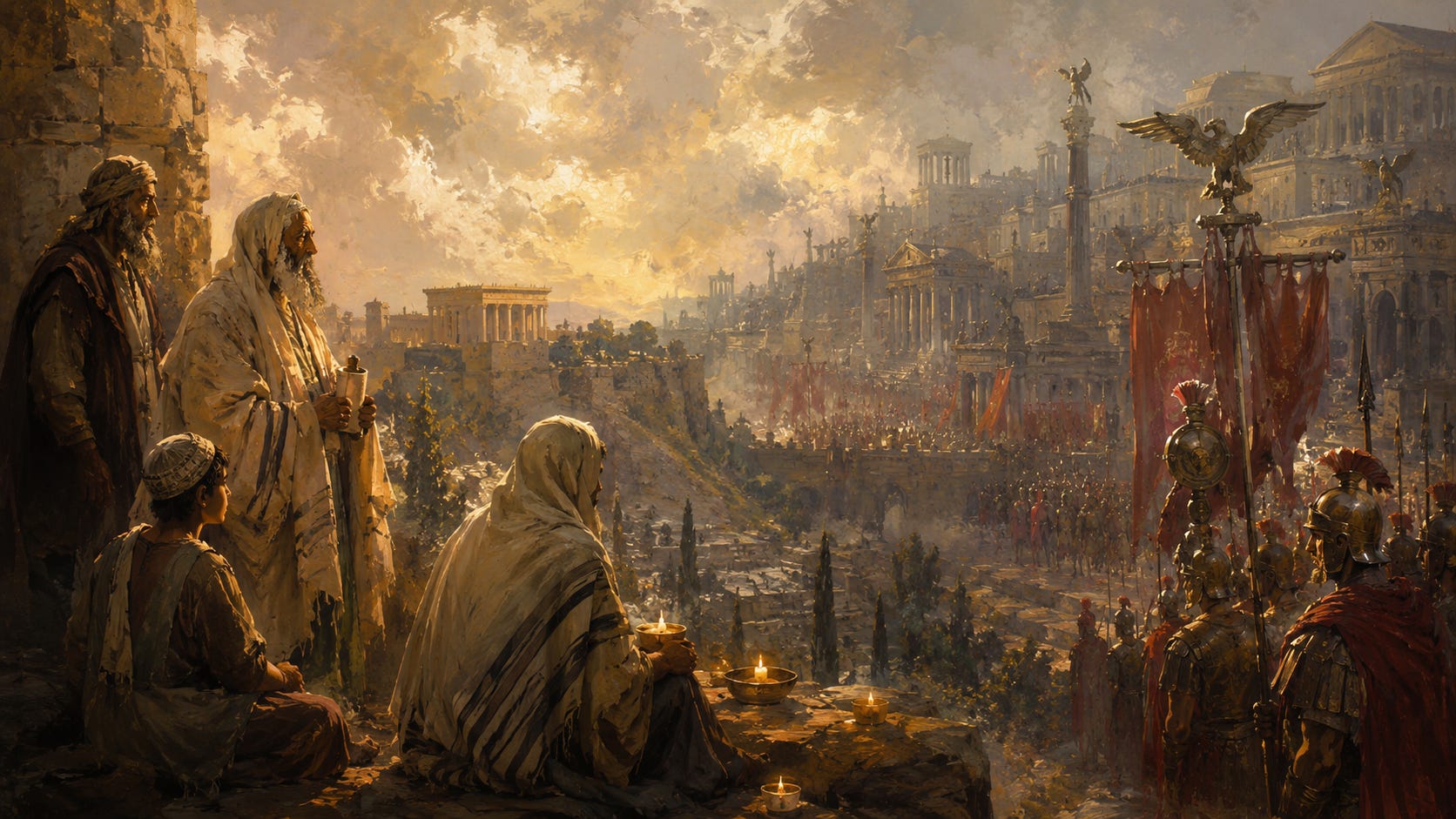
Our return
That’s the miracle Strauss - an historian - saves for the end. He tells the story of a gold medallion dug up near the southern wall of the Temple Mount in 2013, a menorah at its centre, buried with a small hoard of coins around 614CE by someone who meant to come back for it. It took almost exactly fourteen hundred years for anyone to lift it out of the ground. Fourteen hundred years is a long time to keep a promise to the soil. But that’s the whole of us in one object. We are the people who bury the Menorah and trust that someone, someday, will be standing in Jerusalem to find it. And now someone is.
Strauss closes on the oldest vow we have, the psalmist swearing that if he forgets Jerusalem, let his right hand forget its skill. For most of Jewish history that was a love letter to a place we couldn’t reach. Today it’s an address. One that requires a bus pass, a rental car, or an airline ticket to reach in minutes or days.
This week the point makes itself. On June 7 we marked fifty-nine years since Israeli paratroopers fought their way through the stone alleys of the Old City and reached the Western Wall, and a brigade commander named Motta Gur radioed back the three Hebrew words that still give me goosebumps: “Har HaBayit BeYadenu! The Temple Mount is in our hands!” It was one more battle for the walls of Jerusalem, in a line that stretches back two thousand years, except this time, when the smoke cleared, the Jews were the ones left holding the city. Strauss calls the ancient revolts glorious failures. The fight for Jerusalem in 1967 was that same heroism with the ending rewritten. And the gold medallion was pulled from the earth beside the southern wall of that very mount, buried by someone who could never have let themselves dream that the soldiers who would one day take the city back would be speaking Hebrew.
The return that Simon son of Giora and Bar Kokhba died reaching for, that the rebels squandered on faction, that the rabbis preserved without ever expecting to see, has actually happened, and we are the generation alive inside the answer.
Our privilege
So here is what being Jewish today is, on a good day, when I’m not writing about being vigilant, stubborn, or disappointed. It is being a living link in the most durable thing human beings have ever built, a chain that ran through fire it had no business surviving and kept its shape. It is holding both hands open at last: the scroll that carried us when we had nothing else, and the sword we were not allowed to carry for far too long. The trick now, the only trick that was ever the point, is to wield the one with the wisdom of the other.
Strauss said it best by pointing at Homer. For weapons you go to Odysseus, the warrior who is cunning enough to find his way home. For wisdom you go to the rabbis. The question was never whether to hold the sword. It was always how to hold it without becoming the thing we fought. We are, finally, the people who get to answer that. What a privilege, to be born into the chapter that gets to try.
Here’s the Catch
A people can lose every war and still win the long argument, and we are the proof of it. Strauss’s history lands on three things worth carrying around: that we survived on spirit when we had nothing else, that our worst defeats came not from Rome but from turning on each other, and that the return our ancestors swore to and never saw is the ordinary fact of our lives now. The ancients had the sword without the unity. We have a second chance at both. Being Jewish today is not only standing guard over something fragile. It is getting to be the living link in something that has outlasted every empire that tried to end it, holding the scroll in one hand and the sword in the other, and being asked to be wise enough to carry them together.