
We’ve Given Everything
Now We Have the Right to Ask

I know not everyone will agree with the content of this post. This has been one of the hardest articles I’ve written over the last two years. Understand that this comes from a place of love: for the community, for our people, and a deep and abiding love for Israel and Zionism.
If you disagree, please let me know why in the comments. Don’t simply unsubscribe. I’d love to hear from you.
For two years, the Jewish people outside Israel have done something extraordinary. We have stood with Israel - not as spectators, not as donors, but as family.
We’ve written the cheques. We’ve flown on solidarity missions. We’ve buried our dead. We’ve taken the hate on the streets, in our universities, in our workplaces. We’ve lost friends and clients. We’ve watched our children be harassed in classrooms. We’ve wept tears of joy and sorrow. And through it all, we said the same thing: Am Yisrael Chai! The nation of Israel lives!
And we meant it. We mean it. We always will.
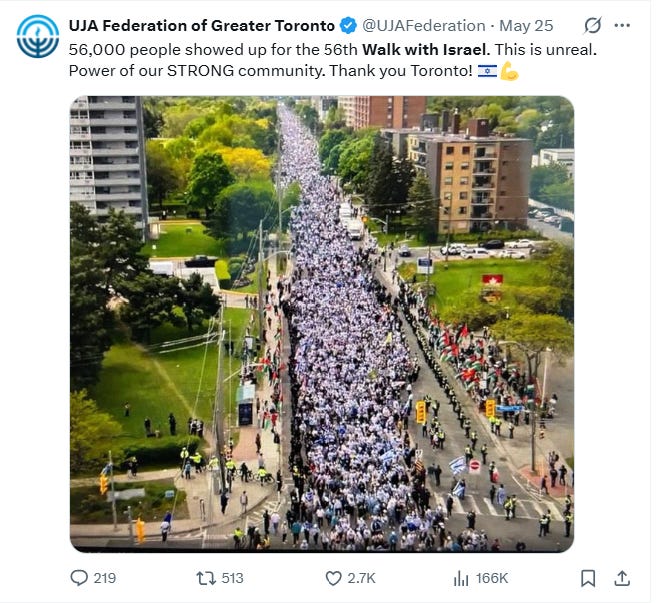
Since October 7, 2023, Diaspora Jews have mobilized in ways unseen in modern memory. Hundreds of millions of dollars have flowed from Toronto, New York, London, and Melbourne into hospitals, recovery centres, displaced families, trauma programmes, and security infrastructure in Israel. Rabbis have turned their pulpits into rally podiums. Business owners have risked reputations to stand up publicly for Israel. University students have fought back against mobs, risking their educational and career opportunities, all in support of the Zionist project.
True, we have not fought bravely on the battlefields of Gaza or Lebanon, in the sea abutting Yemen or in the air above Iran, (though many of our sons and daughters have traveled to Israel to do just that) but the Diaspora has bled with Israel - emotionally, politically, and in some ways physically.
We have done what a scattered people do when their brothers and sisters are under attack: we show up.
With that, I submit, we have earned the right to ask something back.
Israel must now meet the moment, too.
I respectfully request from Israel a change. Not a thank-you note or photo-op, but something tangible. The Diaspora has proven that loyalty is not conditional on convenience. But loyalty does not mean silence. And I ask this only because I have no doubt that Israel can walk and chew gum at the same time. It can defend the homeland and listen to requests from abroad.
Israel has always been a country that multitasks like it’s a competitive sport. In 1949, it wrapped up a war, absorbed waves of shattered refugees, printed its first passports, and declared itself a functioning state. In the 1960s, it squared off against existential threats while building universities, draining swamps, inventing drip irrigation, and arguing about everything under the sun, all at once. In the 1990s, it fought terror, welcomed a million new immigrants from the former Soviet Union, launched a tech revolution, and tried - heroically, naively, pick your adjective - to negotiate peace. And now in 2025, with the war largely behind it, the country’s to-do list hasn’t gotten shorter. It’s time to rebuild, rethink, and remind the world that Israel doesn’t wait for perfect conditions. It just gets on with the work. As former MK Einat Wilf recently discussed on the Boundless Insights podcast, Israel must go from an exile mentality to a sovereignty mentality. Temporary to permanent.
Here’s where I think that begins vis-a-vis its relationship with the Diaspora, with 10 simple asks.
1. A new election. Immediately.
It’s time. Israelis know it, the world knows it, and Diaspora Jews know it. The current government, cobbled together in fear and cynicism, does not reflect the will or the moral standing of the Jewish people. It has failed to deliver safety and unity. Tragically, it is mired in division at a time when we need clarity and cohesion.
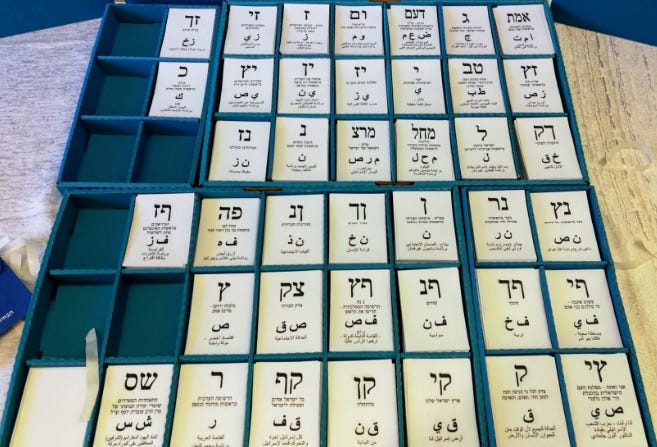
The unity war cabinet that briefly gave Israelis hope dissolved into bickering and blame. The country’s leadership has turned survival into a slogan and accountability into an afterthought. This is not to opine on the way this war was fought - frankly, I believe that any Prime Minister in Netanyahu’s shoes would have fought the exact same war - but it is now time to ask, “What’s next?”
Diaspora Jews cannot vote, but we can speak. And we should. Israel needs a reset. It needs an election not because we want chaos, but because we crave legitimacy.
A newly elected government won’t fix everything overnight, but it will reintroduce trust, and trust is what keeps nations alive, and democracies thriving, when enemies try to break them.
2. Ben-Gvir and Smotrich must go.
We’ve had enough of these pathetic men staining the Jewish name. Itamar Ben-Gvir and Betzalel Smotrich are not defenders of Israel but rather pyromaniacs playing with the matches of our collective morality. Their racism, their incitement, their incompetence, their deliberate attempts to sow division among Jews and between Jews and the world - these have cost Israel dearly.
When our children on college campuses are accused of supporting “apartheid,” these are the faces the haters point to. When Israel’s friends in Western capitals grow uncomfortable defending her, theirs are the quotes they cite. When Western countries are brazen enough to even try to sanction Israeli individuals, they are at the top of the list.
Itamar Ben Gvir has been the Minister of National Security since 2022. How he was not immediately fired before the sun set on October 7, 2023 is beyond me. The fact that he remains today, two years later, is a travesty. Each day, he proves anew that he is not up to the task of being a representative of the Jewish State.
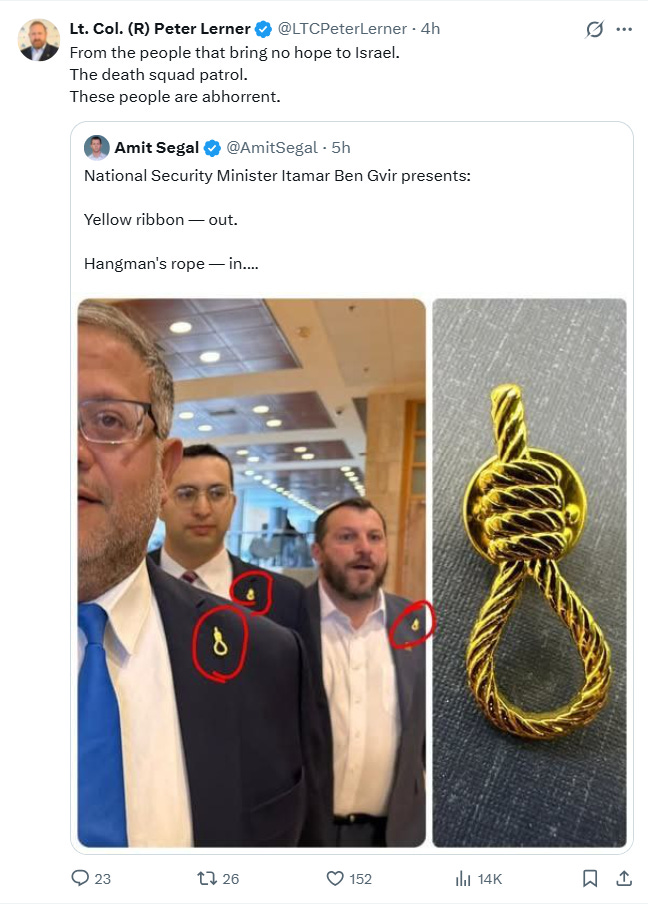
It is not left-wing to demand their dismissal from the Cabinet; it is Jewish. It is Zionist. It is the difference between defending Israel’s right to exist and defending those who degrade Israel from within.
We have sacrificed our peace of mind to defend Israel from lies. It is not too much to ask Israel to now take certain, difficult steps, that should in the grand-scheme of things be relatively low-hanging fruit.
3. A permanent Diaspora committee in the Knesset.
We are stakeholders in the Jewish future, and that future is not bounded by the Mediterranean. But we do not yet have a voice in the conversations that shape Jewish destiny. Often, we are told that because we do not fight in Israel’s wars or sacrifice our children on the battlefields, that we do not have that say. But I dare say the battlefield has expanded, and we are, in fact, fighting on another front, yes, less deadly, but nevertheless important.
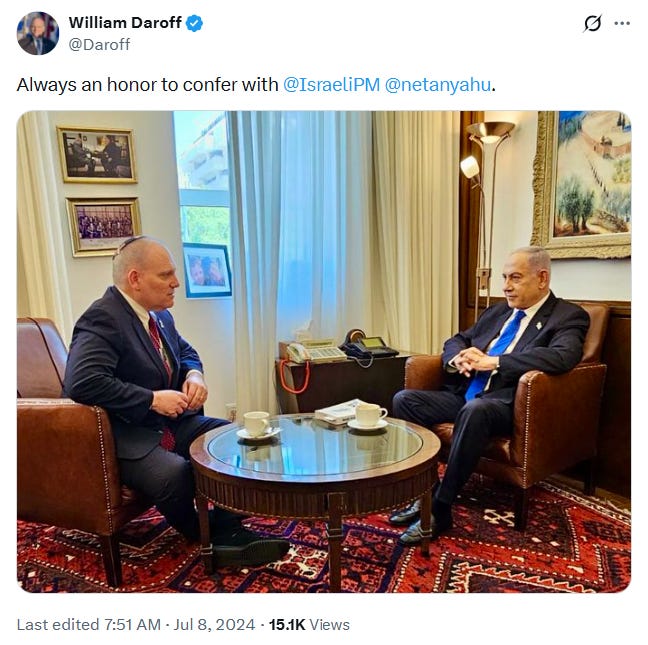
It is time for a formal, institutionalized mechanism - a standing committee of the Knesset, composed of elected Diaspora representatives - to sit at the table when issues of Jewish identity, conversion, the Law of Return, and global antisemitism - especially antisemitism and antizionism - are debated. It can sit alongside or be incorporated somehow into the already-existing Committee for Immigration, Absorption, and Diaspora Affairs.
Let me be clear: this is not about meddling in Israel’s sovereignty. It is about recognizing that the Jewish nation is global, and that Israel, as the nation-state of the Jewish people, cannot define itself in isolation from that people.
Israel can only speak for world Jewry when it listens to world Jewry. This is one surefire way to get that done.
4. Reform how Israel communicates with the world
If there has been one failure since Oct 8, 2023, it is that Israel has utterly failed to explain itself to the world. For years, it has relied on clumsy spokespeople, angry tweets, and tone-deaf talking points (except for Jonathan Conricus from the IDF - he’s phenomenal). The result is that Israel’s enemies now wholly own the narrative, and the Diaspora has been left to fight a propaganda war we didn’t start and shouldn’t have to fight alone.
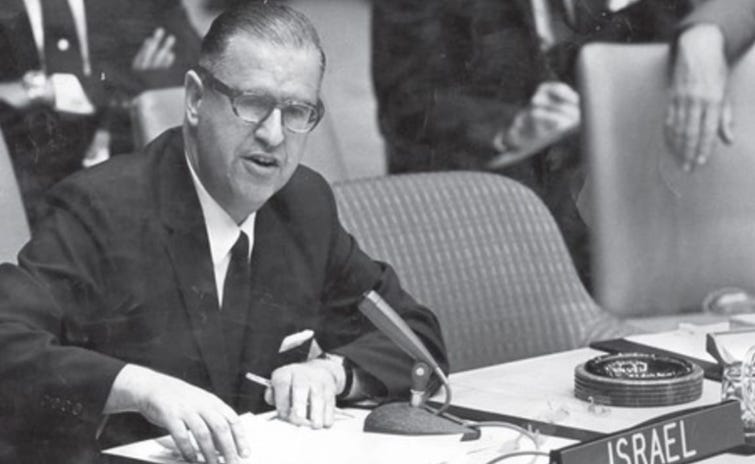
Israel and its government needs a serious, credible, English-speaking communicator - not a political hack, but someone with stature and moral authority. A modern Abba Eban meets Mark Regev meets Eylon Levy meets Jonathan Conricus who can speak calmly, fluently, and persuasively to the world’s media, universities, and parliaments. Someone who understands that explaining Israel is not a defensive act, but a moral one.
If Israel can build world-class technology, it can build a world-class communications strategy. Right now, it has memes where it needs messages. The truth is on Israel’s side but unless it finds someone who can actually tell it, the world will keep listening to everyone else’s lies.
5. Reclaim Jewish unity from political faction
Diaspora Jews are exhausted by watching our sacred symbols dragged through partisan mud. The kippah, the flag, the IDF uniform - these are not the property of one ideology.
We want Israel to rediscover the spirit of October 8: when the country came together not as right or left, but as Jews. When the only question was, “How can I help?” It is the sort of communitarianism that once existed in Israel when they were developing the national water carrier (listen to this recent Call Me Back podcast episode about that), or ways to absorb millions of new immigrants.
I submit the Diaspora has in many respects done a good job modelling that unity. In synagogues and community centres across the world, Jews of every denomination and political leaning stood together. We sang Hatikvah shoulder to shoulder with people we hadn’t spoken to in years. We rediscovered that Jewishness is not something you agree with but rather something you belong to.
Israeli civil society also modelled that behaviour. When the government didn’t show up, they did for one another. I heard Israelis say that in the days following October 7, they felt they did not have a mother or father, but they had plenty of brothers and sisters. But now the state needs to step up, put politics aside, and rediscover its raison d’etre.
We want Israel to build a unity coalition that doesn’t just manage a war, but builds a nation in heart and soul.
6. Elevate ethics and compassion again
Jewish power was never meant to replace Jewish conscience. The Torah commands strength tempered by mercy. The Diaspora has defended Israel’s military necessity on every stage imaginable, but we also know that moral clarity is our most powerful weapon.
When Israel shows restraint, it doesn’t show weakness. It shows who we are.
We want to see a government that invests as much in social healing as it does in deterrence. A country that treats its foreign workers, refugees, and internal minorities not as threats, but as tests of character. This is not some inane call for “tikkun olam” - we are well past that. It goes more to the innate character of the moment, and of ensuring that a nation hardened by two years of war is still focused on what must be important in the long-run.
If Israel is to remain a light unto the nations, it must start by being a light unto itself.
7. A “Birthright 2.0” for Israelis
For 25 years, Diaspora Jews have sent their young people to Israel to discover their identity. It’s time to reverse it: Reverthright™? There are plenty of Israeli-philanthropic dollars available. Every young Israeli - soldier, student, or entrepreneur - should spend a few weeks in Jewish communities abroad. Let them see how their cousins live, fight, and pray without a Jewish majority around them.

If we want Israelis to understand the global Jewish reality, they need to experience not just what makes our communities remarkable, but also the vulnerability we live with each day.
8. Create a Global Jewish Resilience Fund
Every time there’s a war or wave of antisemitism, we scramble to fundraise. Enough of the panic. Israel and major Diaspora Federations should jointly create a permanent Jewish Resilience Fund, a standing pool for crisis response, security infrastructure, trauma care, and educational defence.
We’ve proven we can mobilize. We know the fight’s not over. Now we should institutionalize it together.
9. Reconnect with the Jewish story, not just the Jewish state.
Stop treating Zionism as a political campaign. It is a covenant.
The Diaspora has kept Jewish culture, learning, and identity alive in exile for two millennia. We have raised generations who pray for Israel’s peace even when it costs them socially and professionally. But Israel must meet us halfway by nurturing the spirit of Jewish purpose that makes the state more than just another nation.
Invest in Jewish education, in Hebrew literacy abroad, in exchanges that go both ways. Please stop the quiet condescension toward Diaspora life. We are not “lesser” Jews; we are your mirror, your partners, your proof that the Jewish story did not and does not end at a border. For those who wish to respond to this by simply saying: You don’t like the Diaspora? Make aliya then! I say: aliya is just not an option for everyone, and a vibrant Diaspora helps a prosperous Israel.
10. A national remembrance for October 7 that includes Diaspora victims
Dozens of Jews from the Diaspora were murdered on October 7 or have fought and died since, in Israel’s defence and honour. The official day of remembrance should honour all of them as one family.
This includes, for example, Paul Kessler, who died in California in November 2023 after an altercation with a keffiyeh-clad thug; Karen Diamond, who died from injuries sustained during a molotov-cocktail attack in Boulder, Colorado, in June 2025; and Adrian Daulby and Melvin Cravitz who were killed on October 2, 2025 during the Yom Kippur attack at their synagogue in Manchester, UK.
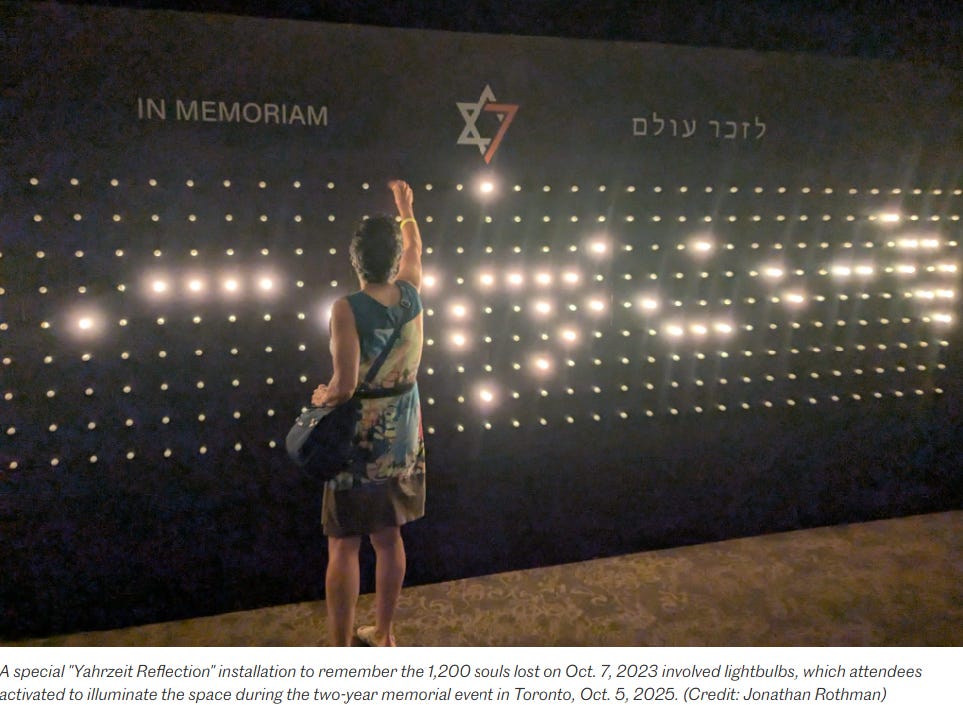
Their sacrifice is not secondary. It’s proof that “never again” isn’t a slogan but a covenant that transcends citizenship.
The Next Covenant
The relationship between Israel and the Diaspora has always been complicated: part romance, part argument, part destiny. For two years, that relationship has been tested in fire. The Diaspora has held firm. There was never any doubt we would.
Now, we have something to ask of Israel.
We will never stop defending her. But love without honesty is idolatry. And Israel was never meant to be worshipped; it was meant to be built.
We have built it with our hands, our money, and our hearts. Now we ask, with love and pride: build it better, with everything both you, and we, can offer.
Great article Adam. A stronger bond between Israel and the diaspora is essential. Both communities bolster each others.
I'd like to point out that expecting Israel to somehow make its center-right disappear is as realistic as Israelis asking the diaspora to make the antizionist "Jews for the genocide of Israeli Jews" disappear. There are Canadian and American Jews who either politically or actively assist Hamas in their goal of destroying Israel and executing an ethnic cleansing of Israeli Jews from their homes.
You find the Israeli far-right loathsome, and so do most Israelis. But antizionist Jews are another level of loathsome traitors and terrorism supporters. Neither will be going away, and you should be aware of the problems that occur in a parliamentary democracy. Canada is where the Jew-hating NDP was part a governing coalition and where Toronto has an antisemitic mayor. The reason we had an increase of a far-right in Israel, and the ascent of the center-right is because the Palestinians murdered the Israeli left at the same time they murdered a thousand Israelis and wounded thousands more in the 137 suicide bombings of the Second Intifada. The Israeli left, which I was part of, promised that giving up land to the Palestinians will bring peace. Instead, it brought more and more intense terrorism. It was very odd to discover that the Israeli center-right were correct assessing the existential threat in believing the Palestinians. And the Palestinians proved the Likud right.
Besides that, please don't compare diaspora Jews finding out that their progressive friends aren't their allies, but rather active Jew-hatrers, to the 815 Israeli civilians murdered, 200+ abducted and tortured, 960 Israeli security service members killed, and over 22,000 wounded civilians and security service members. The impact of this war is massively more significant in Israel. We in the diaspora have just woken up from the delusion that we had a place in the progressive left, and found out that they're old-school Jew-hating freaks. So it goes in Jewish history.
Thanks for daring to plunge into the middle of this difficult subject. You've framed the issues in a way that allows for ongoing conversations based on respect. That alone is a significant step forward.