
When Dirty Laundry Needs Sunlight
The case for airing the family fights when the stakes are this high.


Growing up in Jewish communal life, we learned a simple rule: we don’t air our dirty laundry in public. Showing any cracks in the armour, we learned, would make our community weaker in the face of increasing opposition. Although we teach our children that debate is at the heart of Rabbinic Judaism, many of our community’s leaders have historically felt that shining light on differences of opinion within our community would strengthen those who wish to see us fail. We often try not to show any division or infighting in our community to the outside world.
Although Israel itself is a vibrant democracy with (too) many political parties, there is a strong view that public criticism of Israeli government policies from within our own community is at best, unhelpful, and at worst, ammunition for anti-Zionist and anti-Israel forces.
Although it is in the best interest of our community to have Jewish and Zionist voices in different political parties, Jewish Liberals, for example, recently often feel ostracized from mainstream Jewish community.
Some Jewish day schools and camps teach our children to hug and wrestle with modern day Israel, and some institutions have been less tolerant of that criticism being aired in any public forum.
In many parts of our community, anything other than full-throated support for Israel’s current government policies is seen as treasonous. Same goes for any criticism of positions advanced by provincial or federal Conservatives.
Yet, recently, it seems like the rules are changing. More grassroots groups within our community have begun to organize and vocally question whether our community is prepared to weather the storm ahead of us. And perhaps, post October 7, there is even a willingness to allow for some more open debate among supporters of Israel over the future of Israel.
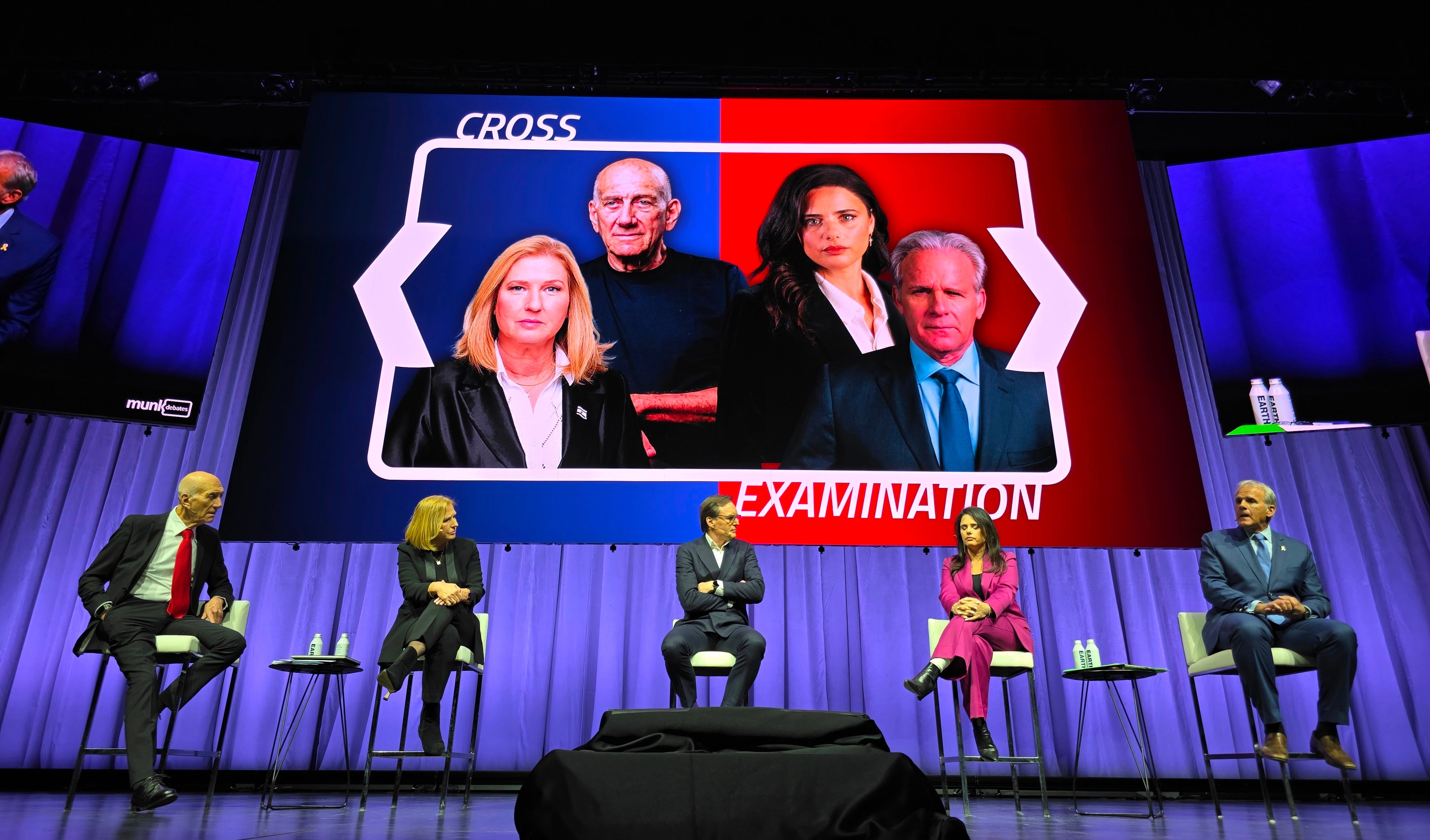
Wednesday night’s Munk Debate on the resolution, “It is in Israel’s national interest to support a two state solution,” is evidence of an important shift within our own community’s dialogue.
The moment the lights dimmed and the speakers walked out, the whole place felt charged. Not with hostility, but with something far more interesting. Curiosity. Nerves. A little fear. And a lot of hope.
Wednesday night was a therapy session for supporters of Israel. Israeli political royalty from opposing camps travelled to Toronto and showed 3,000 supporters of Israel that it is acceptable to disagree in an open forum. Supporters of Israel can both be dedicated to Israel’s future and openly disagree over the path to get there.
What struck us most was not the clash of views, though there was plenty of that. Or Ehud Olmert’s finger pointing in his tight suit, Tzipi Livni’s incredulity, Michael Oren’s professorial (and winning) presentation, or Ayelet Shaked’s…gosh I’m not sure…pink suit? It was the fact that 3,000 people showed up ready to be a little uncomfortable. 3,000 people came knowing that they would hear something other than the full-throated support of Bibi Netanyahu. They showed up, knowing that they would hear things with which they disagreed.
Olmert and Livni argued that it objectively is in Israel’s national interest to support a two-state solution. They believe this because they believe in Israel, because they don’t want to control certain elements of Palestinian life ad infinitum, and because they want to look to the future focusing solely on Israel. To Oren and Shaked however, their opponents resided in a different reality: what imaginary Palestinian State was willing to live side-by-side with Israel? Who would govern such a state? How could they govern, with their history of turmoil, corruption, and deep-seated antisemitism?
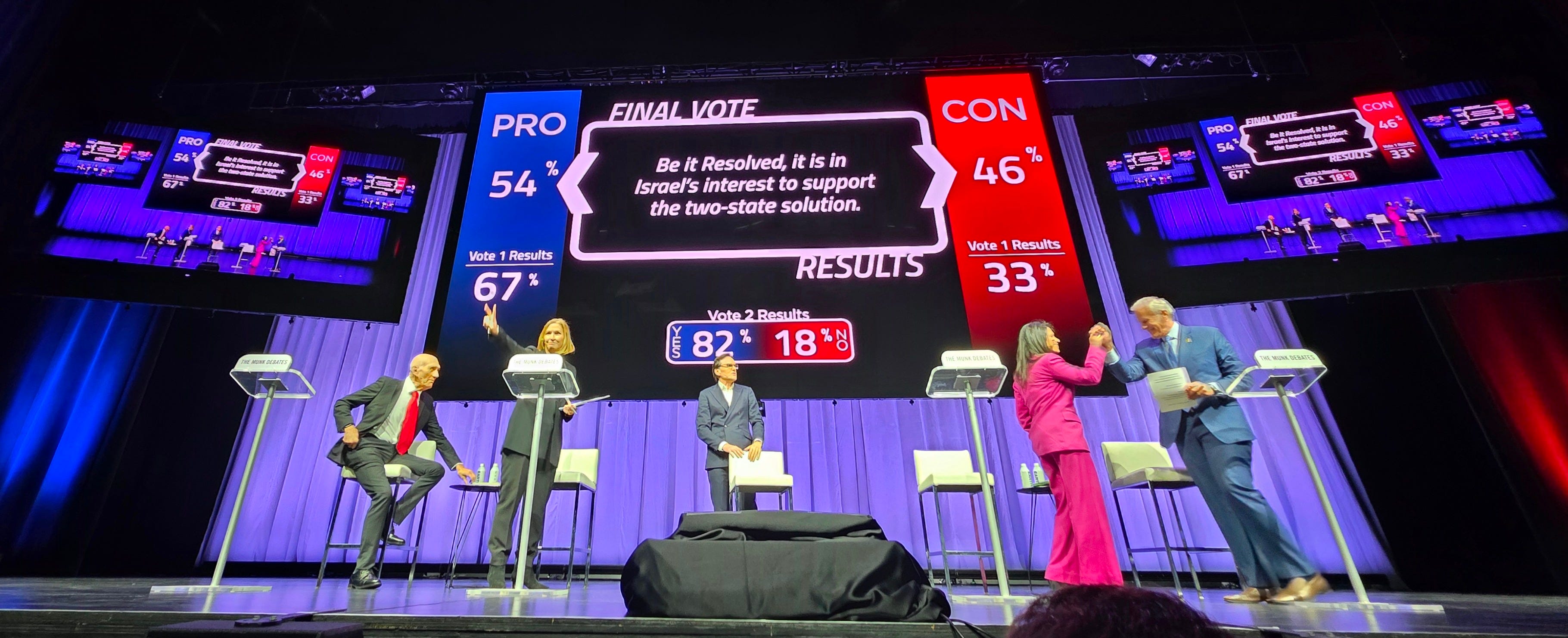
The debate organizers allowed the audience to vote on the resolution before the debate and after it ended.
At the beginning of the debate, the audience was split. 67% supported the resolution at the start and 33% opposed. By the end of the debate, Oren and Shaked managed to convince an additional 13% of the audience to come over to their side. 54% agreed with the resolution and 46% opposed.
The debate did not introduce any revolutionary ideas. In fact, those opposing the resolution simply argued whether or not a two-state solution was viable today rather than strictly arguing the resolution as it was drafted. Yet, perhaps, the new idea that leapt off that stage was that we could have the debate and survive as a strong united Zionist community.
When disagreement becomes taboo, people don’t become more unified. They become more brittle. They stop thinking, stop engaging, and start waiting to be told what opinion is safe. And the wider world stops taking us seriously, because grown communities that cannot argue are treated like children who cannot handle sharp objects.
And he sent
Which brings us to Vayishlach (it’s Friday, you knew that was coming…)
In this week’s parsha, Jacob prepares to meet Esau, after decades of estrangement. The last time they were together, Jacob fled for his life. Family conflict at its worst. History’s first terrible estate dispute. We, as estate litigators, of course read this story with intense interest.
And yet, their reunion involves no physical violence.
It is messy. Emotional. Painful. And ultimately human.
Jacob sends gifts. Esau runs to hug him. They cry. They negotiate boundaries. They do not magically merge their worldviews, but they find a way to stand together without pretending the past never happened. There is a kind of moral courage in that moment. A willingness to face conflict in the daylight, knowing it might hurt, and trusting that the relationship is strong enough to survive the truth.
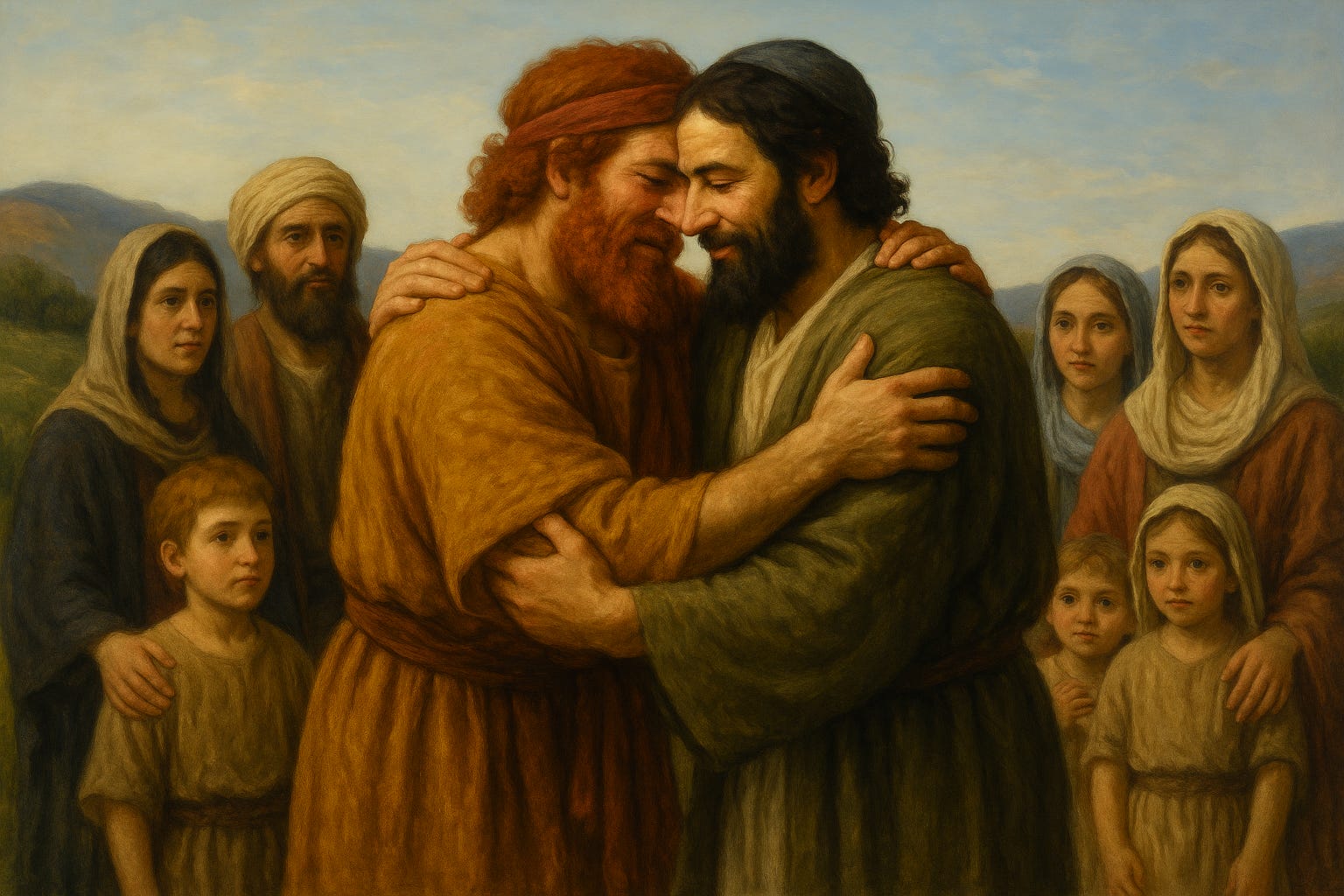
Maybe that is what our community is being pushed toward now. Or maybe that’s just a lesson we can take from Wednesday evening’s debate, especially after we saw Olmert, Livni, Shaked, and Oren speaking cordially after the debate was over.
We live in a moment where running from hard conversations simply invites others to define us. The enemies of Israel aren’t shy. They were loud and annoying on Wednesday night. The people comfortable with half-truths and full lies are certainly not shy. And in a strange twist, we are the only ones who have been shy. Sensible, serious, educated Jews who actually know the history, who care about facts, who believe in nuance, who want to wrestle with real policy ideas, who have important things to say about the future of our community and our people, sometimes stay home out of fear of not being accepted by their Zionist peers.
Many liberal Jews are attracted by anti-Zionist groups because they do not see a home for themselves in our community. Jews who disagree with Netanyahu’s government see no role for themselves in pro-Israel groups. That’s absurd.
Wednesday night’s debate felt like a small but important course correction. A signal that the community can host serious, open, even uncomfortable discussions and not fall apart. That we can argue about the hardest issues facing us without undermining our strength. That honest debate is not a threat to solidarity but one of its pillars.
When we discourage disagreement, other people and causes fill the vacuum. If our young people do not see a place for themselves in our conversations, they will engage with and fund other organizations and other conversations.
Debate is at the foundation of modern Rabbinic Judaism. Our entire tradition is built on generations of Rabbis debating and arguing until they get it right. Their students, then, re-debate and re-evaluate the application of those decisions in every subsequent generation. This has been the Jewish way since Talmudic times. Pages of arguments stacked on arguments. No fear that disagreement will break us.
In reality, our own unwillingness to allow healthy debate and different Zionist voices is the weakness in our armour. It is our adoption of a trend from the outside world that should not penetrate our community. That is the thing that makes us weak.
Jacob and Esau did not reconcile because they trusted each other. They reconciled because Jacob finally stopped running. He faced the uncomfortable conversation. He confronted the unknown instead of retreating from it.
Like Jacob, our post-October 7 community cannot afford to run from our own important conversations. We can’t afford to lose young people to other organizations and causes because they do not see a place for themselves in the conversation.
At a time when we need to reimagine our Jewish and Zionist community post-October 7, when we need Zionist voices in as many fora as possible, we must show our young people that is not only OK, but encouraged, to openly grapple with the issues facing our community and Israel.
Our community is strong enough to tolerate some fresh air (for those of us who waited in line before the debate, we enjoyed a little too much fresh air).
It is uncomfortable to openly criticize our own in front of strangers. Yet, it is time that our community lived with a little more discomfort. A multitude of Zionist voices will not weaken us. As Jacob and Esau and Rabbinic Judaism teaches us: open dialogue and respectful dialogue is the key to our success.
And maybe, like Jacob and Esau, we will find that meeting each other openly is what allows us to keep walking forward. Side by side when possible. On parallel paths when necessary. But always moving forward.
Shabbat shalom.
 | A guest post by
|
The debate was, as the kids say, “epic”. What continues to surprise me is that, when a couple of dozen useful idiots outside such an event make a lot of noise chanting “Free, free…”, the more numerous Jewish and pro-Israel attendees don’t spontaneously burst into a chorus of “Am Yisrael Chai”. I guess we’re supposed to ignore them but I’m tempted to match their tempo with “Kiss my Jewish Ass” 🎶 It fits perfectly.
Really excellent. Thanks you two.