
Within Them
On the cusp of a new war

This week, Israelis have been sealing windows and checking safe rooms. They are running through the old calculations - how many seconds between a siren and somewhere safe, depending on which direction the rockets come from?
War with Iran feels close. Not hypothetical anymore. Israelis are doing what they always do in moments like this: hoping for the best, preparing for the worst, and getting on with their lives in the particular way you do when the threat is real and constant and you have no other choice.
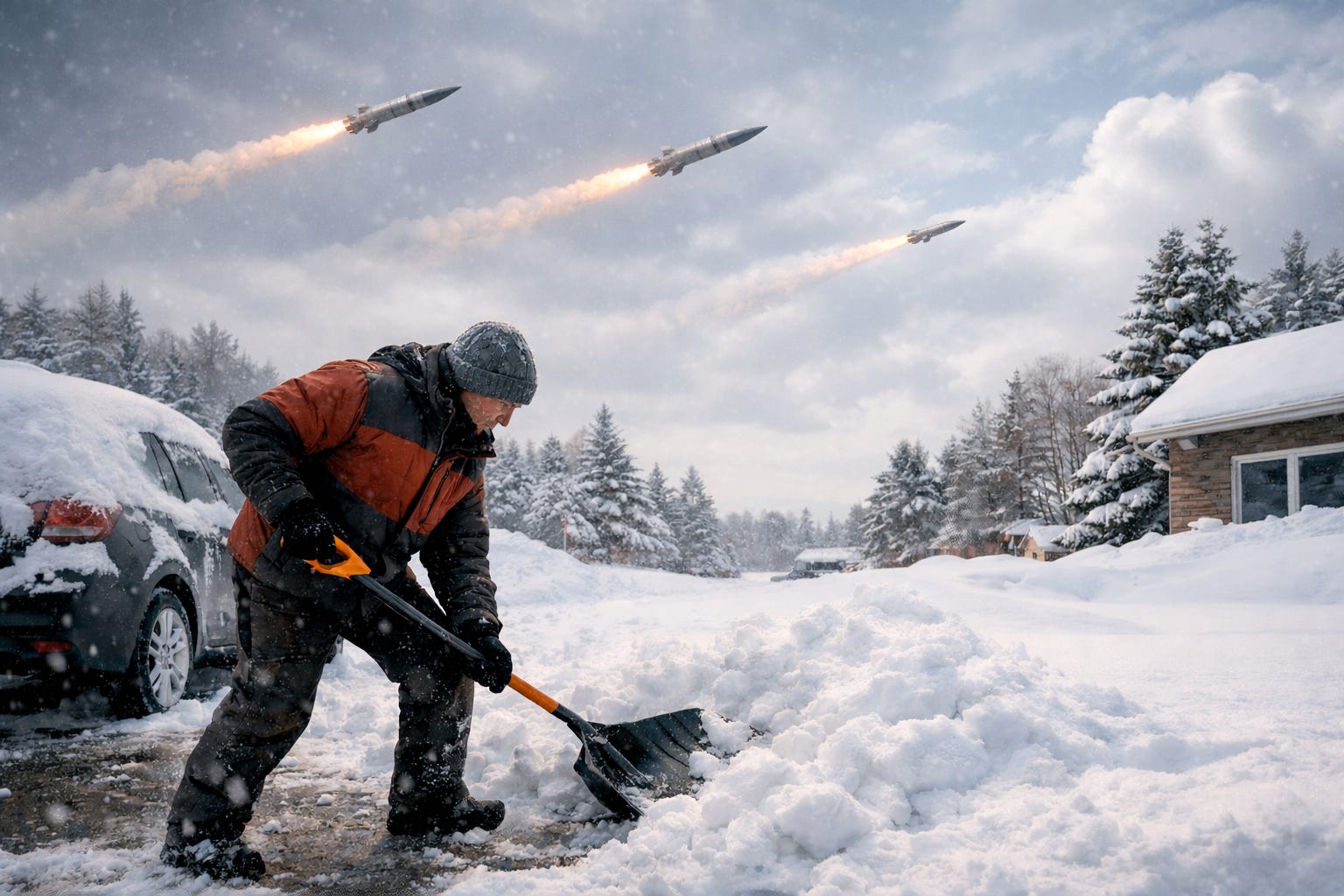
And here I am, shoveling the driveway. Again.
The yellow ribbons are put away. The hostage dog tags, the pins - those visible markers of solidarity that once felt essential to leave the house with. I kept a few and donated some for a community memorial. But somewhere in the ordinariness of this already long winter, they stopped being something I reached for every morning when the last hostage came home. Life now goes on. The world has, in many ways, largely moved on. The antisemitism is still there, but we’ve grimly adjusted to it as something almost permanent now. February in Toronto has its own particular weight, most of which has nothing to do with what is happening nine thousand kilometres away.
And yet I find myself, mid-shovel, thinking about rockets.
Terumah
This week’s parsha is Terumah (Hebrew for “gift” or “offering”). God instructs Moses to collect contributions from the Israelites - gold, silver, wool, wood, oil, spices - to build a Mishkan, a portable sanctuary they will carry through the desert. It will be used to house the Ark of the Covenant, and keep God’s presence protected and safe until a permanent structure can be built in the Promised Land.
And then God says the line that has stayed with me all week: v’shachanti b’tocham. I will dwell among them.
Not in it. Not above it. Among them. B’tocham - within them.
The rabbis always found this strange. Why among them and not in the building itself? The answer they keep returning to is that the Mishkan was never really the point. It wasn’t the building itself, but the act of building. The gold and the acacia wood were just the visible form of something that had no fixed address. God wasn’t describing a location. God was describing a condition - a state of being so woven into the people that it could not be separated from them. Wherever they went, in wilderness or in war, that presence went with them. Not visiting. Not watching from a distance. Inside.
I will not come to you. I already live within you.
Over There
I think that is also what it means to be a Diaspora Jew right now. Especially right now, in this very moment, today, with Israel teetering on the verge of war.
The easy version of this story is about distance and solidarity. Diaspora and Israel. We are here; they are there. We donate, we worry, we advocate, we carry on. There is a gap, and decency and our sense of responsibility asks us to try to bridge it. That is true, as far as it goes. But it is not the whole truth, and I don’t think it’s honest enough for this moment.
Because what I actually feel - standing on my driveway, sweating, arms sore from lifting snow, thinking about the safe rooms being prepared by my friends and family a world away - is not sympathy from afar. It is something closer to…residence.
Some part of me is already there, already inside it, already waiting for the siren. That’s not a figure of speech. It is the most accurate description I have of the experience.
We are b’tocham - within them. Our friends and family and people we will never meet. In their hearts and minds and bomb shelters and safe rooms and stairwells and parking structures if God forbid that’s where they need to be. In the cockpits of the airplanes flying sorties, in the navy destroyers and submarines, in the command centres, and at home, holding their kids’ hands, telling them that everything will be OK. And it will be OK. We are there not because we have chosen to be, or because solidarity demands it, but because that is what the Jewish people actually are to each other across every distance. One body. When part of it is in danger, the rest of it knows. The rest of it feels it.
Caspi
The iconic Israeli singer Matti Caspi died twelve days ago. He was seventy-six, and for fifty years his music lived inside the Israeli home the way very few artists’ music ever does - on the record player, at the Shabbat table, on long drives through the Galilee. In 1973, during the Yom Kippur War, he stood beside Leonard Cohen on a makeshift stage near the Suez Canal and played guitar for soldiers who were about to head into battle. Some of them he played for in the afternoon. By evening, he was helping carry them to helicopters.
One of his beloved songs, Brit Olam - Eternal Covenant - opens with a line that feels, this week, like it was written for something larger than a love song: a little more, and we become one body.
“Day after day and night,” the song goes. “On the same path, unmarked. Together and apart.”
That is us. That has always been us. The pins are put away, the winter is long, and we are both together and apart - shoveling our driveways, thinking about rockets, already within them.
That is where we have always been.
Am Yisrael Chai and Shabbat shalom.
That song is so incredibly beautiful, as is what you shared here. Shabbat Shalom to you too, from a non-Jew — keeping Israel and all her children in my prayers. 🙏🇮🇱❤️
שבת שלום