
All on One Wall
Part 2 of 2

In Part 1, I wrote about how support for Israel has become the load-bearing wall of Diaspora Jewish identity, and what that means when the wall comes under attack. The short version: it doesn’t land like a policy disagreement. It lands like an attack on the thing most of us have, at this point, instead of Judaism. If you missed it, start there.
This Part 2 was harder to write. It’s not about the attack on the wall. It’s about whether I would want the wall to do the whole job, even if no one were attacking it.
I wouldn’t, but let me explain why.
I’m a Zionist. Surprise! I think the case for the State of Israel is one of the most morally serious cases a people has ever made, and I believe it’s correct. I think the Jewish return to sovereignty is one of the great events of the modern world, and I think the survival of the Jewish state is non-negotiable. I won’t soften any of that. If anything, I think the events of the last three years have made the case stronger and more urgent than it was before.
But here’s what else I’ve been thinking about: There’s a version of being a Jew in the Diaspora in which the only thing left, when you scrape everything else away, is solidarity with Israel. And the closer I look at my own priorities, the more I think that’s the version I’m living in. Not because the solidarity is wrong, but because the everything-else has seemingly gone quieter around it. I read more articles about Israel than I read pages of Torah. The rhythm of my Jewish year now answers more or less to a news cycle and the Jewish calendar. I can often more immediately describe my Jewish week in terms of what I felt about a country, more than what I did or thought about the Jewish religion.
It’s important at this stage to say that I do think a lot and care about my ‘Judaism,’ and I don’t want it to seem like I’m minimizing what being or doing Jewish is. Judaism, of course, is a religion as well as a heritage, a civilization, a people, a tradition, and a way of life. I’m not seeking to take away from any of this.
At the same time, I’m not in distress about any of this (though my Rabbi may be - and yes I have a Rabbi). As I wrote in Part 1, I’m fine with how I’m doing my Judaism right now, and I am. But fine is a way to describe the present. It’s not a description of the structure. The structure is what I want to think about a bit more. Come along!
Responding
I noticed something else while writing this. For two years now, the vast majority of what I have written about being Jewish has been about Israel. About the war. About antizionism. About what October 7 did to us. About the Diaspora’s reaction to the Diaspora’s reaction. I’ve written about Pesach in terms of the hostages and the lessons of leaving Egypt to go to Israel. I’ve written about Shavuot in terms of covenantal obligation in a moment of siege such that we are experiencing now. The Jewish content of my own writing life has been almost entirely a response to a present-tense pressure on the Jewish state. I wonder sometimes if that’s just where my mind is, or what I think my readers will be more interested in reading. I’m not sure.
It’s not wrong. The pressure is real. I think the writing and these ideas are needed. But when I look at the body of work, I notice that the older content has gone quiet on my page as well as in my house. By the older content I mean the things that were Jewish before there was a state, and would still be Jewish if the state didn’t exist. The things that, when I do write about them, get far fewer hits than when I write about Israel. The page of Talmud. The argument over what it says. The cycle of the year. The slow work of teaching our kids to read a sentence in Hebrew. The kehilla. The shul. The chevra kadisha. The chevruta. None of these required a blue-and-white flag, and none of them require one now. To be clear, they aren’t, by any honest accounting, smaller parts of Judaism. They are what carried our people through two thousand years of exile without a state, which is an astonishing thing that we sometimes forget to call astonishing. There is no other religion I would rather belong to, and most of the reasons for that have nothing to do with sovereignty which has only existed for the last 78 of our 4,000+ year history. Maybe I’ve just not been making enough time for all of it.
What I Missed
After Part 1 went out, a friend wrote to me. The piece was missing something, he said. There’s also a connection to Jewish community that binds us individually and collectively to our Jewishness. For him it was perhaps number one, with Israel tied or close behind. He thought it was likely a factor for others too.
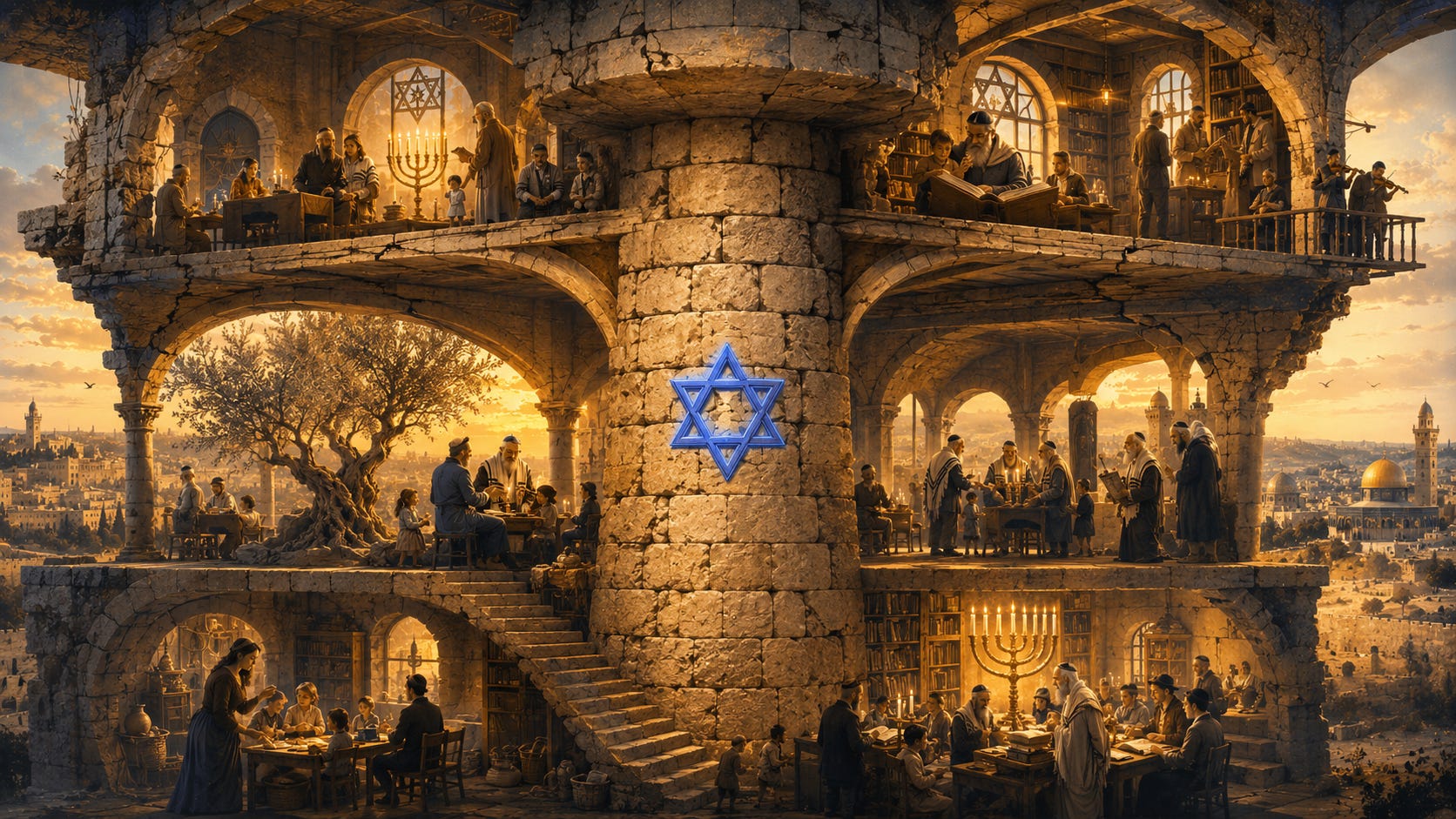
He’s right. I had folded community into the religious dimension in Part 1, listing the kehilla and the shul and the chevra kadisha alongside the text and the year cycle as if they all belonged to the same category. They don’t, quite. The practices are one thing. The people who are present for them are another. A Jew who doesn’t learn but who shows up every Shabbat at the kiddush is still inside the building. A Jew who learns alone is doing something different. So the house has more than two walls. It has at least three: Israel is one. The religion in all its older forms is another. And the community, the kehilla, the people we sit with at simchas and stand next to in shul and call when news breaks, is a third.
The Israel wall is bearing the heaviest weight right now, while the community wall and the religion wall are bearing, in some respects, less than they used to. Which means there’s even more rebuilding to do, on more sides, than I had said.
Covenants
I’ve been thinking about Rabbi Joseph Soloveitchik, who wrote in the decades after the Holocaust about two covenants of the Jewish people.
One was the covenant of fate. We are bound together by what’s done to us, by our shared history of being a people the world keeps deciding things about.
The other was the covenant of destiny. We are bound together by what we choose to build, what we choose to learn, what we choose to do as a people inside our own lives.
He thought both were necessary.
The covenant of fate, on its own, can only tell us who we are when others come for us.
The covenant of destiny is what tells us who we are the rest of the time.
What I notice is how loud our covenant of fate has become, and how quiet our covenant of destiny is in the same hour. We’re obviously a people attacked together. That’s not something for which we must apologize. But the covenant of destiny, which is the ongoing project of building a Jewish life on its own terms, has been running thin for a while now. Not because Israel is the cause. Because we’ve stopped feeding it. I think about Ahad Ha’am who wrote, “It’s not that the Jewish people have kept Shabbat, but Shabbat that has kept the Jewish people.” Meaning, our observance of Judaism has kept us who we are. But right now, my own Jewish life mostly answers to the louder covenant, that of fate. That’s fine for a year, or two, or three. It is not, I think, fine forever.
I am not saying Zionism is too much. God forbid. I am saying everything else has become too little, in the role it plays in our lives. Or in the role that we allow it to play in our lives. But I worry, in a small and private way that I am only beginning to admit in writing, that we have built a Jewish life in the Diaspora that runs almost entirely on a single voltage. I worry about what happens to people who get cut off from that voltage. I worry, more honestly, about what it is doing to me when it’s the main current in my own life. When my kids can name one bearded man in my life, Herzl, without being able to name the other, my Rabbi. Most importantly, I worry what happens to our people if, God forbid, Israel disappears. After all, it’s a tangible, physical place, under current and constant threat.
The Problem
I want to come back to Phoebe Maltz Bovy, briefly. I strongly disagreed with her framing of the Walk With Israel and what our community needs in Part 1. This week I’ll say it more directly: respectfully, I think she is, on the deeper question, wrong. Her wish was that the big Jewish gatherings be Jewish cultural events that include Israel rather than Israel events that double as Jewish gatherings. The implication of the wish is that Israel-centricity is the problem to be solved. It’s not. The Walk With Israel doesn’t need to be smaller, or quieter, or less itself. 60,000 Jews walking for Israel in the middle of the worst Jewish crisis of our lifetime is exactly what one would hope for from a community that knows what’s at stake. The only problem with that - in my view - is the number of people who turned out. Actually, it’s the number of people who didn’t turn out. Three-quarters of Toronto’s Jewish community sat out the Walk, even on a beautiful day.
As Seth Mandel wrote in Commentary magazine: “The reason Israel Day parades are so popular as the main Jewish self-celebration is because they are a celebration of Jewish autonomy, Jewish self-determination, Jewish history ancient and modern, and Jewish particularism. In a word, peoplehood. Such parades don’t need replacing, they need embracing.”
The problem is not that the Walk is too Israel. Maybe it’s that we have no equivalent gathering, no equivalent moment of mass communal Jewish life, in any of the other fifty-one Sundays of the year.
The answer is not to subtract from the Walk.
It is to add to the rest of the year. And yes, it may interfere with baseball tournaments and swimming lessons and pickleball classes and what not, but so be it.
This is the bind. The attack on Israel is real. The need to defend the wall is real. The rest of Judaism feeling quiet while we defend it is also real. The defending takes the time I would perhaps otherwise spend on the rest of Judaism, and so the rest of Judaism keeps thinning even as I work harder than I ever have at being Jewish. I don’t have a clean way out of this. But here is the commitment I want to make, in writing, where I can see it and be held to it. I will keep taking Israel as seriously as I have been. I will also give more of myself to the rest of Judaism, and our community, which is not a smaller part of what we are, and which has already carried our people through far worse than this. Both, from here on.
After the Walk
On June 7, I was one of 60,000 people walking through Toronto. I walked, sang the songs, and waved the flag. The walking was real. The flag was real. The country I love is real.
To write a piece like this, I had to talk about Israel and Judaism and even our community as if they were three different things. They aren’t, and they never have been. The Land, the people, the law, and the covenant are not four items on a list. They are one religion, and have been since Sinai. The Walk With Israel and the page of Talmud aren’t opposites, and are both ways of being inside the same religion. I think I have just not been paying both of them the attention they deserve.
So there should be more after the walk than the walk. Not because the walk is one thing and Judaism is another. Because the religion has more limbs than I have been using. I don’t yet know exactly what attending to all of them looks like, and my days are already full. I think the noticing might be where it begins. And the commitment, where it continues.
Maybe I’ll start with the fact that this week’s parsha is Shelach. Moses sends twelve spies into the Land. Ten of them look at it and lose their nerve, and a whole generation loses the Land for forty years. They lie, while only two tell the truth. It’s the Torah’s most devastating story about the Land of Israel. And then the parsha ends, strangely, with tzitzit. Fringes on the corner of a garment, given so that we would look at something small and daily and remember the covenant, to do the mitzvot. The same verb, even: the spies are sent latur, to scout the land, and the tzitzit come to teach v’lo taturu, do not scout after your own heart and eyes. The Torah put the Land and the fringes in the same parsha, and we have been reading them together ever since. One portion. One religion. I’d like to learn to read my week the same way.
Here’s the Catch
There are two worries to sit with here, not one. The first is the attack on the wall, and that is the worry that gets all the air in the room. The second is harder, and quieter, and mine. It is that I would not want the wall to do the whole job even if no one were attacking it. I want a Jewish life with more in it than a country I love. I do not yet know how to build that life inside a moment that keeps demanding I defend the country instead. But it gives us an opportunity to do so much more.
I found this to be a very thoughtful piece especially this (pun intended) framing:
“So the house has more than two walls. It has at least three: Israel is one. The religion in all its older forms is another. And the community, the kehilla, the people we sit with at simchas and stand next to in shul and call when news breaks, is a third.”
The one nuance missing, though, is a wall that is as much outward facing as it is inward facing. (Think, perhaps of one of those modern garage doors composed of steel and glass that allow for an extra room rather than just a parking spot. You neglected to mention how those of us who are educated (though certainly not to a rabbinic level), thoughtful about our Jewishness, zionist and also not particularly theistic (not that there’s anything wrong with that … well, most of the time) and who struggle with some of the liturgy and even Torah passages feel deeply protective of the who, what and why we are Jews and who have connected our ethical sense to being raised Jewish (and the inexplicable depth of that feeling that can only be assigned to millennia of DNA).
I also disagree with your reading of Phoebe’s article. What I read in her piece was that she was noting that Rabbi Jacobs was the one seeking to de-couple Israel from the breadth of its Jewishness. (So not Phoebe). A Rabbi is the one seeking to yank out one of the critical load-bearing walls that is being battered by wrecking balls from the outside. Phoebe was doing the most Jewish thing ever: She was reflecting on and weighing in on the angle proffered by a thoughtful and influential religious community leader and who was, I believe, speaking in good faith (literally in all the ways) - and with whom I expressed my strong disagreement in my comment to Phoebe’s article. Calling Phoebe out here comes across as … well, shaming. I hope that was not the way you intended. But, given that it came across that way, I invite you to be more clear and, perhaps, less judgemental in pronunciations and call outs of Jews who care deeply about our entire mishpacha and who are supportive of Israel’s right to exist (and free of constant genocidally-motivated attacks) as well as the complexity of who we are in both religious and secular environments.