
Complaint as Harassment
Part 3 of The Architecture of Exclusion

This is Part 3 of a five-part series on anti-Palestinian racism (APR) called The Architecture of Exclusion.
If you’d like to read the previous essays, they are here:
Part 1: The Training They Don’t Want You to See

There’s now a pattern in Canadian public education that goes something like this: An institution adopts a policy. Citizens object to the policy. The institution treats the objection as proof that the policy was needed. Rinse and repeat until everyone stops objecting or leaves.
If that sounds circular, it is! And if it sounds like something that should concern anyone who cares about democratic governance regardless of where they stand on the Israeli-Palestinian conflict, it should. Because what’s happening in Ontario school boards right now is not just a fight about anti-Palestinian racism (APR). It is a fight about whether public institutions in this country are still accountable to the public.
This piece is about process. Not about what was decided, but about how it was decided, who got to speak, and what happened to the people who said the wrong thing. The details matter because the details are where democracy lives or dies.
The TDSB Vote
On June 20, 2024, Toronto District School Board (TDSB) trustees voted 15 to 7 to add APR to its Combating Hate and Racism Student Learning Strategy. The vote came after a process that should make anyone who believes in institutional fairness deeply uncomfortable, regardless of which side they support.
Let’s start with some data. The TDSB’s own numbers showed that antisemitic incidents in its schools had tripled. 56% of reported hate crimes in Toronto in 2024 targeted Jewish people. At Faywood Arts-Based Curriculum School, nearly 200 adults escorted a Jewish child to class after he was physically intimidated and told classmates would “do to him what Hamas did to Israel.” Students at Earl Haig Secondary reported being told “Hitler was right” (this was a year or so before they played the Canadian anthem in Arabic on October 7, 2025). Swastikas were appearing in school bathrooms. There have been so many more incidents in the years since.
Into this environment, staff brought a report recommending the addition of APR to the board’s anti-hate strategy. The report didn’t define the term. It didn’t address the tripling of antisemitic incidents. It didn’t explain how APR would interact with existing protections or how competing claims would be adjudicated. The TDSB’s own Director of Education, Colleen Russell-Rawlins, expressed concerns that the report did not adequately address antisemitism and recommended it be sent back to staff. Board Chair Rachel Chernos Lin moved to do exactly that, noting that the absence of a definition “has caused a lot of fear, concern, questions“ among Jewish families.
That motion failed on a 4-4 committee vote. The report moved forward.
Now, who got to speak? At the June 5 committee meeting where delegates were heard, the voices urging adoption of APR included representatives from Independent Jewish Voices (IJV), the Jewish Faculty Network, and Toronto Jewish Families. These three are organizations that describe themselves as antizionist. They were presented, and received, as evidence that “the Jewish community” supported the initiative.
This is important: IJV represents a particularly small slice of Jewish opinion: explicitly antizionist, opposed to the IHRA definition of antisemitism, and aligned with the BDS movement that seeks to dismantle the Jewish State. Sure, that is their right. But about 91% of Canadian Jews believe Israel has the right to exist as a Jewish state, according to survey data. The delegates who spoke in favor of APR at the TDSB simply did not represent the mainstream Jewish community. They represented the fringe. And the board knew this, because the Centre for Israel and Jewish Affairs (CIJA), which represents the organized Jewish community, couldn’t address the committee.
CIJA submitted a written statement. They were not given the floor. When hundreds of Jewish parents rallied outside the TDSB headquarters on June 18, they were a backdrop to a process that had already been decided. A motion to include “anti-Israeli racism” alongside APR was defeated on an 11-11 tie. The final vote, 15 to 7, came after midnight.
Trustee Alexandra Lulka Rotman put it plainly. The APR framework “goes well beyond ensuring equity and protecting against discrimination and could be used to silence all voices of opposition to a particular narrative.” She pointed to the TDSB’s own data on antisemitism and asked the obvious question: staff looked at a 300 percent increase in antisemitic incidents and decided the priority was adding APR to the strategy? Why?
The answer, of course, is that the question wasn’t really being asked. The institutional machinery was already in motion. The report had been written. The delegates had been scheduled. The vote had the numbers. What looked like a deliberative process was a conveyor belt with a predetermined destination.
The Playbook
What happened at the TDSB isn’t an isolated incident. It’s a pattern, and the pattern has identifiable features.
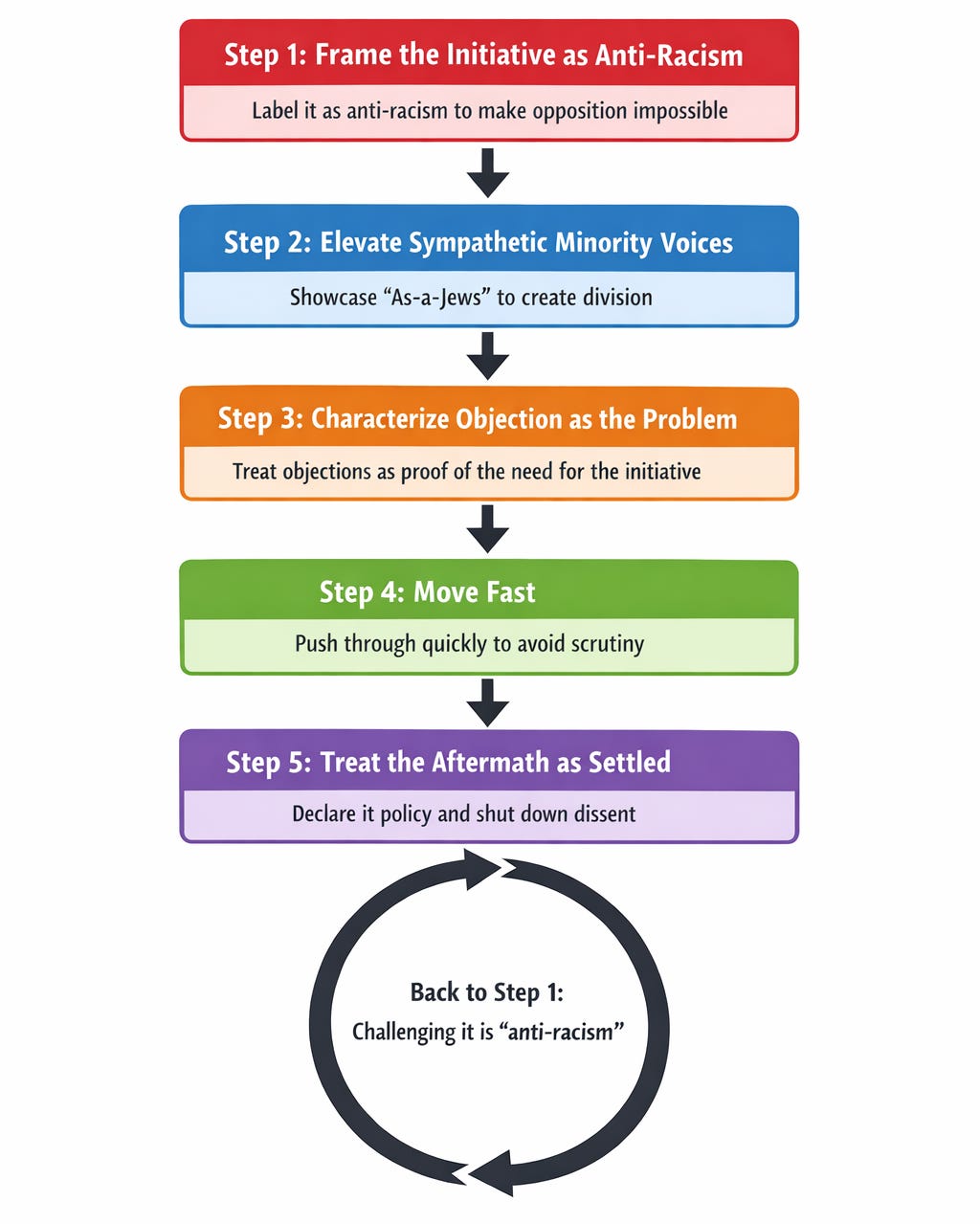
Step one: Frame the initiative as anti-racism. This is the critical move. Once a proposal is categorized as anti-racism, opposing it becomes functionally impossible within the institutional culture of Canadian public education. Nobody wants to be the person who voted against combating racism. The framing does all the heavy lifting before a single argument is made.
Step two: Elevate sympathetic minority voices. Find members of the potentially affected community who support the initiative and place them front and centre. In the TDSB’s case, this meant platforming antizionist Jewish organizations. As I like to call them, the “As-a-Jews”, or “Un-Jews.” The message to trustees is: even the Jews support this! The message to the public is: the Jewish community is divided, so mainstream objections can be treated as just one perspective among many rather than as a serious institutional concern. (We are now dealing with a similarly Kafkaesque situation, in which IJV has been hired to do antisemitism training for the Elementary Teachers’ Federation of Ontario. For more, read here).
Step three: Characterize objection as the problem the initiative addresses. This is where the circularity kicks in. When Jewish parents express fear that APR will be used to suppress Jewish identity in schools, that fear is treated not as a legitimate concern to be addressed but as further evidence of the need for APR. The objection proves the thesis. CIJA’s written statement, in which they argued that APR endeavours to redefine what does and does not constitute antisemitism and “is inherently oppressive,” was treated as an obstacle to be overcome, not a warning to be heeded.
Step four: Move fast. The ACLA definition was published in April 2022. The TDSB vote happened in June 2024. In institutional time, that is lightning speed for a concept that had never existed before, had no legal foundation, and had not been tested against established human rights frameworks. Speed serves a purpose: it minimizes the window for scrutiny.
Step five: Treat the aftermath as settled. Once the vote passes, it becomes policy. Once it is policy, challenging it becomes challenging anti-racism, which brings us back to step one.
It’s the ciiiiiircle of lies.
The Silencing Machine
The TDSB isn’t alone. The pattern repeats across Ontario school boards with variations in detail but remarkable consistency in structure.
At the Hamilton-Wentworth District School Board (HWDSB), as we saw in Part 1, the board delivered mandatory APR training to 8,613 teachers and then invoked a safety exemption to prevent the public from seeing the content. We now know from teacher testimony what that content included: a map of Israel covered in the Palestinian flag, a description of Jews as “colonizers,” a definition of Jihad as “peaceful struggle,” and a framework that linked APR to “anti-colonialism.” When teachers raised concerns, their complaints were routed to the board’s equity officer, who responded with boilerplate language that “interpretation of materials can vary.” That same officer was later found to have shared arguably antisemitic content on her own social media. The board’s response to the complaints was not to review the training but to train principals on “how to field questions.” When citizens filed freedom of information requests, the board characterized the resulting public interest as “harassment” and “unmanageable.”
At the Waterloo Region District School Board, trustee Mike Ramsay, a Black immigrant and former RCMP officer who had served on the board since 1989, was censured and banned from attending meetings after he criticized the board chair’s decision to cut off a teacher’s presentation about age-appropriate library materials. The complaint process was conducted in secret. The deliberations were in camera. When Ramsay asked for the complaint and report to be released publicly, the board refused, claiming it was “for his protection.” Ramsay, who was re-elected by his constituents, called it a “political vendetta.” His all-white board colleagues voted to silence the board’s only Black member for holding views they found inconvenient.
The common thread is not the specific issue. It is the institutional response to dissent. In each case, a Canadian school board treated democratic engagement, whether it took the form of delegate presentations, freedom of information requests, trustee speech, or parent complaints, as something to be managed, contained, or punished rather than as the normal functioning of public accountability.
The word “harassment” keeps coming up. The HWDSB used it to describe FOI-generated complaints. School boards across Ontario have used code of conduct processes to discipline trustees who dissent publicly. The message is always: if you object to what we are doing, it’s you, hi, you’re the problem it’s you.
The Democratic Deficit
Here is what makes this different from ordinary political disagreement:
When a government passes a law you disagree with, you can organize, campaign, vote, and try to change it. The process is transparent and the debates are public. The arguments are recorded. You may lose, but you lose in a system that at least acknowledges your right to participate.
School boards in Ontario are not operating quite that way. They’re adopting policies of enormous consequence, policies that define what teachers can say and think about one of the world’s most contested conflicts, that they then teach to our children, through processes that minimize public input, exclude inconvenient voices, and treat scrutiny as a threat. When the policies are adopted, they’re implemented through mandatory training that the public isn’t allowed to see. When citizens exercise their legal rights to request disclosure, the institutions invoke safety exemptions designed for circumstances that bear no resemblance to an argument about curriculum.
This just isn’t governance. It’s administration by fiat dressed in the language of equity.
And it’s happening in institutions responsible for other people’s children. That’s the part that should keep parents up at night. Not just Jewish parents. Not just parents who care about Israel. Any parent who believes that the people entrusted with educating their child should be accountable for what they teach.
The equity framework in Canadian public education has become a closed system. It generates its own mandates, selects its own validators, defines its own opposition as evidence of its own necessity, and treats transparency as a threat. It is accountable to no one except the internal logic of its own premises. And when you point this out, you are told that pointing it out is itself a form of the problem being addressed.
If there is a more elegant trap, I haven’t seen it.
Here’s the Catch
The TDSB adopted APR into its anti-hate strategy through a process that excluded mainstream Jewish community voices, elevated antizionist Jewish organizations as representative, ignored its own data showing a tripling of antisemitic incidents, overrode its own Director of Education’s recommendation, and passed the measure after midnight on a 15-7 vote. This isn’t an isolated failure. Across Ontario school boards, a pattern has emerged in which dissent is recharacterized as harassment, transparency requests are treated as threats, and the equity framework functions as a closed system that generates its own mandates and defines its own opposition as proof of its necessity. The question is no longer whether Canadian public institutions are accountable. It is whether they believe they need to be.
Part 4, “The Machine We Built,” will examine the Jewish community’s own role in building the institutional infrastructure that is now being used against it.
This needs to be seen as a front of the war Islamists have declared against the west . Thank you for your clarity and amplification of the fallacy of APR .
Holy cow, Adam.
Firstly, thank you for your meticulous research and reporting.
And for informing us of the (stinking) details.
I’m reading accounts of similar nature in many professions.
It’s such a bleeding outrage.
כל הכבוד for your outstanding work.