
The Eviction Notice
Part 5 of the Architecture of Exclusion

This is Part 5 of a 5-part series on anti-Palestinian racism (APR) called The Architecture of Exclusion.
If you’d like to read the previous essays, they are here:
Part 1: The Training They Don’t Want You to See
Part 3: Complaint as Harassment
You can download a booklet that includes all five here
I want to tell you about a moment that won’t make the news.
Somewhere in Hamilton or Toronto or Waterloo, a Jewish teacher is standing in a staff room after completing mandatory anti-Palestinian racism (APR) training. She has just spent an hour watching a video that describes her connection to Israel as a colonial project. She has just been told that the narrative she grew up with, that her grandparents built their lives around, that she teaches her children on Friday nights, is a form of racism against someone else. She’s been told this not by a stranger on social media but by her employer. In a training session she was required to attend. With professional consequences implied for noncompliance.
She says nothing. She signs the attendance sheet. She goes back to her classroom. With her head held a little lower than before.
That silence is the sound of an eviction in progress.
What Eviction Looks Like
When I say eviction, I don’t mean that Jews are being physically removed from Canada. Nobody is being forced to pack suitcases (though more are doing so voluntarily). The eviction I’m describing is subtler and, in some ways, more complete than that. It’s the systematic removal of Jewish identity from the category of things that Canadian public institutions are willing to protect.
Consider what’s happened across this series. A school board spent $70,000 on training that its own trustee described as an effort to “resist Zionism.” When the public asked to see the training, the board said disclosure would be dangerous. An advocacy group published a definition of racism that classifies mainstream Jewish beliefs as bigotry. The largest school board in Canada adopted that framework over the objections of its own Director of Education, its own Chair, and the overwhelming majority of the Jewish community it serves. Across Ontario, the institutional infrastructure that Jews helped build is being repurposed to encode their delegitimization into professional development, policy documents, and complaint mechanisms.
None of this required a single act of violence. It did not require anyone to shout a slur or break a window or paint a swastika. It required only that the right concepts be fed into the right institutional systems by the right people at the right time. The violence, such as it is, is administrative. It lives in slide decks and policy manuals and equity frameworks. It’s clean and procedural and difficult to fight, because fighting it means fighting the institution itself, and the institution has already classified your fight as evidence of the problem it is solving.
This is what institutional eviction looks like. Not a door slammed in your face, but a form you’re required to sign.
The Diaspora Question
I have spent some time recently writing about what I call the death and rebirth of the Diaspora. Not the physical Diaspora, which continues to exist, but the idea of the Diaspora: the comfortable assumption, held by most Western Jews for the past 80 years, that you could be fully Jewish and fully a citizen of your country without those two identities ever coming into serious conflict.
That assumption rested on a deal, mostly unspoken, between Jews and the liberal democracies they lived in. The deal went something like this: We will integrate. We will contribute. We’ll be loyal citizens. We’ll support the institutions of this country. And in return, those institutions will protect our right to be who we are, including our connection to Israel, which is not a foreign policy preference but a core element of Jewish identity for the vast majority of Jews alive today.
For 80 years, give or take, the deal held. It held through wars and intifadas and UN resolutions and BDS campaigns. It held because the institutional infrastructure of Western liberal democracies, the human rights commissions, the anti-discrimination laws, the equity frameworks, operated on principles that included Jews in the circle of the protected.
The deal is now breaking. Not everywhere and not all at once. But in Canadian public education, it’s breaking fast and visibly. When a school board adopts a framework that defines Zionism as racism, it is not just making a policy choice. It’s telling every Jewish family in its jurisdiction that a core element of their identity is now officially classified as a form of oppression. It’s telling Jewish teachers that their private beliefs about Israel are a professional liability. It’s telling Jewish students that their connection to their people’s homeland is something to be trained out of the adults responsible for their care.
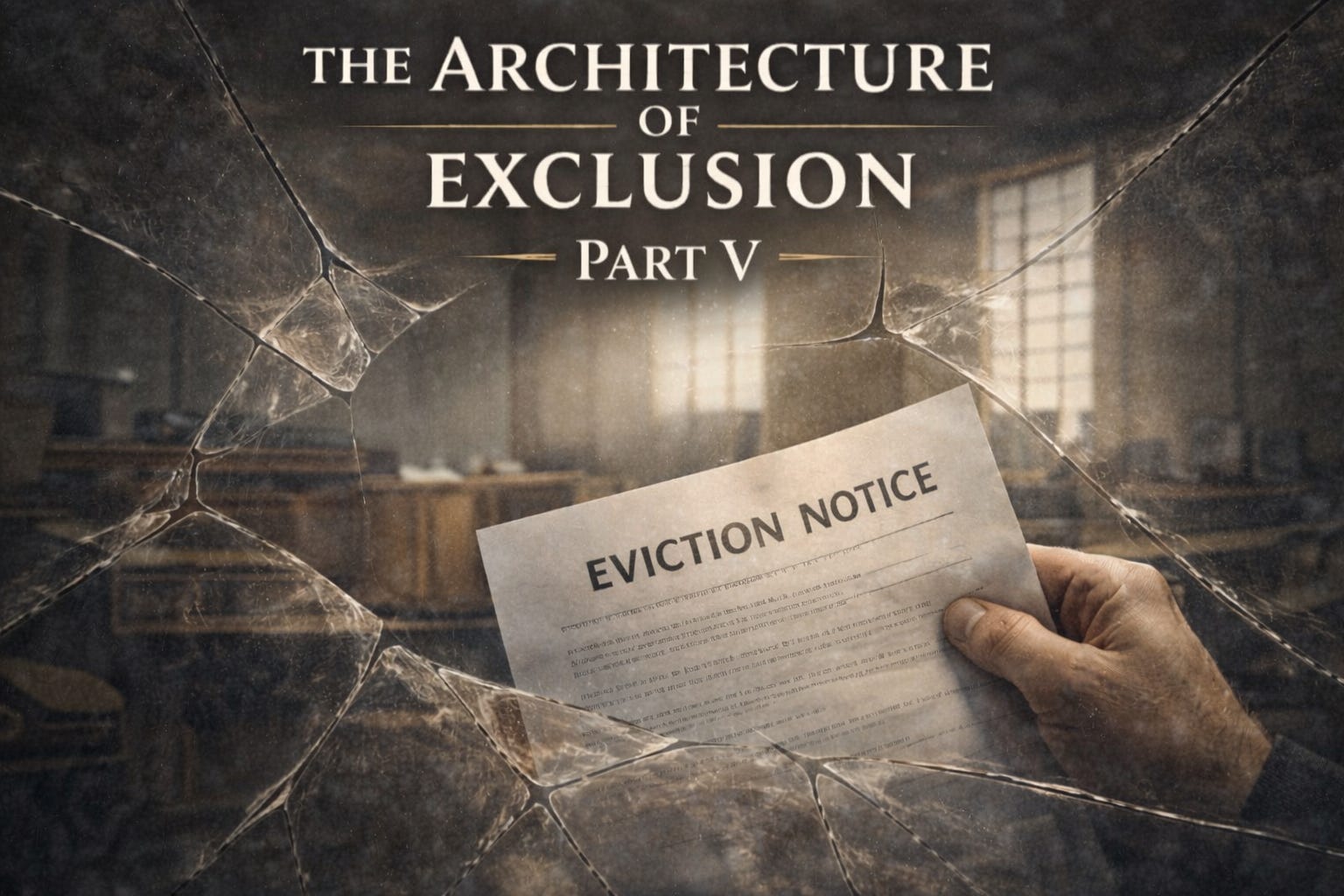
That just isn’t inclusion. That’s an eviction notice dressed in equity language.
The Three Responses
Jewish communities facing this kind of institutional pressure tend to respond in one of three ways.
The first response is to fight within the system. File complaints. Organize delegations. Lobby trustees. Demand balanced representation. Rally outside board meetings. This is what most of the organized Jewish community is currently doing, and it is producing limited results. Not because the community lacks resources or commitment, but because the system is not designed to produce the outcome our community is seeking. You can’t win a fair hearing from an institution that has already decided what fairness means.
The second response is to exit. Pull your children from public schools. Send them to Jewish day schools. Build parallel institutions. Withdraw from the public systems that no longer serve you. This is what a growing number of Jewish families are doing, and it is a rational response to an irrational situation. But it comes with costs. Public schools running rampant with no Jews, without Jews holding them in check for their anti-Jewish behaviour, is problematic because what will the children left in the system learn about us when we are all gone? Withdrawal from public institutions means withdrawal from public life. And there is something deeply troubling about a community that helped build the public education system being forced to abandon it.
The third response is to challenge the premises. Not just the content of APR but the entire institutional architecture that allows a concept like APR to become mandatory training in two and a half years. Not just the specific vote at the TDSB but the system that makes such votes possible and their outcomes unchallengeable. Not just the equity framework’s treatment of Jews but the equity framework’s claim to adjudicate political conflicts through the language of racism.
This third response is the hardest. It requires the community to move beyond defensive advocacy and into structural critique. It means saying, publicly and clearly, that the problem is not that the machine is being operated unfairly but that the machine should not have this kind of power in the first place. It means building coalitions with people who share that structural concern even if they don’t share the community’s specific interests. It means thinking in decades, not news cycles.
And it means accepting something difficult: that the version of Diaspora life the community has known, the comfortable integration, the institutional trust, the unspoken deal, is over. Not because the community failed, but because the terms changed. The institutions changed. The categories changed. And no amount of advocacy within the old framework will restore what the old framework no longer offers.
What Remains
I want to end this series not with despair but with clarity, because clarity is what the moment requires.
The APR framework isn’t going away. It will continue to be adopted by school boards, embedded in training, and operationalized through complaint mechanisms. The institutional infrastructure that supports it is too well established and too deeply aligned with the prevailing culture of Canadian public education to be dislodged by letters and rallies alone.
But the framework’s greatest vulnerability is also its most obvious feature: it can’t survive scrutiny. That is why the HWDSB is fighting to keep its training video hidden. That is why the TDSB adopted APR without defining it. That is why the entire architecture depends on speed, on framing, and on the suppression of democratic accountability. The framework works in the dark. It falters in the light.
The Jewish community’s most powerful tool right now is not advocacy but transparency. Every FOI request filed. Every training document leaked. Every policy manual obtained and published. Every board meeting recorded and shared. The community does not need to convince the institutions. It needs to show the public what the institutions are doing. Because the public, when it sees clearly, tends to be more sensible than the bureaucracies that claim to act on its behalf.
The HWDSB IPC appeal is, in this sense, the most important fight happening in Canadian Jewish life right now. Not because of what the training video contains, though that matters. But because the principle at stake, whether public institutions can hide publicly funded ideological training from the public, will determine whether this kind of institutional capture can continue to operate in darkness or whether it will be forced into the open.
If the video is disclosed, people will see it. They will form their own judgments. And whatever those judgments are, they will be the product of democratic engagement rather than bureaucratic fiat. That is all anyone should be asking for.
I started this series with a school board that did not want you to see what it taught its teachers. I am ending it with an argument that seeing is the whole point. Not just for Jews. For anyone who believes that public institutions in a democracy belong to the public.
The Diaspora is not dead. But the terms of its existence have changed. The old deal is off the table. The institutions we trusted have been captured. The frameworks we helped build have been turned against us. The comfortable middle ground between Jewish identity and Canadian public life is narrowing.
What comes next depends on whether the community is willing to see that clearly, to say it honestly, and to act accordingly. Not with panic. Not with despair. But with the discipline that this moment demands.
The eviction notice has been served. The question is what we do now that we have read it.
Here’s the Catch
The APR framework represents the bureaucratic formalization of Jewish exclusion from Canadian public life. Not through violence or overt discrimination, but through the quiet, procedural reclassification of Jewish identity as a form of oppression. The old deal between Diaspora Jews and liberal institutions, full citizenship in exchange for full integration, is breaking. The community now faces three options: fight within a system designed to produce its marginalization, exit into parallel institutions, or challenge the premises of the system itself. The last option is the hardest and the only one that leads somewhere. The framework’s greatest vulnerability is that it cannot survive public scrutiny. Transparency, not advocacy, is the community’s most powerful tool. The Diaspora is not dead. But the terms have changed, and seeing that clearly is the first step toward deciding what comes next.
Thanks to those who have followed along with this five-part series. If you’d like to download a collection of all five essays, you can do so here.
Thank you. What's next?