
Threat or Challenge
Why an op-ed in Toronto can hurt more than a siren in Ashkelon

I returned from Israel this month with a puzzle.
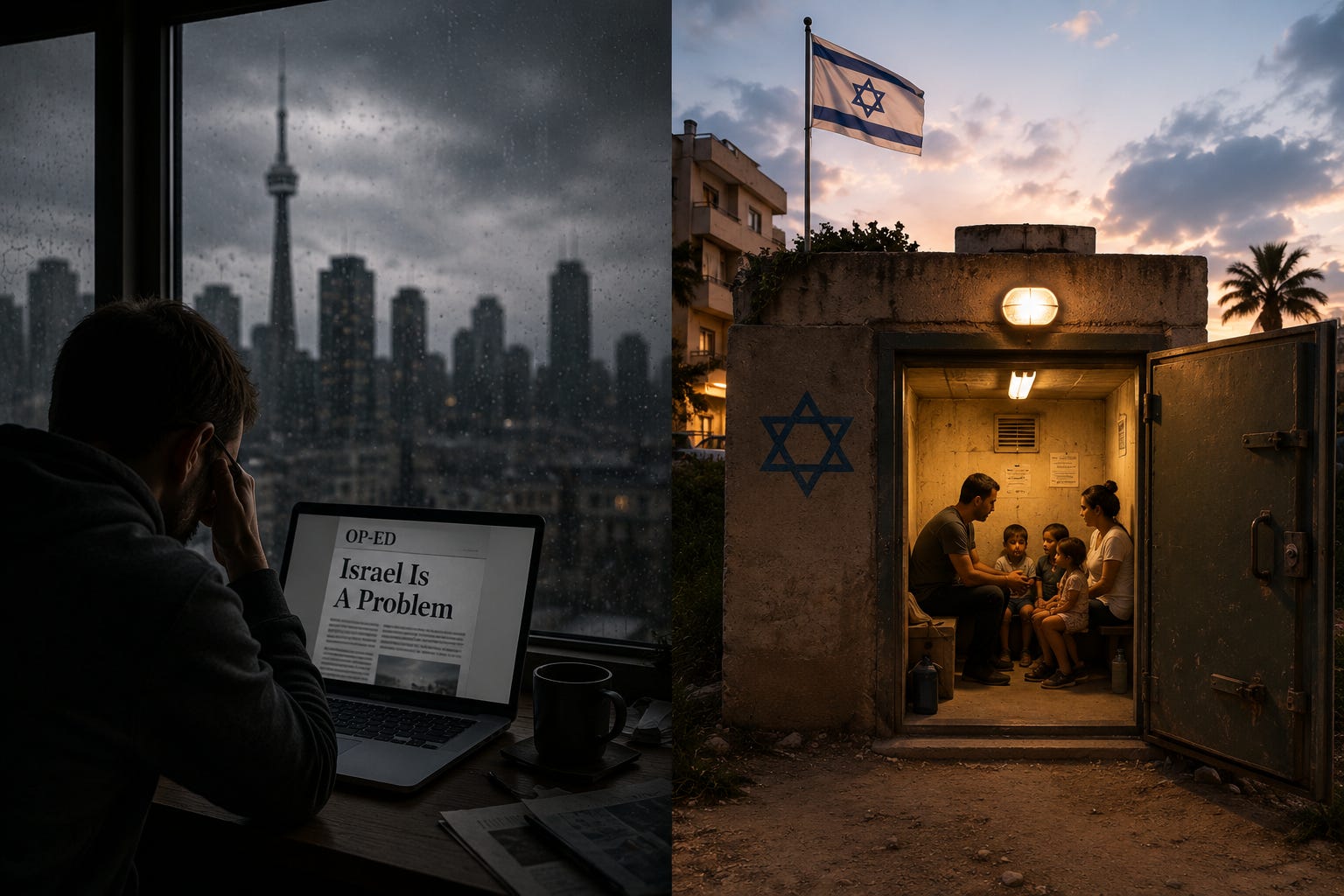
I had spent a week with educators, travelling through a country that has recently been at war, that has more reason than almost anywhere on earth to feel under siege. And what I kept noticing was how little the people I met seemed to be bracing. They were tired, and of course many were grieving. Many seemed to have family in active service, in Lebanon, Gaza, or elsewhere. Nobody was pretending things were fine. But there was a steadiness to them, a kind of forward lean, that I don’t always feel at home.
Then I landed back in Toronto, opened my phone, read a single op-ed in a single newspaper, and felt my stomach drop.
That gap has been bothering me. An Israeli in Ashkelon hears a siren and goes to the stairwell. A Jew in Toronto reads a column and starts thinking about renewing her passport. By any honest measure the person in the stairwell is in more danger. So why does the column land harder?
I think I found part of the answer in the work of a running coach.
Steve Magness
Steve Magness is an American coach and writer, the author of Do Hard Things and Win the Inside Game. He spends most of his time on athletes and performance, but the idea at the centre of his work isn’t really about sports at all.

It comes out of a body of research in psychology going back to the 1990s, associated with a researcher named Jim Blascovich, sometimes called the biopsychosocial model of stress. Let’s see if I can explain this clearly:
When you encounter something difficult, your brain runs a quick calculation, mostly below the level of conscious thought. It asks two questions: How hard is this? And what do I have to meet it with?
If the answers come back that your resources are roughly equal to the demand, your body enters what researchers call a challenge state. If the answer comes back that the demand is bigger than anything you have, you enter a threat state.
Both states feel like stress. In both, your heart rate climbs, your palms go damp, your attention sharpens. You can’t tell them apart from the inside just by how activated you feel. The difference is in what your body then does with that activation.
In a challenge state, your blood vessels open, your heart pumps more blood with each beat, and you get more fuel delivered to the places that need it. Your attention stays wide, you notice things, you keep thinking flexibly, and you move toward the problem.
In a threat state, your blood vessels constrict. Stress hormones like cortisol take over. Your attention narrows and turns inward, toward yourself and how badly this is going. You stop taking in new information, and you protect rather than engage.
Same stress. Opposite response. The difference? A quick calculation about available resources.
Magness is clear about what he thinks does not work here: You can’t usually talk yourself across the line. Standing in front of a mirror telling yourself that fear is really just excitement might get you through a mildly awkward meeting. It falls apart under real pressure, because the calculation your brain is running isn’t fooled by shouting slogans at yourself in the mirror. It wants to know what you actually have available to use.
So the way to move the ratio is to change one of the two numbers. Lower the demand, or raise the resources. Magness identifies a handful of things that genuinely count as resources: preparation/practice, previous experience with hard things, social support, and above all a sense of agency, the belief that what you do affects how this turns out.
And in Win the Inside Game he adds one more, which is what led me to want to write this essay: when your identity narrows down to one thing, everything becomes a threat. If you are only a runner, then every race is a referendum on whether you deserve to exist. Losing the race means losing yourself, and the calculation can never come out any other way. The athletes who hold up best are the ones who are also something else. Not because they care less but because they have more to stand on.

What this explains about us
Now, let’s apply that framework to the puzzle I came home from Israel with.
Israel
The obvious explanation for the gap between Israel and here is that Israelis are simply braver, or tougher, or more used to it. They live in a rough neighbourhood, geopolitically, after all. But I don’t believe that, and I don’t think it’s a useful thing to tell anyone.
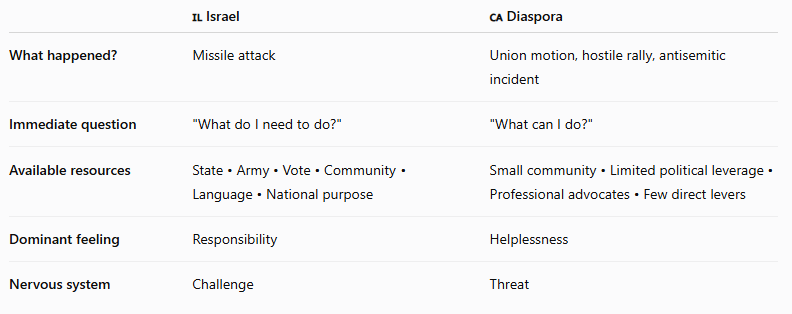
The Magness framework offers a better answer. It’s not that Israelis face a smaller demand. Their demand is enormous and it’s physical and real. However, it’s that they have an overwhelming pile of resources on the other side of the ledger.
Think about what an Israeli has when something happens. A country. An army. A vote in a system that governs the outcome. A language. A flag that belongs to them and not to a debate. A job to do, whether that is reserve duty or driving supplies south or hosting an evacuated family. When the news breaks, there is something to do and someone to do it, and that someone is you.
That is a challenge state. Not because the threat is small, but because the resources are large.
Canada
Now think about what a Jew in Canada has when something happens. A motion passes at a union local. A professor assigns a reading. A city councillor says something at a rally. A swastika spraypainted on one’s business. The demand is, in physical terms, much lower. But ask the second question: what do I have to meet this with?
We are 1% of the population. Most of us can’t name the process by which that motion passed, let alone reverse it. Our institutions frequently ask us to stay calm and let the professionals handle it, which is sometimes wise and always, at the level of the nervous system, a message that says you have nothing to contribute here. Agency, the single biggest lever in the entire model, is the resource we’re shortest on.
So the calculation comes back the way it comes back. Demand exceeds resources. Threat. Vessels constrict, attention narrows, we turn inward, we scan for exits. We start checking whether our grandmother’s birth certificate is enough for an EU passport.
Let me be clear: I’m not saying the threat here is imaginary. Some of it is entirely real, and people have been hurt, and some institutions have failed us, and a person who tells you it’s all in your head isn’t being helpful or honest. The claim isn’t that the demand is small. The claim is that maybe we’ve been trying to solve this problem entirely on the demand side, by cataloguing how bad it is, when the side that actually moves is the other one.
The identity trap
There is a second thing going on too.
Since October 7, a great deal of Diaspora Jewish identity has narrowed to a single strand: defending Israel and tracking antisemitism. For many people that is now what being Jewish primarily consists of, in terms of hours spent and emotional weight carried. Is there anything else you discuss at your shabbat dinners with such frequency?
Go back to Magness on the runner who is only a runner. When identity collapses to one thing, every event involving that thing becomes existential, because there’s nothing else holding you up. I think that’s unfortunately, exactly where we are. Every news cycle becomes a referendum on whether we get to keep existing here. Not because any single news cycle is that important, but because we’ve arranged our inner lives so that it has to be.
This is why a bad column can wreck a week. It’s not the column. It’s that the column is landing on the only strand we feel we have left.
The way out, then, is not to care less, but to be more. Text, practice, community, food, argument, music, obligation, joy. Not as a distraction from the fight, and not as a nicer alternative to it. As the thing that makes the fight survivable, and that turns it from a threat you can only endure into a challenge you can truly meet.
A Jew who has a Shabbat table, a chevruta (study collective), a choir, a reason to be Jewish that exists whether or not anyone is attacking, walks into the fight with resources. A Jew whose entire Jewish life is the fight walks in with nothing but the fight.
And ya there’s an obvious irony to this: the narrowing happened because we were under attack, and it felt like the responsible thing to do. Drop everything else, all hands on deck! But the narrowing is what turned an attack we could have met into a threat that unmoors us. We defended ourselves into a weaker position.
Why this matters most for young people
Here’s where I think the stakes are highest.
Threat framing has one useful property: It mobilizes people who are already committed, quickly. That’s why we reach for it. Tell someone who already cares that the house is on fire and they will run.
But threat framing doesn’t offer a role, it only offers an alarm. And when you give a 19 year old alarm with no role, you get one of two responses, and we have all seen both in the last few years. Some of them freeze and disengage, because a demand with no available action is unbearable and the only escape is to stop caring. The others roll their eyes, because they have heard the house is on fire every. year. of. their. conscious. life. and the house is still standing, and after a while the alarm just sounds like background noise.
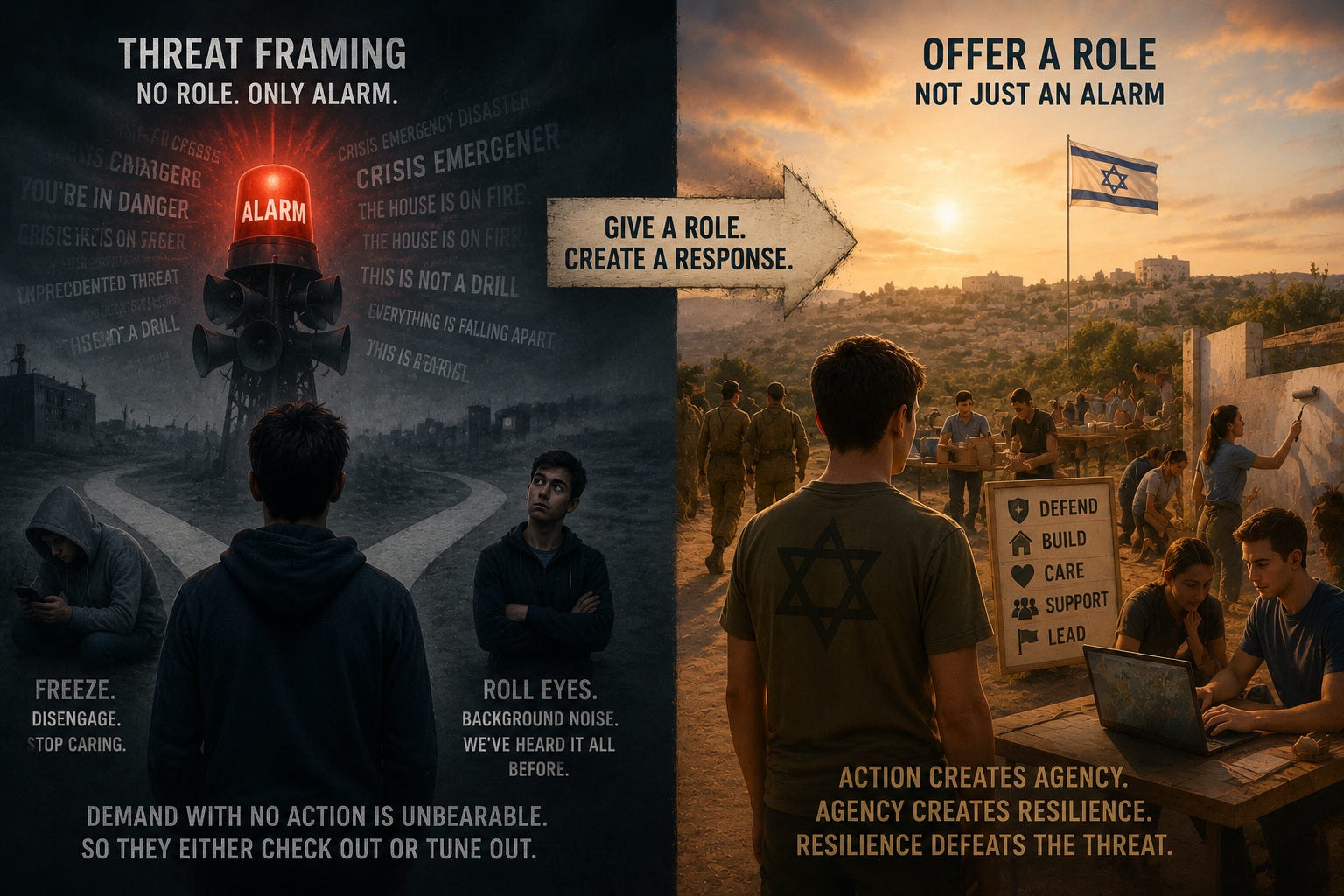
Challenge framing offers something else. It offers a task. Here is a hard thing, here is what you would need to meet it, here is how you get that, here is your part. And kids love rising to a challenge.
Magness makes a related argument about how we train toughness, and I think it lands squarely on our communal messaging. The old model of toughness manufactured threat on purpose. Fear, humiliation, unpredictability, the belief that if you scared people enough they would come out harder. What it actually produces is compliance in the room and collapse under real pressure, because nobody built any resources, they just learned to perform.
I unfortunately think that we’ve done a version of this. We’ve built a great deal of communal communication on fear and catastrophe, and suddenly wonder why young people either burn out or drift off. They can smell it. They can tell when they’re being handled rather than equipped.
What to actually do
The obvious prescription falls out of the model. Four resources, four moves.
Build agency. This is the big one and it’s also the most concrete. Find the level where a person can actually affect something and put them there. School boards. Riding associations. Union locals. Student government. Campus paper. Not because any one of these is decisive, but because the difference between a person who has changed one outcome and a person who has never changed anything is the difference between a challenge state and a threat state. Agency isn’t a feeling but a track record.
Build competence. Nobody feels resourced arguing a case they can’t make. A lot of what reads as fear in young Jews is simply not knowing the history well enough to speak without dread. Teach the material. Teach the hard parts, including the parts where our side has something to answer for, because a person who has only heard the polished version knows deep down they’re carrying something brittle and it makes them scared to be tested. Preparation is a resource in the literal, measurable sense.
Build the social layer. Magness lists social support as a resource because it is one. Nobody should be doing this alone in a seminar room. The person who knows that eleven other people have their back after the meeting is running a completely different calculation than the person who doesn’t.
Widen the identity. Give young Jews a Jewish life that’s bigger than the conflict, and teach them that Israel isn’t just an argument to be won. This is the most important one, and it’s also the vaguest sounding, so let me be concrete about what it means in practice.
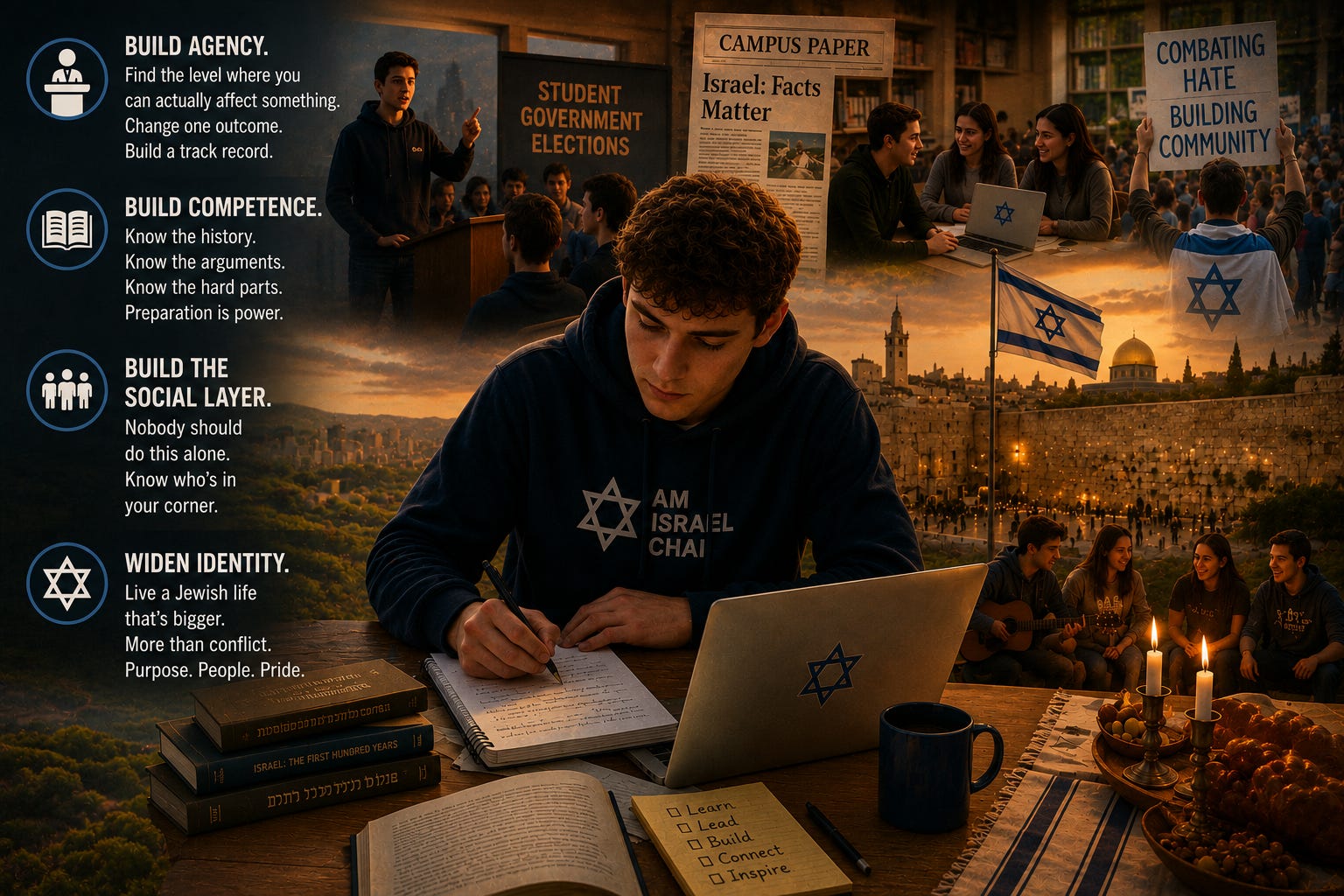
It means a kid who can lead something. Not attend something, lead it. Kiddush, a chunk of the seder, a shiur for younger kids. It means one text they have gone deep enough into that they own it and could teach it. It means a table they are expected at every week, which is a different thing from an event they are invited to. It means a Jewish skill that has nothing to do with the argument, whether that is cooking, singing, reading, or building. It means a relationship with Israel that includes food and music and cousins and landscape and not only headlines and history and grievance.
Every one of those is a leg. A person standing on six legs responds differently to a bad week than a person standing on one. Not because they care less about the one. Because the one is no longer carrying the whole weight of who they are. I wrote about this several weeks ago here.
Our current urgency makes this the hardest sell, because everything on that list feels like a luxury when the alarm is going. It isn’t a luxury though, as its a load bearing.
None of this makes the demand smaller. It just changes what we bring to it.
The Israelis I met recently aren’t calm because nothing is happening to them. They’re calm because they have somewhere to put their hands.
We can build that here. It’s slower, and it looks less like a rally and more like a decade of hard work at the level of the school board and the Shabbat table. But it’s eminently buildable, and it is the only thing I can think of now that turns dread into something a person can actually carry.
Thank you for anther fabulous column.
It’s so helpful to identify the feeling and state we are in and give us strategies to live by.
https://substack.com/@robertmoisescu/note/p-208513621?r=7a02yu